
1981, Donnally Street: Jesse Jackson and the West Virginia He Never Forgot
By Crystal Good
A reflection on Rev. Jesse Jackson’s deep ties to West Virginia, and the working-class vision that brought him here
The image is grainy, the way truth often is when it survives long enough to matter.
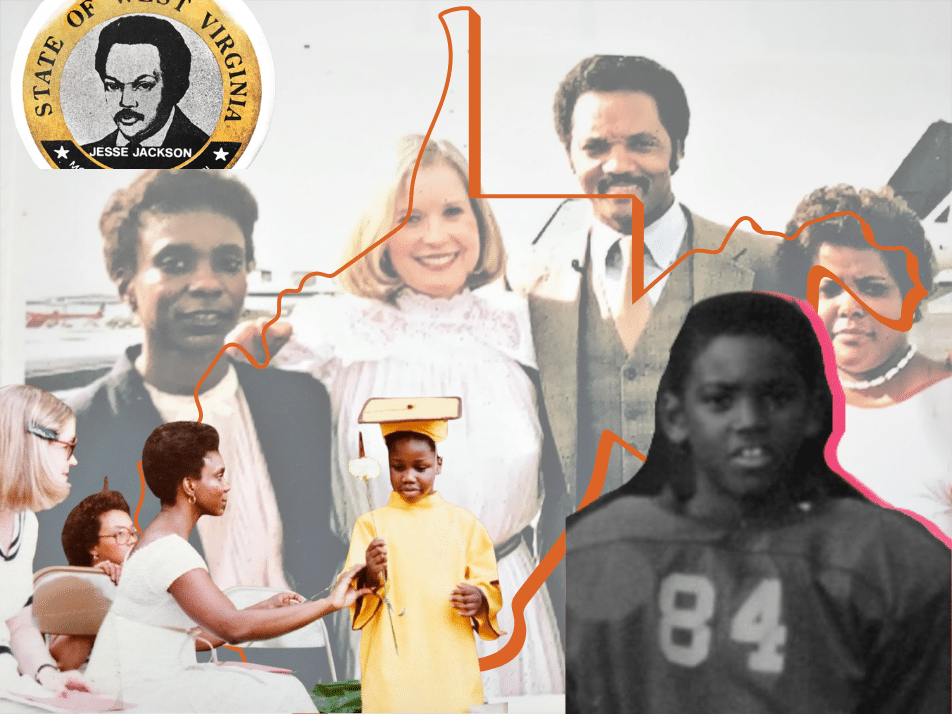
It is 1981, Charleston, West Virginia. Rev. Jesse Jackson stands at the dedication of the Kanawha County Family and Children’s Center on Donnally Street — then the only Black-owned child care facility in the state. Beside him are Sharon Rockefeller (wife of then-Governor Jay Rockefeller), Myrtolyn English (the Center’s founder), and Charlene Harris. Around them, the quiet evidence of what Black women organizers had built from almost nothing. (Photo and story nod courtesy of Reverend Ronald English.)
Among the preschoolers who would pass through those doors in the years that followed was a boy named Randy Moss, whose mother, Maxine, would become a beloved cook at the center for many years. He would grow up to be a Pro Football Hall of Famer. But that day, he was just a child in a community that someone had decided was worth building something for.
That is where this story begins — not in 1988, not on a campaign trail, but in a moment of institution-building that Jackson understood as inseparable from the movement.
In 2022, a young man named Aiden Satterfield picked up his phone, hit record for BBG, and reminded the internet of something too many people had forgotten. Before Barack Obama, there was Shirley Chisholm — and there was Jesse Jackson. His TikTok named a truth that reshaped the national imagination: Black presidential campaigns did not begin in 2008. They were built decades earlier through courage, coalition, and visits to places like West Virginia.
This article honors Rev. Jesse Jackson’s deep ties to the Mountain State. With his passing on February 17, 2026, at age 84, it also reflects on a lifetime of activism, inspiration, and public witness that continues to echo across West Virginia and beyond.
Jesse Louis Jackson was born on October 8, 1941, in Greenville, South Carolina. He graduated from North Carolina A&T State University, where he joined the Omega Psi Phi fraternity and was a standout quarterback, leading the Aggies to the 1964 CIAA championship. It was there that Rev. Dr. Martin Luther King Jr. recognized him as a rising leader. He went on to earn a master’s of Divinity from Chicago Theological Seminary. A Baptist minister, civil rights strategist, and political force, he would ultimately run for the Democratic presidential nomination in 1984 and 1988, negotiate the release of hostages abroad, found Operation PUSH, and stand on picket lines for six decades.
In 1996, Operation PUSH merged with the National Rainbow Coalition to form the Rainbow PUSH Coalition — People United to Serve Humanity. At the center of both of Jackson’s presidential campaigns was this intentional alliance of Black Americans, Hispanics, Native Americans, Asian Americans, family farmers, organized labor, the poor, women, peace activists, gay and lesbian Americans, and progressive whites. Jackson argued that these communities — often divided by race, geography, or culture — were bound together by shared struggles: unemployment, low wages, lack of healthcare, underfunded schools, housing insecurity, and political exclusion. The “rainbow” was not just symbolic of diversity; it represented the belief that political power could be built by uniting those pushed to the margins into a single, multiracial, working-class coalition.
In West Virginia, that argument found soil.
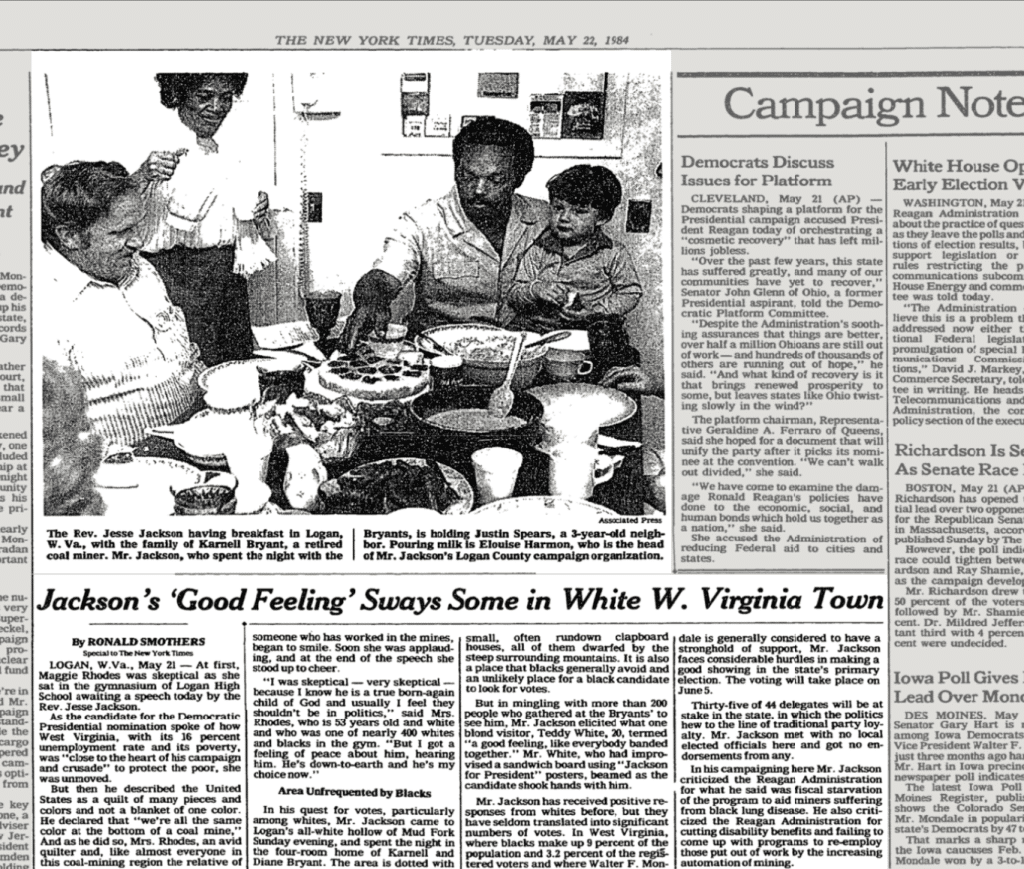
During his presidential campaigns, Jackson did something that still feels almost unimaginable in modern politics. He spent the night at the home of an unemployed white coal miner while campaigning in southern West Virginia. The next day, he traveled to Arnett, a small, nearly all-white coal town of about 300 residents. More than 500 people showed up to hear him speak.
What he said that day has never stopped being true: “They have their race, but they don’t have jobs. They have their race, but they don’t have health insurance. They have their race, but they don’t have hot and cold running water. Their race does not address those needs.”
He did not pretend race didn’t exist in Appalachia. He named it — and then named what race alone could not fix. It was a message that recognized the specific conditions of coalfield poverty without erasing its racial dimensions, and it landed in a room full of white miners who had been told, implicitly and explicitly, that their struggles and Black struggles were opposites.They were not. In both the 1984 and 1988 Democratic primaries, Jackson performed unexpectedly well in West Virginia, outpacing the expectations of national political observers who had never bothered to listen to what coalfield workers were actually saying.
A Return That Was Planned
Decades after campaigning in the coalfields, Jackson signaled he wanted to come back.
On April 2, 2022, Rev. Jesse Jackson was scheduled to appear at Haddad Riverfront Park in Charleston for a “Rally for Our Rights.” The event was planned to bring together local and national leaders, musicians, and activists to address voting rights, worker rights, human rights, healthcare access, environmental protection, and economic justice. The rally ultimately did not take place, but what remains clear is that Jackson wanted to return to West Virginia even in his final years.
Even in his 80s, living with Parkinson’s disease and its complications, he intended to stand again on West Virginia soil and challenge residents to organize, vote, and defend democracy. That intention was not incidental. It was the continuation of a relationship built not on symbolism alone, but on shared struggle and mutual respect.
When news of Rev. Jesse Jackson’s passing spread on February 17, 2026, voices from across West Virginia responded with reflections rooted in labor solidarity and civil rights memory.
Cecil Roberts, longtime president of the United Mine Workers of America, captured it plainly in comments to The Dominion Post: “He knew what it was like for the working men and women. It didn’t matter if you were from southern West Virginia or the south side of Chicago.”
Former West Virginia Delegate and coal miner Mike Caputo offered a different frame, equally precise, also speaking to The Dominion Post: “After Dr. King, he knew he had to continue the mission. And he did.”
Charleston Pastor David M. Fryson remembered being in the room both times Jackson ran — and still feels it. Speaking to WOWK, Fryson recalled: “It was really in 1984 when the slogan was Run, Jesse, Run. It was just an exhilarating time when we were seeing this national candidate, this African American that we never would have imagined.”
Fryson also lifted a thread that runs straight through West Virginia history into the national civil rights movement: the person who helped launch Jackson’s career was Dr. Leon Sullivan, a former West Virginian who urged Dr. Martin Luther King Jr. to center economics in the movement. “This is a local context,” Fryson told WOWK. “The person who gave Reverend Jackson his start was a former West Virginian, and that was Reverend Dr. Leon Sullivan.”
That thread — from Sullivan to Jackson to the coalfields of West Virginia — did not happen by accident. There was a lineage of people who believed that economic justice and civil rights were not separate causes but the same cause, and that the Mountain State was not a footnote in that story but part of its foundation.
Jesse Jackson never forgot that. And neither should we.
Rev. Jesse Jackson, October 8, 1941 – February 17, 2026.
If you appreciate BBG's work, please support us with a contribution of whatever you can afford.
Support our stories
Author

Related Articles
Eastern KY artists celebrate America’s 250, Black history with ‘pursuit of liberty’ quilt
The Southeast Kentucky African American Museum unveils its ‘Pursuit of Liberty’ community quilt project in Hazard, honoring Black history and Appalachian roots.
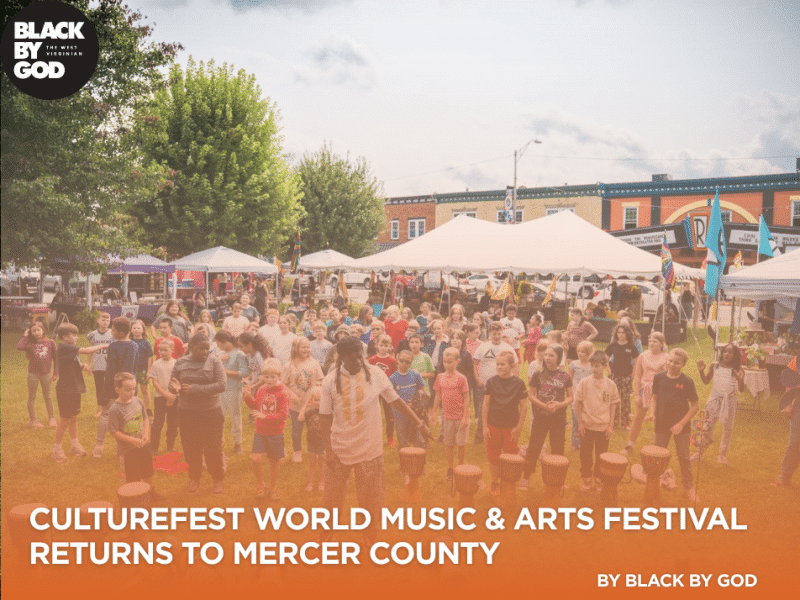
Culturefest World Music & Arts Festival returns to Mercer County
Culturefest returns to Princeton, WV Sept. 8–13 featuring global artists, school workshops, and 4 days of free live music, art, and food in the Grassroots District.

Live Listening Party takes stage at Multifest
Mountain State hip-hop artists took center stage at Charleston’s 36th annual Multifest, bringing unity, local pride, and raw talent to Haddad Riverfront Park.