
10 Reasons Why Understanding Black Appalachian Foodways Matter
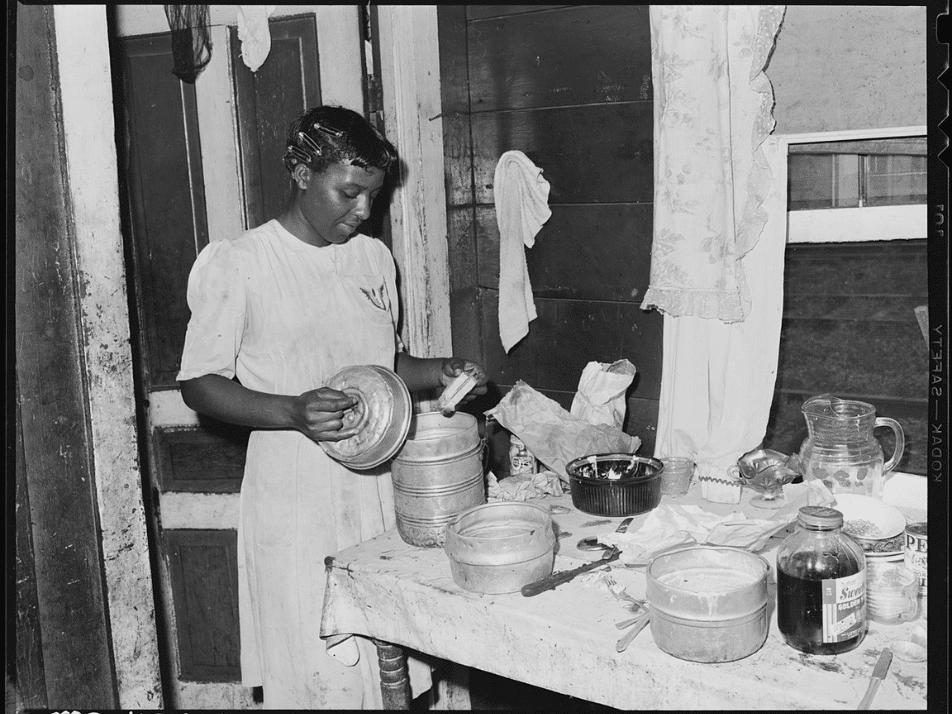
Russell Lee, National Archives.
By Fresh & Fried Hard Appalachia powered by Black By God: The West Virginian focuses on the foodways and lifestyle of Black West Virginians as well as neighboring Central Appalachia from a historical perspective.
Because sometimes it’s the ‘why’ and not the ‘what’ that offers the best narrative about being Black in Appalachia
One thing for sure, you can’t just slap the word “Appalachian” on some food content to gain a full and meaningful understanding of the people or the foodways – Black people’s way with food – found in Appalachia. There’s nothing generic to be trivialized in the ways in which Black residents in the subregions engage with food as growers, producers, eaters, consumers and cooks. Until the recent past, the voices representing Appalachia and the foodways were white. (A few were Black but not identifying as Appalachian, which is a story within itself.)
Still, understanding Black Appalachian cuisine and culinary practices matter. Here are 10 reasons why:
- Our foodways affirms identity. No self-respecting person identifying as Creole would ever deny the importance of etouffée or gumbo as a part of their culinary practices. Black Appalachians can follow suit.
- Our foodways preserve culture. Culinary practices and technique are non-negotiables in most cultures. Our foodways say this is who we are and this is where we come from.
- Our foodways represent our connection to the land. It reconnects Black people to the land and the history of farming, foraging, and hunting within the Appalachian ecosystem.
- Our foodways challenge narratives about being both Black and Appalachian. There is a fine line between expectation and truth. Truth is, Black Appalachians, urban and rural, have foodways that deserve respect. Those foodways are a story we tell better than anyone.
- Our foodways represent migration patterns. Recipes and ingredients can trace the movements of Black families both within and outside Appalachia, revealing complex family histories. Those histories include migration due to chattel slavery, self-emancipation as well as leaving one location to seek employment (and educational) opportunities in another.
- Our foodways reflect how we have built community and communities. To simplify this point: the first Black owned businesses in segregated communities and in all-Black towns were grocery stores, diners and boarding houses. We provided food and communed over food to survive and thrive.
- Our foodways counter invisibility. The more we advocate for our foodways, the least likely we are to be invisible to those who sometimes forget that there are Blacks in Appalachia.
- Our foodways are diverse. We have Black hunters, Black farmers, Black foodmakers, Black vegans and vegetarians, Black soul food and fine dining enthusiasts, Black foragers and more. There is no one Black Appalachian foodways story, and each story is worthy of documentation and respect.
- Our foodways honor the labor of Black women in the kitchen. Food preparation was often the domain of women, and understanding foodways is a way to honor the unrecognized labor and knowledge of Black Appalachian women – women who live in rural and urban areas.
- Our foodways represent our resistance. The primary thing we are resisting is erasure. Food, as in our recipes and practices, is as important to cultural tenacity as our use of language and our history.
Black Appalachian foodways are bigger than what can be found in a social media reel or on a streaming site. Black Appalachian food culture is as big and diverse as all of Appalachia. The Appalachian Regional Commission defines the Appalachian Region as an expansive area covering 206,000 square miles. This region includes all of West Virginia and portions of 12 other states, totaling 13 states and 423 counties, stretching from Southern New York down to Northern Mississippi.
To quote the great West Virginian Katherine Johnson, “Numbers don’t lie.” For as many places Black folk living in Appalachia, there are as many stories about our foodways.
Your food story is one of them.
If you appreciate BBG's work, please support us with a contribution of whatever you can afford.
Support our stories
Related Articles


Mama’s Meatloaf
From a 2025 Appalachian Foodways Practitioner Fellowship winner, a family dish with a reputation!