
From Mountain Eagle to Mountain Blueprint: Land reform for West Virginia’s future
By Jim Branscome | West Virginia Watch
This article was originally published by West Virginia Watch, an independent, nonpartisan news service based in Charleston. You can make a donation here.
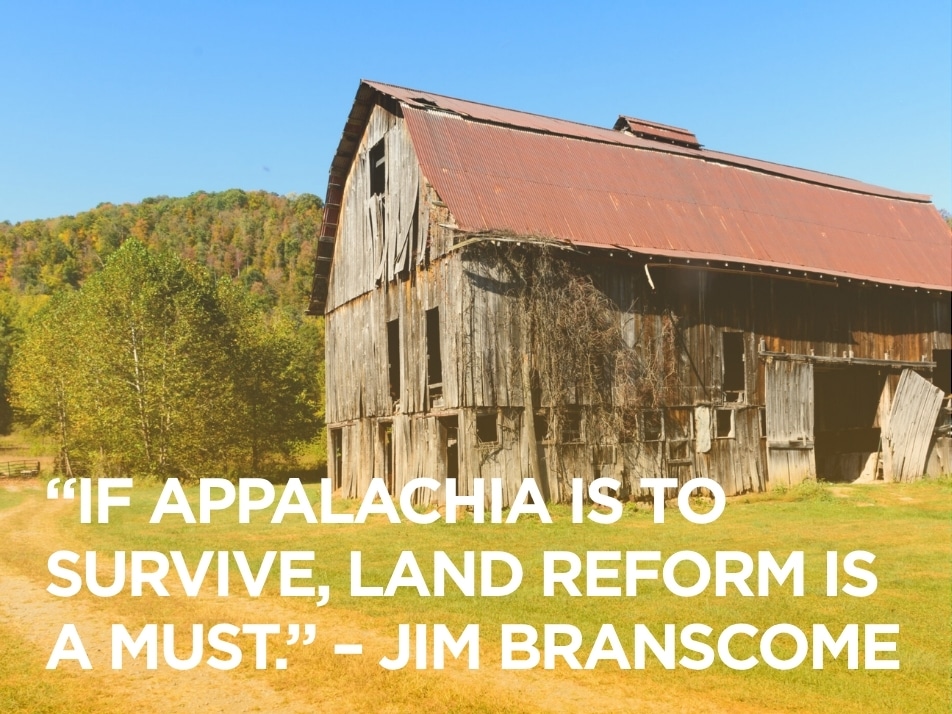
“If Appalachia is to survive, land reform is a must.” — Jim Branscome, Mountain Eagle (Whitesburg, Kentucky), January 4, 1973
A half-century wait for justice
In early 1973, I wrote those words for the Mountain Eagle of Whitesburg, Kentucky, making the case that nothing could really change for Appalachia’s people — no matter how many government programs or anti-poverty initiatives — until we broke the pattern of absentee land ownership that has defined and damaged our region for more than a century.
Today, 52 years later, much has changed in our mountains, and much, regrettably, remains the same. The coal industry that once promised prosperity has largely collapsed, leaving behind environmental devastation and economic despair. Climate change has brought unprecedented flooding that kills our neighbors and destroys our communities. Yet the fundamental issue I identified five decades ago persists: ordinary mountain people remain “landless in their own country,” while corporate interests control the fate of the best land for housing not subject to flooding, land that can support renewable energy projects, vertical agriculture, carbon credits, and otherwise be the inspiration for new visions by mountaineers of what a post-coal, post-industrial era can look like.
The urgency of this moment cannot be overstated. The catastrophic flooding of July 2022 that killed 45 people in eastern Kentucky, and the many floods since all over coal country, served as a brutal reminder that our current path is unsustainable. Families were swept away in their sleep as waters rose in narrow valleys where safe, buildable land has long been monopolized by coal companies and outside speculators. Meanwhile, on the high ridges above the floodplains, vast tracts of corporate-owned land sit empty or scarred by strip mining.
Meantime, the depopulation of the coalfields continues. Projections from West Virginia University’s Bureau of Business & Economic Research show further steep declines by 2040 across the southern coalfields. McDowell is projected to lose nearly a third of its people (-31.8%), with Summers (-20.2%), Mingo (-19.4%), Wyoming (-18.2%), Boone (-17.1%), Fayette (-16.6%), Logan (-14.4%), Nicholas (-12.1%), Raleigh (-9.5%), Mercer (-8.7%), and even Kanawha (-6.6%) not far behind. Statewide, West Virginia’s population peaked at 2,005,552 in 1950 and fell to 1,793,716 by 2020. In McDowell County alone, population plunged from 98,887 in 1950 to 19,111 in 2020 — a decline of more than 80%.
We’re not just losing numbers — we’re losing the critical mass that keeps communities alive. Shrinking tax bases strain schools and clinics. Volunteer fire and rescue squads struggle to replace aging equipment. Local businesses close earlier, then for good. And after every flood, more families ask if it’s sustainable to rebuild at the bottom of a hollow while idle acreage sits on benches and ridgelines above town. The worst projected decline I have seen is minus 48% for Buchanan County in Southwest Virginia, according to the University of Virginia. Harlan County, Kentucky, is projected to lose nearly 45%, according to the University of Kentucky. The coalfields have a lot more in common than just coal history.
The stranglehold of absentee ownership
No place demonstrates the consequences of absentee ownership more starkly than Southern West Virginia. In the 1990s, journalist Beth Spence led a landmark investigative series, “Who Owns West Virginia?” working with the Appalachian Leadership and Education Foundation. Her research confirmed what people in Mingo, Wyoming, and McDowell counties long suspected: vast acreage and the mineral wealth beneath it were held by a handful of out-of-state corporations and land companies.
Spence found that in some southern West Virginia counties, fewer than a dozen entities owned more than half the private land. In McDowell County, just ten companies owned more than 75% of all private land, rendering local government and residents virtual tenants in their own communities. Over 25% of West Virginia’s surface was held by just ten absentee corporate owners.
While much has changed — coal companies renamed, assets traded and new timber and energy interests seeking short-term profit — the basic reality endures. Nearly half of the state’s surface acreage and most of its mineral rights remain controlled by outside entities rather than local hands.
The costs are visible from Williamson to Bluefield. Land is held off the tax rolls or under-assessed, depriving schools and public services of crucial revenue. Economic development is stymied not by lack of initiative, but by lack of access. Would-be homeowners and small farmers cannot buy or borrow while the best land sits idle or cut-over or stripped. Decisions about land use — whether to strip mine, replant or sell off for speculation — are made from boardrooms in Pittsburgh, Houston or New York, not from courthouse squares in Welch or community meetings in Pineville.
Learning from Kentucky’s bold response
The devastating 2022 floods that claimed 45 lives in eastern Kentucky sparked an unprecedented response from Gov. Andy Beshear’s administration. Rather than simply rebuilding in the same flood-prone valleys, Kentucky launched an ambitious program to create new high-ground communities on safer ridgetop locations. The state is acquiring land, building infrastructure and offering families the chance to relocate to elevated sites that could withstand future floods. There are no reasons West Virginia cannot do the same.
Beshear’s efforts represent exactly the kind of bold, land-focused thinking that West Virginia desperately needs. Beshear’s approach recognizes that climate resilience requires fundamentally rethinking where and how we build communities. It acknowledges that the old pattern — of families crowded into narrow valleys while corporations control the high ground — is not just unjust but deadly.
West Virginia faces the same climate threats that devastated eastern Kentucky. The narrow valleys flood regularly, and climate scientists warn that extreme precipitation events will only intensify. Yet we continue to allow the safest, most buildable land to remain in corporate hands while families crowd into flood-prone areas.
Tools for transformation
The mechanisms for change exist today in ways they didn’t in 1973. Community land trusts have proven successful across Appalachia, from the Woodland Community Land Trust in Tennessee to similar efforts in Kentucky and West Virginia. These organizations keep land accessible for housing, farming and business while protecting it from speculation and corporate takeover.
Land banks have become vehicles for returning tax-delinquent or abandoned coal lands to community use. Environmental cleanup programs offer opportunities to acquire and remediate damaged lands. Federal infrastructure investments provide unprecedented resources for rural development.
Most importantly, millions of dollars in federal and state funding are now flowing into West Virginia for mine reclamation, broadband infrastructure and climate adaptation. This represents a historic opportunity to reshape land ownership patterns while building resilient communities. The state could begin with a $100 million demonstration project using funding available from the Inflation Reduction Act and the Infrastructure Investment and Jobs Act.
An Appalachian Homestead Act
My proposal for a modern Appalachian Homestead Act would harness these resources to finally address the land question that has plagued our region for generations. The state would acquire tax-delinquent, bankruptcy, and underused corporate acreage, particularly in the southern coalfields with the most concentrated absentee ownership.
These lands would be redistributed as 10-to-40-acre homesteads to local families, returnees, and new settlers committed to adding value to the community. Each plot would come with tax relief and essential infrastructure, from broadband to flood-resistant siting on high ground. Homesteads would be part of community land trusts or similar shared-ownership models, protecting against outside speculation while preserving individual autonomy over homes and improvements.
New landowners could plant orchards, vineyards or native hardwoods. They could build farm stays, small mills or food businesses. They could sell carbon credits, harvest wild ginseng or develop renewable energy projects. Most importantly, they could live on and live from their own land in communities designed for climate resilience rather than corporate extraction.
West Virginia University and the state’s other colleges could provide technical assistance not just for industrial agriculture, but for small-scale, diversified, locally rooted economies. Extension agents could help new landowners navigate everything from sustainable forestry to agritourism to renewable energy development.
The moment of decision
As West Virginia stands at another crossroads, the choice is clear: decline by inertia, tolerate the continued depopulation of Southern West Virginia, or renewal through justice. The tools exist. The money is finally arriving. The political will, fueled by necessity and decades of local organizing, is growing.
The 2022 Kentucky floods reminded us that our current land use patterns are not just economically unjust but physically dangerous. Beshear’s response shows that bold action is possible when leaders prioritize people over corporate interests. West Virginia can learn from Kentucky’s example while charting its own course toward land justice. Nothing is more American than homesteading. Conservatives can cherish local initiative and private property values; progressives can celebrate meaningful change that did not happen with previous poorly funded economic development projects.
Fifty years ago, I argued that Appalachia’s future would be decided by who owned the land and how it was used. No area bears this out more clearly than Southern West Virginia. The land — and its people — have waited long enough for justice. With bold land reform, the Mountain State can become a model not only for Central Appalachia but for rural renewal across the country.
The choice belongs to this generation of West Virginians. The land remembers those who fought for it. History will judge whether we had the courage to finally claim it for our people.
If you appreciate BBG's work, please support us with a contribution of whatever you can afford.
Support our stories
Related Articles


Mama’s Meatloaf
From a 2025 Appalachian Foodways Practitioner Fellowship winner, a family dish with a reputation!