Rural West Virginia Can’t Afford to Lose Its Data
By Aiden Satterfield – BBG Tech
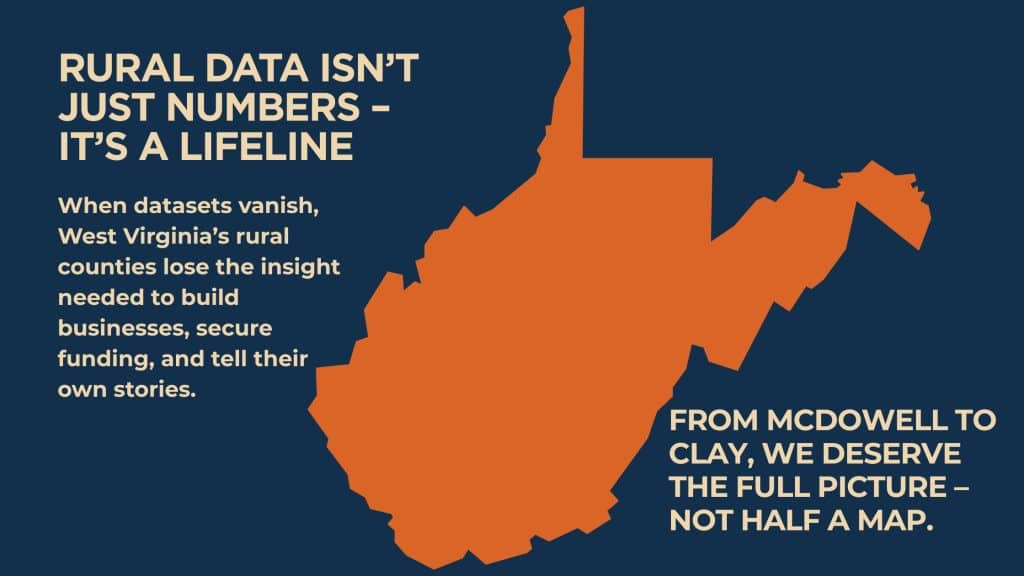
When reliable data disappears, rural communities lose more than statistics, they lose direction. For places like McDowell, Logan, or Clay County, good data is what guides everything from small-business loans to broadband grants. Without it, local leaders, potential help from the federal government, are now left to make big decisions with essentially half a map.
Shoutout to rural innovation for bringing this to light first, too! Check them out.
Across the country, federal data programs, such as the Bureau of Economic Analysis and the Bureau of Labor Statistics, face significant budget cuts. These are the new scorekeepers of America’s economy, tracking jobs, wages, and entrepreneurship down to the county level. However, years of underfunding have resulted in fewer staff, outdated collection methods, and the gradual loss of rural-specific data. The BEA has already released detailed tables on self-employment, which are vital for understanding how small businesses are surviving in post-industrial regions like Appalachia.
But, let’s think about West Virginia, where a single mine closure can reshape a county’s economy(we’ve seen this happen a few times) losing county-level data makes it harder to respond quickly and target investment. Nonprofits, universities, and journalists rely on this information to write grants, attract funding, and measure what’s working. When those numbers vanish, so does accountability.
Some think artificial intelligence might fill the gap, but AI is only as good as the data it’s trained on and can be bias, if not given the proper data. It can’t create new facts about local economies, it can only remix what’s already there. Without fresh, reliable numbers, even the smartest algorithms will miss the real story of rural recovery.If we want a fair shot at rebuilding and competing, we need more than slogans about innovation,we need the data to prove what’s possible. Protecting public information isn’t just good policy.
It’s survival.
If you appreciate BBG's work, please support us with a contribution of whatever you can afford.
Support our stories
Author