Forgotten Freedom Fighters: The West Virginians Who Carried the Civil Rights Movement Forward
By Traci Phillips | Black By God: The West Virginian
When most people picture the Civil Rights Movement, they imagine the Deep South — marches in Selma, sit-ins in Greensboro, or Dr. Martin Luther King Jr.’s voice echoing across Washington, D.C.
Each January, as the nation honors Dr. King’s legacy, the same question returns: who carried the movement forward when the cameras were gone?
Hundreds of miles north, deep in the hills of Appalachia, West Virginians were also standing up, sitting in, and speaking out. Their stories rarely made national headlines, but they mattered just as much. A new book is finally bringing those voices into view.
We’ll bring the best from BBG right to your inbox. You can easily unsubscribe at any time.
Sign Up for our Newsletters!
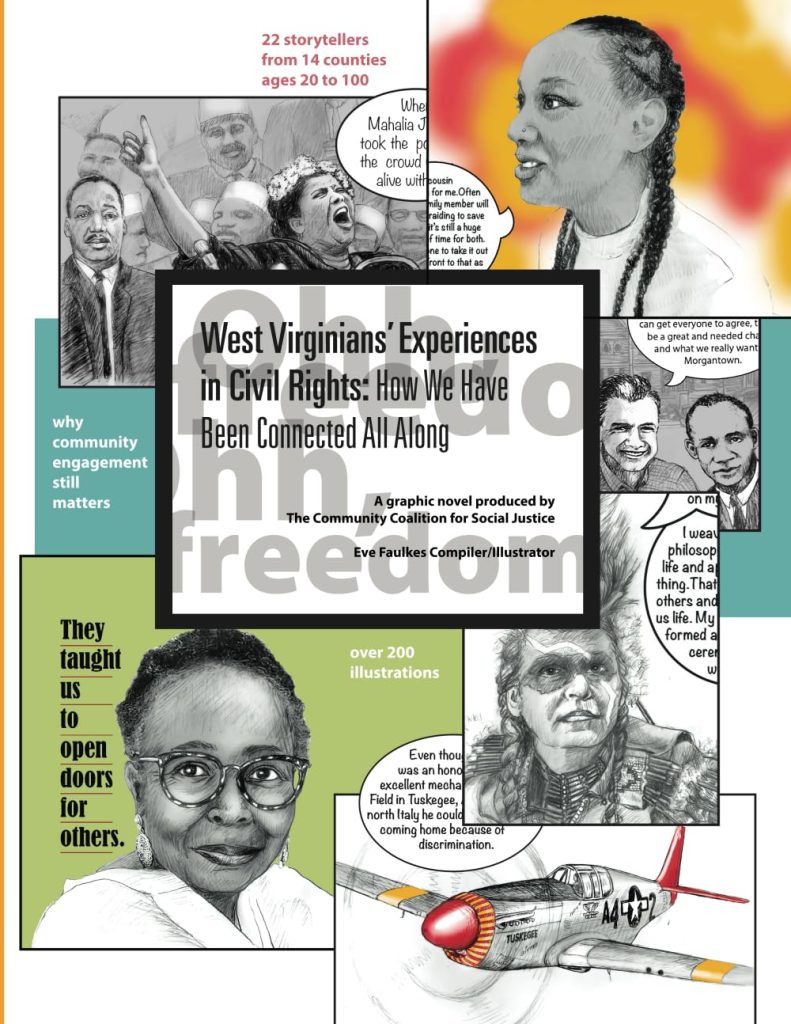
West Virginians’ Experiences in Civil Rights: How We Have Been Connected All Along documents the lived experiences of more than twenty people who shaped, witnessed, and sustained the fight for racial justice in the Mountain State. Compiled and illustrated by Eve Faulkes and edited by Barb Howe and Joan C. Browning, the book pairs first-person narratives with vivid illustrations, bridging generations — from Freedom Riders of the 1960s to community leaders still challenging injustice today.
West Virginians marched on Washington in 1963. They joined the Freedom Rides in 1961. They fought segregation in schools, hospitals, and public spaces long before national attention reached the state. Yet many of their names never appeared in textbooks. Stories like Al Anderson’s memories of racial unity in Osage, or Janie Claytor-Woodson’s attempt to volunteer as a candy striper in Charleston’s hospital system, were often left out of the historical record.
That absence is what makes this project feel urgent. The book and its accompanying exhibit were produced by the Community Coalition for Social Justice, whose work recently received a Leadership in History Award of Excellence from the American Association for State and Local History. The award recognizes not only the book, but the broader community programming and public history efforts surrounding the project. The West Virginia Humanities Council plans to highlight the honor in an upcoming issue of its People and Mountains e-newsletter in 2026.
At the heart of the project is visual storytelling. Faulkes, a professor emerita of graphic design, collected oral histories and transformed them into illustrated narratives that capture the emotion, pride, and quiet defiance of everyday people.
“The art gives breath to the stories,” Faulkes said in an earlier conversation. “It reminds us that these were our neighbors, teachers, and friends.”
For Black By God – The West Virginian, this recognition is long overdue. Appalachia has always been part of the Black freedom struggle, even when the nation wasn’t paying attention. These stories remind us that justice doesn’t live only in Washington or Montgomery; it lives in classrooms in Institute, church pews in Charleston, and picket lines in Morgantown.
Dr. King often reminded the nation that “the arc of the moral universe is long, but it bends toward justice.” In West Virginia, that arc was bent by ordinary people who didn’t see themselves as heroes — just neighbors doing what was right.As communities across the country honor Dr. King’s legacy this January, West Virginians’ Experiences in Civil Rights reminds us that the movement was never confined to one city, one state, or one voice. It lived — and still lives — wherever people chose courage over comfort and justice over silence.
Where to Find the Book
West Virginians’ Experiences in Civil Rights: How We Have Been Connected All Along
Compiled & Illustrated by Eve Faulkes
Edited by Barb Howe & Joan C. Browning
Published by the Community Coalition for Social Justice
(Morgantown, WV 2024)
Available through local and online booksellers.
If you appreciate BBG's work, please support us with a contribution of whatever you can afford.
Support our stories