The National Association of Black Storytellers Announces the Black Appalachian Storytelling Fellowship Awardees for 2025

By Ilene Evans
The National Association of Black Storytellers chose this year’s theme to be “Journeys Well Travelled: Preserving the Oral Tradition of the African Diaspora.” This is a global theme, because so many of our generations have journeyed away from countries and villages of origin to lands far away and unknown. Immigrants and emigration have been an age long reality for all the people of African descent. We know about the arduous nature of travel, of taking our knowledge and wisdom with us, packing and unpacking, making and breaking home again and again. Managing resources, living with scarcity while living abundantly. All along the mountain regions of Appalachia people have learned the value of the old stories while creating new ones to help the next generation survive and thrive in the most meager and mean times.
The Black Appalachian Storytellers chosen for 2025/26 are joining the NABS family as recognized Fellows with this award. They are following a tradition of being culture keepers, telling the story of our ancestors, preserving our heritage, demonstrating the courageous, valiant, and vigilant efforts to hold the truth and complexity of our sojourn. Where we are and where we have been reveals the tragedies, triumphs, victories and losses in search of freedom, independence, and self-reliance. These are indeed stories of journeys well-travelled.
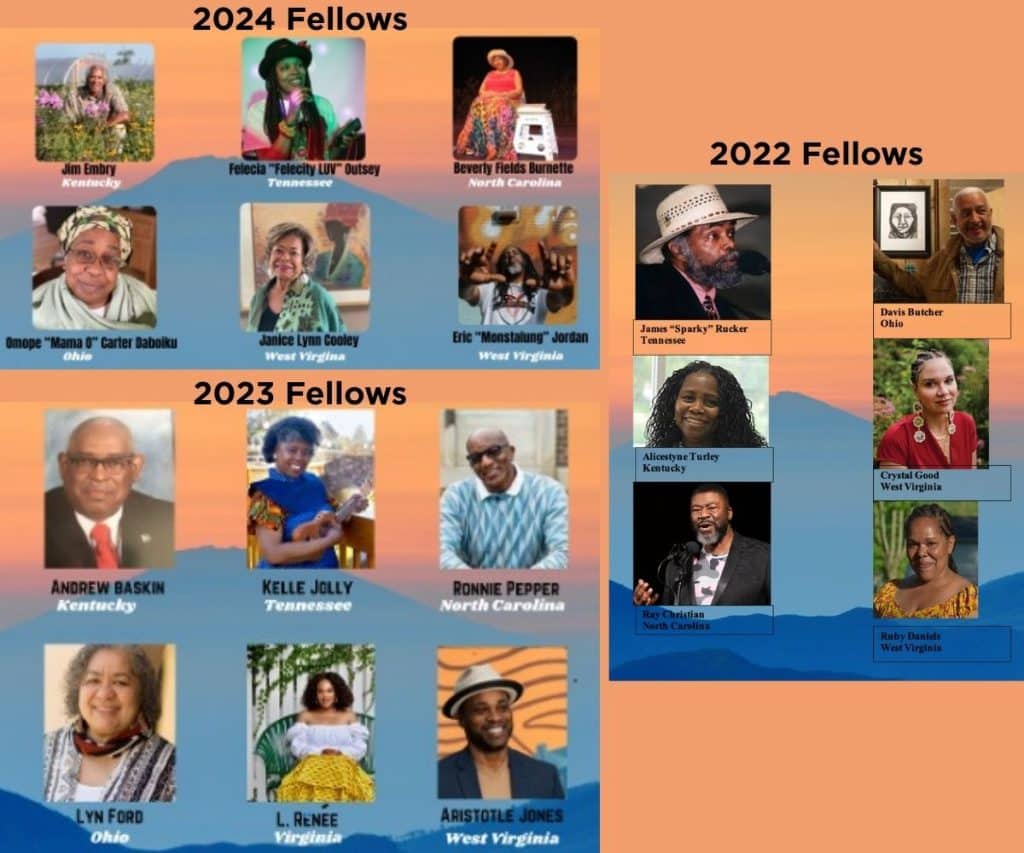
We are proud to announce this years’ choices for these fellowships. This 4th year fellowship is an adjudicated award recognizing artistic excellence in representation of Black Appalachian storytelling and cultural heritage. The NABS Black Appalachian Storytellers Fellowship is made possible through partnerships and funding in part by Mid Atlantic Arts’ Central Appalachia Living Traditions Program and South Arts as part of the In These Mountains, Central Appalachian Folk Arts and Culture. The 2025/26 Black Appalachian Storyteller Fellowship awardees are: Hasan Davis, Dewayne Barton, Dr. Trevellya Ford-Ahmed, Jazmine LeBlanc, Doris Fields, and Naomi Hodge-Muse.
Kentucky
Hasan Davis: Storyteller, Performer, Teaching Artist, Author, Workshop Presenter, Advocate, Historian, Mentor; from Madison County, Kentucky. Hasan’s work is rooted in first-person oral tradition—bringing historical figures to life through performance, poetry, and presence. It’s a form not often practiced, but deeply powerful. With over 30 years of experience, Hasan has become known for blending traditional Black Appalachian storytelling with theatrical interpretation and social commentary. He mentors young people, including his own sons, to carry this work forward. “My stories don’t just preserve the past—they ignite a sense of belonging and possibility in those who hear them. That, to me, is the heart of Blackstorytelling—and my highest calling.”
North Carolina
DeWayne Barton: Storyteller, Performer, Author, Activist, Workshop Presenter, Advocate, Historian, Mentor, Advocate, Tour Developer; from Buncombe, North Carolina. As a cultural preservationist DeWayne has spent time with elders and young people to learn the power of storytelling as a bridge between generations and as a catalyst for change. In 2015, he launched Hood Huggers International and Hood Tours to shine a brighter light on these narratives. Hood Tours features historically Black neighborhoods in Asheville, NC—how we live, grow, and persist in the face of ongoing societal challenges. Each tour features not only storytelling but also musicians, performers, and historians, creating a layered, deeply meaningful experience. DeWayne lifts up the stories behind local and regional policies highlighting those that support community-led growth and resilience.
Tennessee
Jazmine LeBlanc: Storyteller, Performer, Teaching Artist, Workshop Presenter, Advocate; from Hamilton County, Tennessee. Jazmine LeBlanc is an Appalachian storyteller and librarian whose work honors tradition while amplifying new voices. Rooted in Tennessee, she weaves storytelling like fiber art, threading music and heritage into vibrant community narratives. Jazmine believes that everyone deserves to see themselves reflected in stories and lives this belief daily as the Executive Director of ELLA Library, a community-based art and culture nonprofit in Chattanooga.
Ohio
Dr. Trevellya “Tee” Ford-Ahmed: Storyteller, Performer, Author, Workshop Presenter, Advocate, Mentor; from Athens, Ohio. Dr. Tee has had a long career in storytelling as activism. Now retired from academia, she has embraced philanthropy, focusing on storytelling of the little-known and nearly forgotten history of Athens, Ohio, a stop on the Underground Railroad. She researched this history and developed “Heritage Square Tours”, an hour long walk which she leads while sharing stories of a once-thriving Black Appalachian business district, now marked by ‘mere’ plaques/monuments. Dr. Tee produced and narrated a 3-part docuseries of films titled “Black Wall Street Athens,” when the120-year-old Mount Zion Baptist Church building was facing the wrecking ball.
West Virginia
Doris Fields – “Lady D”: Storyteller, Singer, Teaching Artist, Author, Workshop Presenter, Advocate, Historian; from Raleigh County, West Virginia. Doris Fields is a native West Virginian, a coal miner’s daughter. Her song, “Go Higher” won the best Obama Inaugural Song in 2008 and she and her band, MI$$ION performed at the Obama For Change Inaugural Ball in 2009 in Washington, DC. She has been performing her original one-woman play, The Lady and the Empress, based on the life and music of blues legend, Bessie Smith, and produced a series of videos called “Those Who Came Before” highlighting the black community’s contribution to West Virginia’s culture and heritage.
Virginia
Naomi Hodge Muse: Storyteller, Performer, Author, Advocate, Mentor; from Raleigh County, West Virginia. Naomi grew up in Henry County, Virginia, the subject of her recently published book, The Tales of Koehler Hollow: An African American Family in Rural Appalachia, her family’s account of everyday life in the Holler. Naomi features the rich and varied nature of this American experience. To be sure, not all of it is pretty. Many, she says, “suffered similar humiliations that our urban city cousins were accustomed to, yet they made the conscious decision to stay and learned to live and thrive under these conditions because our attachment to the land.”
“What is special about a storyteller who is Black and Appalachian – or as some say, “Affrilachian?” The terms may confuse and confound. The stories of people in Appalachia, especially black people, and people of color in Appalachia often take a back seat to stories of our urban brothers and sisters. Historians, genealogists, researchers, ethnographers, physicians, are speaking out more and more as to the importance of these voices from the mountains, who laid the foundation of Black entrepreneurship, finance, education, invention, literary prowess, and the law to be recognized around the world today. Black Appalachian Storytellers are sharing stories of reclaimed land, preserving cemeteries, and legacy herbs and formulas for healing, midwives who were often called on for every medical need imaginable besides childbirth; traditions that hold the community together. They tell tales of forced relocation, the trials of segregation, prohibition, legalized terror. But there were also stories of ingenuity, resilience, entrepreneurial excellence, strategic analysis, and healing, despite oppression and neglect.
Stories are not just entertaining; they are how we organize our life experiences and measure our growth; map our way through life’s perils. Some of the stories were difficult to hear, difficult to tell, and hard to bear. The stories we tell ourselves about ourselves link us to past and future generations. Traits that are passed on from one generation to another are part of the long story of our genealogy. This information is so important that there are designated people in many cultures, especially African cultures, where the one who remembers and renders – holds a place of honor and respect. We honor this year’s fellows as they join the National Association of Black Storytellers, keeper of our culture, history, and traditions.
Our truth has often been denied by the outside world. The sideways glance reveals the understanding shared by our intimates and extended family. So many times, our truth is too bitter for others to believe. Our stories hold the deep emotions we feel until we can process and heal the wounds of disbelief.
“Blackstorytelling” as coined by Dr. David “Sankofa” Anderson in 1995 was further defined by Dr. Caroliese Frink-Reed, as the repository of our families, our traditions, our heritage, our identity, and our culture. “Blackstorytelling is defined and honed and developed by our experiences here and by the oppression, the denigration, but also the joy and the triumphs and successes of us here.” It holds the key to our future, not just survival, but also our victory over oppression. Blackstorytelling houses the tools for accessing our creativity – ensuring our grandparents’ dreams for our success, prosperity, and joy. We are their dreams come true.
If you appreciate BBG's work, please support us with a contribution of whatever you can afford.
Support our stories