February 3rd, Freedom Day: West Virginia’s True Emancipation Date
By Crystal Good | Black By God: The West Virginian
West Virginia has a freedom date that most people in the state have never been taught to name.
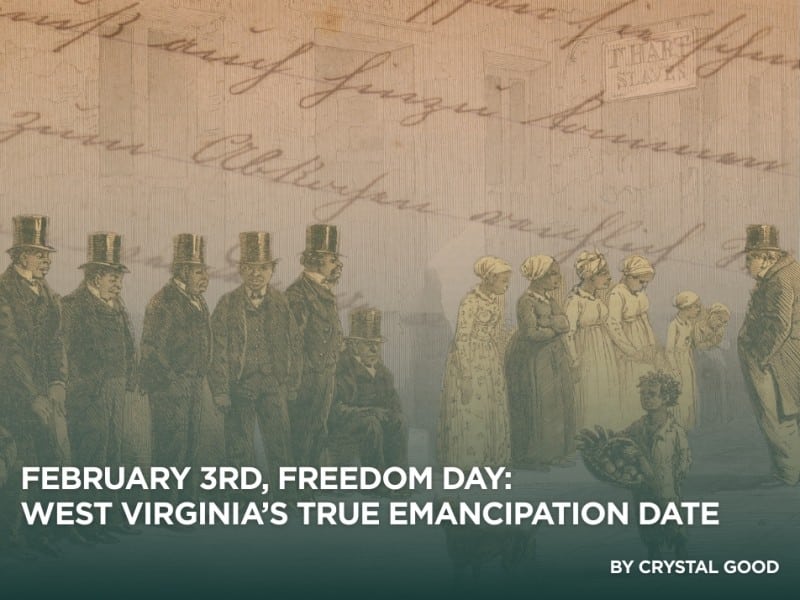
In West Virginia, people were enslaved for nearly two years after the Emancipation Proclamation—and in some cases, after the state already existed.
February 3, 1865, is the day the West Virginia Legislature passed an act abolishing slavery in the state, later signed by Governor Arthur I. Boreman. Advocates call it West Virginia’s Authentic Freedom Day because it marks the moment slavery was formally ended here by law, in the place where enslaved people were still being held.
This isn’t folklore or interpretation. It’s documented in the state’s own historical record. State cultural archives identify February 3, 1865, as the day the Legislature abolished slavery. BBG’s reporting and community civic memory work have brought that fact back into public view.
What the day is—and what it corrects
Freedom Day isn’t “another Juneteenth.” Juneteenth marks the moment news of emancipation reached enslaved people in Texas in June 1865. West Virginia’s story follows a different path.
The myth the state often tells about itself is that West Virginia broke away from Virginia to escape slavery. The truth is more complicated. West Virginia entered the Union in 1863 as a slaveholding state, becoming the last slave state admitted to the Union.
Federal lawmakers required the new state to address slavery before approving statehood, but West Virginia’s solution was not immediate freedom. Through the Willey Amendment and related provisions, the state adopted gradual emancipation. Enslaved children under age 10 on July 4, 1863, would be freed at 21, while those between 10 and 21 would not be freed until age 25.
That meant many Black West Virginians—particularly adults—remained enslaved even after statehood. The state could claim loyalty to the Union while still holding human beings in bondage.
Slavery in West Virginia was not abstract. In the Kanawha Valley, enslaved people were forced into dangerous labor that powered the salt industry and related coal operations—work that generated wealth and shaped the region’s development.
February 3 marks the moment West Virginia lost the legal authority to hold Black people as property.
How February 3 returned to public memory
The date has long existed in the archives but not in public culture. It resurfaced because advocates, historians, and Black civic leaders examined the record and insisted the state confront its own history.
That work became visible in 2024 when a proclamation at the Capitol formally recognized February 3, 1865, as Freedom Day and acknowledged that West Virginia entered the Union as a slave state.
House Bill 4254 was also introduced to designate February 3 as Freedom Day in the state code. While the bill did not advance, it placed the issue into the legislative record and clarified what remains unfinished.
What Freedom Day looks like now
By 2025, Freedom Day began evolving from a single recognition into an ongoing civic practice.
On February 3, 2026, Black By God – The West Virginian, in partnership with the Black Voter Impact Initiative, will mark the date with Young, Gifted & Black, a virtual civic conversation focused on Black youth and policy engagement ahead of Black Policy Day at the West Virginia Legislature. The event will take place at 7 p.m. on Facebook.
The event reflects a broader shift toward using February 3 as a point of preparation, education, and community connection—not just commemoration.
Why this date still matters
Emancipation in the United States did not happen all at once. The 13th Amendment was not fully ratified nationwide until December 1865, and freedom arrived unevenly depending on location, law, and power.
West Virginia’s February 3 date is a reminder that people lived—and died—inside those delays.
Remembering Freedom Day is not only about honoring emancipation. It is about telling the truth about slavery in West Virginia.
Choosing to remember February 3 is a choice to move beyond myth and include the people whose labor powered West Virginia’s industries and whose freedom was postponed by design.
In a time when public institutions debate what history can be taught and whose stories matter, this date is a test—not of the past, but of the present.
West Virginia needs the courage to tell its true history.
If you appreciate BBG's work, please support us with a contribution of whatever you can afford.
Support our stories
Author

Related Articles
Black Love & Marriage According to The Advocate
The newspaper only survived 12 years but thanks to the foresight of the publisher, an archive of Black West Virginian marriages and wedding practices exists 114 years later.