Narry a Southern Accent Lost: Crystal Good Takes Her Voice to Hot Springs
By Crystal Good
HOT SPRINGS, Ark. —
Hey…
How are you?
Did you hear me sing to you?
Did you sing back?
I hear you.
And I think that’s why sometimes when I travel, it feels heavy, like I’m taking a bunch of people with me—all my supporters and people who want me to represent them—and sometimes it’s just easier to stay home. But I’ve been on the road for about a month: DC, Costa Rica, NYC, Durham, the usual nooks and crannies of West Virginia, Detroit, and now Arkansas. Everywhere I go, I carry my “‘Invest Appalachia” bag.
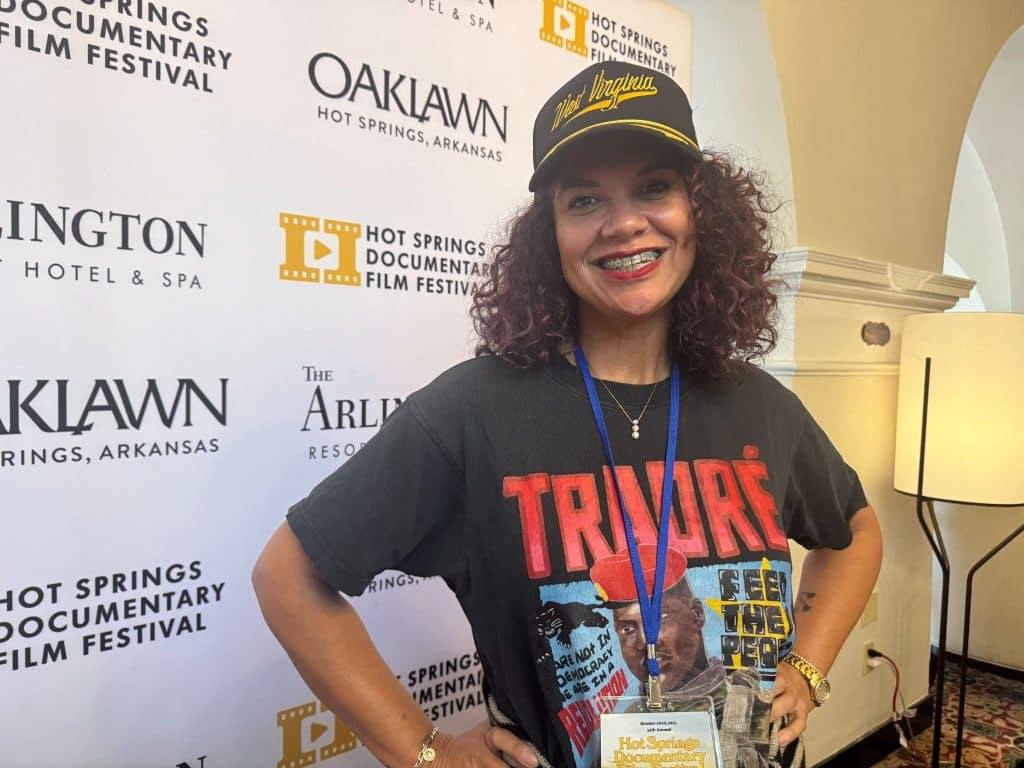
I’m here for a panel at the Hot Springs Documentary Film Festival called “Where are the Southern Accents?”—bringing together documentary makers to talk about the unique challenges of bringing authentic regional stories to national audiences.
People always say I talk funny. They never know where I am from. They never guess West Virginia, just “Southern”—and I am, southern, the upper South, but also the mountains that make my accent and yours different, special, unique.
Tomorrow is my birthday—also West Virginia filmmaker Elaine McMillion Sheldon’s birthday— I turn 51! I’ll be sitting on that panel at the longest-running documentary film festival in North America, still working on my first documentary as a film as a producer. But calling me a first-time filmmaker at 51 doesn’t tell the whole story. I’ve been a story advisor on King Coal, the Sundance documentary by Elaine. I’ve been a feature and consulting producer on CNN’s United Shades of America with W. Kamau Bell. My poem “Boom Boom”—about strippers and strip mines—was featured on Anthony Bourdain: Parts Unknown, where my voice and accent were recognized by many people across the country when it aired. That was special to me.
I was a featured storyteller and consultant in Indelible Appalachians. I’ve dabbled in production and have been in front of the camera plenty. Now I’m working on Dear Appalachia / Black By God with Ashley York, acclaimed for the film Hillbilly, and producer John Fee.
The panel brings together Mississippi native Hanna Lane Miller of Terrible Creek Productions, Producer Zuri Obi, Ashley, and me.
I’ll probably be the only Black Southerner and Appalachian in the room. Maybe not. But in most cases, outside of the region, I’m the only Southern Black and Appalachian in the room who admits it.
I’m here because for years I’ve been working on this film with Ashley—it’s slow coming, but maybe that’s what makes it so special when it comes. The question isn’t just about accents disappearing from film and media. It’s about understanding where they came from in the first place—and why they matter, and matter now as a way to bridge so much polarity.
The southern Appalachian accent didn’t appear out of nowhere. It carries the DNA of Elizabethan English, preserved in the hollows and ridges where Scots-Irish settlers made their homes centuries ago. Linguists have long documented how words like “reckon,” “yonder” (or “yander” in mountain speak), “britches,” and constructions like “ I might could” are holdovers from older forms of English that disappeared elsewhere but took root in Appalachia’s isolation.
Researcher Kirk Hazelton from West Virginia University has called for greater respect and understanding of “Appalachian Englishes”—plural, because there’s no single way mountain people talk. My favorite way to talk Appalachian is with double nouns. I love me a stairstep—so unnecessary but true to the Appalachian dialect.
But that’s only part of the story.
What’s often left out of the narrative is how Black migration—from the Deep South to the coalfields, from cities back to the mountains—has infused and shaped Appalachian speech. Before film and TV, there was print—newspapers like Black By God carrying the mantle of Black storytellers who used their platforms to inform, empower, and represent. The accent isn’t monolithic. It’s a living, breathing thing that reflects the people who’ve moved through these mountains, worked in them, raised families in them.
Recent research shows that Southern accents among Black residents have changed in places like Atlanta, mainly due to the “Reverse Great Migration.” African Americans who moved North during the Great Migration have seen their grandchildren and great-grandchildren return South in large numbers, often college-educated and bringing different speech patterns with them.
I once tried writing traditional haikus and was so proud of my collection until I realized I make one-syllable words two. Now I call them Appalachian Haikus and own the creative form that matches how I actually speak.
I remember watching Randy Moss on TV—the West Virginia native and NFL legend from Rand, my Daddy’s town, whose deep country drawl made me feel proud, even as I noticed how it made others perceive him. Then, over time, Moss’ accent shifted. He became more “polished,” more palatable to mainstream audiences. But he’s still West Virginia, still country, and dang gone it if he didn’t make it on ESPN as a host—something they said couldn’t be done because he sounded too country.
So many people change the way they talk. They lose their West Virginia accent. So many people have reached out to me and said they wish they had kept their accent.
I kept mine. I built poems with it. I built stories around it, even a newspaper. I’m proud of that. As Georgia Tech linguist Lelia Glass observed, educated young people today often want to sound “nonlocal and geographically mobile” rather than tied to a specific hometown.
I worry that instead of turning off my accent tomorrow, I might turn it on—I might twang it out a little more, and maybe that’s okay. My accent is a literal road home. Anyone who has one is connected, because people always want to know where you’re from. It’s your own passport visa that never expires.
In an industry where decision-makers cluster in New York and Los Angeles, Southern filmmakers must fight to bring authentic regional stories to the screen without having them filtered, flattened, or dismissed.
So tomorrow, on my birthday, I’ll walk into that room, sit on a panel with award-winning filmmakers, fellow southerners, and carry the one thing I always got with me – my accent and home.
The future is local.
Want to send me a birthday present? Please send me your voice, your accent, and tag me on IG, text me, email me! I want to hear from you.
If you appreciate BBG's work, please support us with a contribution of whatever you can afford.
Support our stories
Author