What Am I Doing at the James Beard Awards — again?
I’ve always said: I do not cook.
So when I was asked to write a poem for the Spinster’s Measure and Pour album, prompted by the question, “If you made music the way you cook, what would it sound like?”—I paused. Then I wrote:
“I do not cook. I do not cook.”
But I’ve started to wonder if that was ever really true.
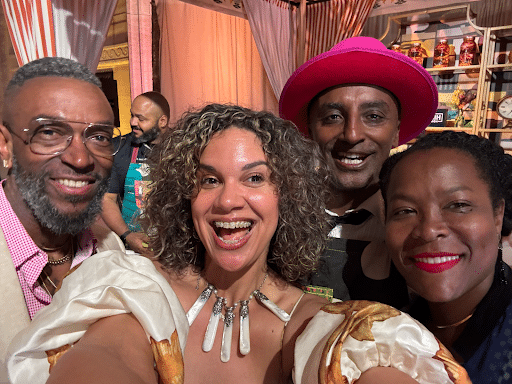
Last night, I attended the James Beard Awards in Chicago—for the third time. But this time, I didn’t feel like I was just watching. I felt part of it. Still starstruck, still nervous—but also like I belonged.
James Beard brings together the most progressive, fashionable, tattooed, radical food crowd you’ll ever meet. A “F*ck ICE” kind of crowd. I don’t always know who’s who—though I know Tristen Epps just won Top Chef, and I’m a loyal alum of The Family Reunion at Salamander.
I want to be in the room with the heart of Black American cuisine and bring West Virginia, Affrilachia, with me.
Last year was electric. It was West Virginia’s moment: Chef Paul Smith, from Charleston’s 1010 Bridge (and its sister spots), became the first chef from West Virginia to win a James Beard Award, taking home Best Chef: Southeast. That energy was carried through the ceremony, and a strong WV delegation was present in the room.
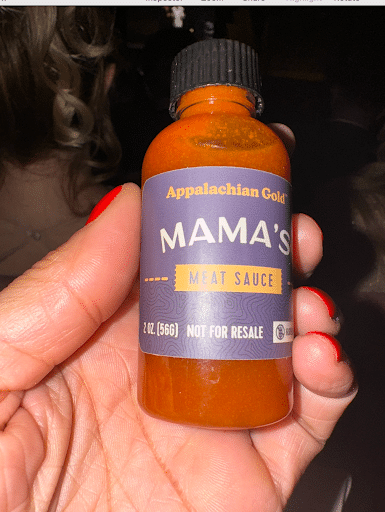
Last year, without JBL’s permission, I also passed out a Mama’s Meat Sauce jar from my bag. Folks were tickled to get a jar straight from West Virginia—from my purse to their hands, a story.
It comes from Ronnie Marie Tartt, whose family migrated from the Black Belt of Alabama to WV’s coal camps during the Great Migration. Her grandmother, Ms. Penny, started the recipe with love and scraps. Ms. Alberta kept it alive, even in her boarding house kitchen—two guns in her apron. Mama Tartt inherited it, passed it down through generations, and finally became part of Appalachian Gold, a majority-Black WV brand.
Mama Tartt isn’t my birth mother. But she’s my Mama—cooking with instinct, spirit, and memory. And teaching me. Whether in her kitchen, on FaceTime, or through voicemails, Mama is showing me that cooking isn’t just a task—it’s a way to love, to call someone home, to slow down and listen.

Mama also helps run a 335-acre farm in McDowell County, alongside her son, Jason Tartt. Apple orchards, peach trees, honeybee apiaries, raspberry and blackberry bushes—all growing on land once stripped by coal. Jason co-founded McDowell County Farms and EDGE (Economic Development Greater East), proving that sustainable, equitable farming is Appalachia’s future.
Mama isn’t just teaching me how to cook. She’s teaching her community to can, grow, and preserve. And it’s part of a much bigger story.
A story that voices like Toni Tipton‑Martin have been telling for years.
“I’ve spent a lifetime so that the voiceless were heard,” she said while accepting her Lifetime Achievement Award.
Her message rang clear: Food is healing.
Toni and my friend Ronni Lundy, author of Victuals, have worked to amplify the legacy of Malinda Russell, the first Black woman to publish a cookbook in the U.S. in 1866—a woman who wrote to go home.
Ronni’s curiosity about Russell led her down a winding path that revealed a missing thread in Appalachian culinary history. Malinda Russell wasn’t just the first Black woman to publish a cookbook—she was, arguably, the first Black Appalachian cookbook author. That discovery grounds me.
That’s my heritage, too.
That’s what makes me feel like I belong at James Beard.
That’s what connects my love of food to the first woman who wrote it all down, from right in my Mountains.
As Crystal Wilkinson writes in Praisesong for the Kitchen Ghosts, sometimes the grandmother teaching us is not beside us, but lives inside the pots we stir.
I don’t say I don’t cook anymore.
I don’t cook was protection.
I don’t cook was pain.
I don’t cook was saying I don’t know where to begin.
Now I’ve begun.
The highlight of my night?
Chef Marcus Samuelsson‘s afterparty at Union Station. His fluke tartare with green apple aguachile, berbere oil, and crispy plantain ceviche!! Pure magic. I drank the juice. Unapologetically.
Mama says she loves me because I love to eat.
She’s right.
But more than that, I love the people who feed us.
The growers. The gatherers.
I still don’t always know what I’m doing in the kitchen—or at the James Beard Awards.
But I know where I come from.
And that’s the basic ingredient for everything.
Somewhere, in a kitchen not yet built,
My great-grandchild is listening for me—
Just like I’m listening for my grandmother now.
It all starts with love, land, and a story.
If you appreciate BBG's work, please support us with a contribution of whatever you can afford.
Support our stories
Author