America at 250: What We Celebrate and What We Must Confront
A mathematical and historical critique of America’s 250th anniversary. Dr. Sonya Armstrong examines the axioms of liberty, the erasure of DEI, and voting rights.
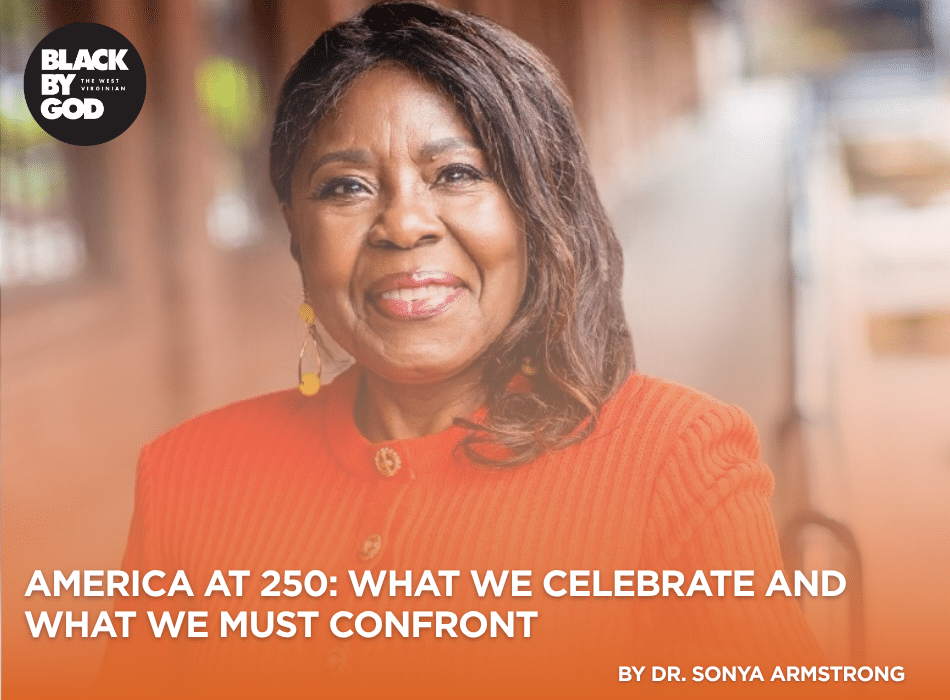
By Dr. Sonya Armstrong
In 1776, Thomas Jefferson helped put into words a powerful idea: that people could claim liberty, govern themselves, and build a nation on the belief that all are created equal. As I prepared for today, I thought about that idea not only as a citizen, but also as an educator and a mathematics professor. One of the courses I taught was the history of mathematics, and in that class we talked about Euclid, one of the great mathematicians. Euclid gave us what we call axioms—basic truths or starting points that help us move step by step toward a conclusion.
In one chapter, I asked my students to read the Declaration of Independence and think about whether Jefferson was doing something similar: laying out reasons, one after another, to explain why the colonies believed they had to act. As I looked back at some of what my students had written, it helped me see this speech in a new way. America’s founding words were not just beautiful language; they were a case being made about human dignity, fairness, and responsibility.
Two hundred and fifty years later, we come together not only to celebrate America’s endurance, but also to ask what that promise asks of us now. This anniversary gives us a reason to be grateful for the progress others have won, and honest about the work still left to do. And for us here in West Virginia, with our history of resilience, sacrifice, service, and neighborly strength, it reminds us that democracy is not something we receive once and keep forever. It is something each generation must renew, protect, and pass on.
What We Celebrate
Two hundred and fifty years after the Declaration of Independence, America has much to celebrate. The nation’s founding promises of liberty inspired a long struggle for freedom, self-government, and expanded rights. Across generations, Americans have worked to make that promise more real: through the 13th Amendment’s abolition of slavery, the 14th Amendment’s guarantee of citizenship and equal protection, and the 15th Amendment’s protection of voting rights regardless of race, color, or previous condition of servitude. That work continued through landmark laws such as the Civil Rights Act of 1964, which outlawed discrimination in public accommodations and employment, the Voting Rights Act of 1965, which protected access to the ballot, and the Fair Housing Act of 1968, which prohibited discrimination in housing.
We also celebrate the extraordinary economic growth, innovation, and technological progress that have shaped American life. From industrial expansion and scientific breakthroughs to medical advances, space exploration, digital technology, and new tools that connect people across communities and continents, America’s story includes a remarkable capacity to imagine, build, adapt, and lead.
These achievements remind us that American progress has never been automatic; it has come because people organized, sacrificed, legislated, marched, voted, invented, labored, and insisted that the nation live closer to its ideals.
What We Must Confront
At the same time, this anniversary calls us to face the parts of our history and present reality that cannot simply be celebrated.
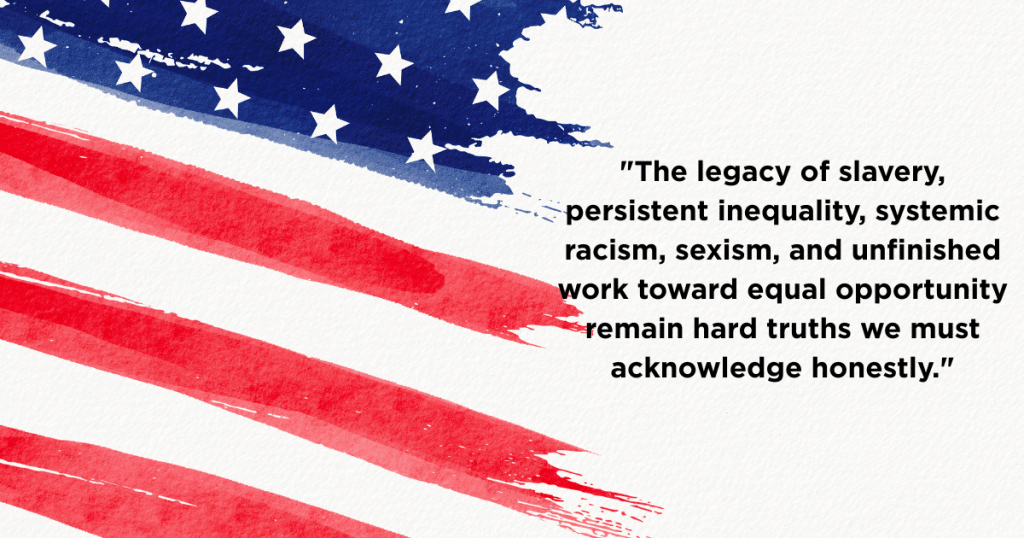
The legacy of slavery, persistent inequality, systemic racism, sexism, and unfinished work toward equal opportunity remain hard truths we must acknowledge honestly.
When we think about what it means to be Black, to be free, and to be truly American, we must listen to the voices of those who forced this nation to face its own hypocrisy. I think of Sojourner Truth, who stood tall in her identity and reminded the world of her dual reality as a Black person and an American. She famously noted the agonizing contradiction of a country celebrating its independence while keeping millions in chains, stating, “I hear the paper read that all are created equal… but if God is the father of us all, why may not one daughter have the same rights as another?”
She knew that freedom was not merely the absence of chains, but the presence of equal status. She boldly declared her place in the American fabric, saying, “I have as much right as any man to have my right of way.”
Yet today, those very rights of way are being blocked. We must confront the ways hard-won rights are actively being weakened, rolled back, or denied. We are witnessing a systematic repealing of voting rights through restrictive laws that disproportionately silence communities of color, effectively undermining protections gained through the Voting Rights Act of 1965.
Furthermore, we must confront the aggressive lack of Diversity, Equity, and Inclusion (DEI) initiatives in our institutions today. The deliberate dismantling of DEI programs in education, government, and corporate sectors is a direct attempt to erase the progress made since the Civil Rights movement. When we ban the history of marginalized people and eliminate equity frameworks, we leave people treated as less worthy of dignity, safety, and opportunity.
To take Sojourner Truth’s words to heart is to realize that true freedom requires active inclusion. We must also confront:
- Homelessness and poverty that leave too many people without security or hope.
- Inequities in opportunity, health, education, housing, and justice.
- Large-scale development, including data centers and other projects, that can strain land, water, energy, and community resources if not guided by the public good.
- The greed of people in power when private gain is placed above public responsibility.
- A loss of neighborly compassion toward people we see as different from ourselves.
To confront these truths is not to reject America; it is to take America seriously. If we believe in liberty, equality, and justice, then we must be willing to protect those promises whenever they are threatened and extend them wherever they have been denied.
What Comes Next
As we look toward America’s tricentennial fifty years from now, West Virginians have a special role to play. This is a state built by people who know hardship, who understand sacrifice, and who have shown again and again that resilience is not just endurance—it is action. The next chapter of our national story should call us to keep working, together, toward a more perfect union by:
- Strengthening democracy in our communities through trust, participation, and accountability.
- Expanding opportunities and intentionally fighting for diversity, equity, and inclusion so every child, every worker, and every family has a fair chance to thrive.
- Reclaiming the ballot and aggressively resisting any efforts to repeal or suppress our fundamental right to vote.
- Facing hard truths with honesty while refusing to give up on the promise of America.
- Carrying forward West Virginia’s spirit of resilience, service, and neighborly commitment.
So let us say it together: We will show up. We will speak out. We will vote. We will serve our neighbors. We will hold our leaders accountable. And we will keep working for an America where the promise belongs to all of us.
When they ask who will defend democracy, we answer: We will. When they ask who will protect freedom, we answer: We will. When they ask who will help build a more perfect union, we answer: West Virginia will.
The work of democracy is never finished. It belongs to every generation, and now it belongs to us. Let us leave this celebration not only proud of how far America has come, but determined to do our part—here in West Virginia—to make freedom, equality, and opportunity more real for ALL. All means everyone: every child, every worker, every family, every neighbor, and every person whose dignity must be honored.
We must also call on our elected leaders to do their part—to honor the trust we placed in them when they were elected, to serve with integrity, and to put the common good above division, greed, or self-interest. If West Virginia’s story teaches us anything, it is that people who have known hardship can still choose hope, people who have carried heavy burdens can still lift one another, and communities rooted in resilience can help lead a nation forward.
So let us honor the past by acting in the present. Let us protect the rights that were won, extend opportunity where it has been denied, and keep working—together—toward a more perfect union for the next 250 years.
West Virginia, this is our moment—stand up, speak out, and let us build that more perfect union together!
If you appreciate BBG's work, please support us with a contribution of whatever you can afford.
Support our stories
Related Articles
Toxic Water, Corporate Handouts: Water Crisis of West Virginia
Today, as the coal industry fades, the very communities that served as the backbone of this state are being left behind to drown in its toxic legacy.