
Toxic Water, Corporate Handouts: Water Crisis of West Virginia
Today, as the coal industry fades, the very communities that served as the backbone of this state are being left behind to drown in its toxic legacy.
By Martec Washington
For generations, the Black and Brown families of West Virginia’s southern coalfields gave their labor, their health, and their lives to power this nation. We built the wealth that built America. But today, as the coal industry fades, the very communities that served as the backbone of this state are being left behind to drown in its toxic legacy.
The political leadership in Charleston—leadership these counties overwhelmingly voted for—has abandoned them. We are watching a deliberate erasure of marginalized Appalachian communities, trading our basic human rights for political theater and corporate handouts.
You don’t have to look far to see the reality of this environmental racism; you just have to look at the water.
Just weeks ago in Mingo County, Pigeon Creek turned a toxic, bright orange. Runoff from an abandoned mine land, disturbed by railroad maintenance, flooded the waterway. Independent testing showed levels of lead, fluoride, and hydrogen sulfide exceeding Safe Drinking Water standards. Residents in Ragland and Delbarton were left demanding answers while emergency management told them it was just “iron-related” deposits.
In McDowell County, the situation is a daily, living nightmare. During Public Service Commission hearings this spring, residents of Gary testified that the water coming from their taps is leaving them with full-body blisters. They are pulling brown, rusty sludge from their sinks. The local water systems are collapsing, with PSC records showing the town of Gary is losing up to 94% of the water it pumps because of decaying infrastructure. Families living below the poverty line are being forced to spend hundreds of dollars a month on replacement filters and bottled water to survive.
On June 3, Congress rejected a meager $50 million proposal to help fix the drinking water in southern West Virginia, deciding via an unrecorded voice vote that our lives weren’t worth the investment. At the state level, lawmakers similarly killed proposals to fund water projects during the last legislative session.
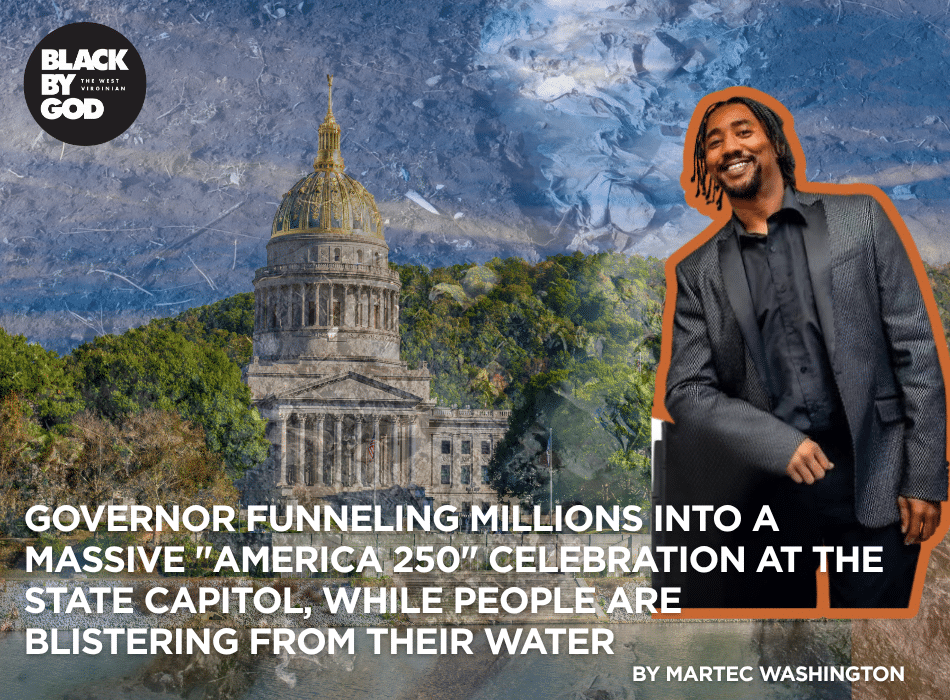
Yet, while our people are blistering from their tap water, Governor Patrick Morrisey has found the money to throw a party.
The Governor’s office is currently funneling millions from the state’s Civil Contingency Fund into a massive “America 250” celebration at the State Capitol. They are bringing in the world’s tallest portable Ferris wheel. They are paying for specialized drones to map the Capitol for a 3D light show. They are selling limited-edition merchandise.
How do you celebrate the founding of a nation while the people who powered it cannot safely bathe their children? How do you look Black and Brown coalfield residents in the eye and tell them there is no money for their collapsing water systems, but there is unlimited funding for a light show?
We are done waiting for a rescue that isn’t coming. We are demanding action.
Our coalition recently hand-delivered a 60-Day Emergency Operational Blueprint to the Governor’s office. This is a legally sound, actionable plan under West Virginia Code 15-5-6 to declare a State of Emergency in the southern coalfields. It demands the immediate mobilization of the National Guard to distribute water and set up mobile hygiene trailers, followed by a permanent $250 million infrastructure overhaul.
Our communities are dealing with a new environmental disaster every other week. We refuse to be the collateral damage of a forgotten industry. The blueprint is on Governor Morrisey’s desk. It is time for him to prove whether he governs for all of West Virginia, or only the parts he deems worthy of clean water.
If you appreciate BBG's work, please support us with a contribution of whatever you can afford.
Support our stories
Related Articles

Why I protested Education Secretary Linda McMahon’s visit to West Virginia
Parent Sarah Harris responds to Education Secretary Linda McMahon’s Barboursville visit, calling for federal support for West Virginia public schools.
Solar energy is building a resilient future for West Virginia
For nearly two centuries, working-class people have built West Virginia’s economy as a coal-producing powerhouse. So why do we pay for some of the most unaffordable electricity in the country?