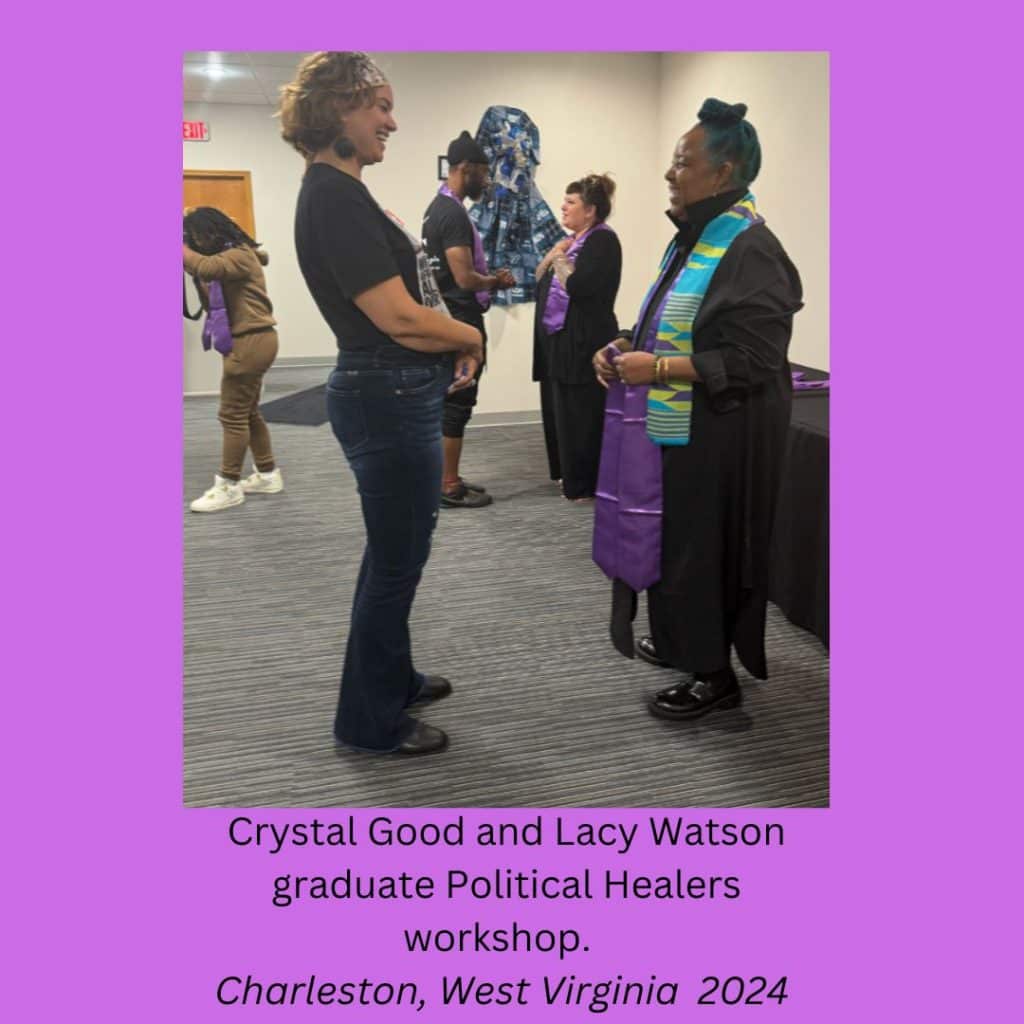
OPINION: How the Political Healers Framework Transformed My Approach

The Political Healers framework, introduced to me at a transformative event organized by Dr. Shanequa Smith and the Political Healers team in the summer of 2024, has reshaped my understanding of leadership. The framework is built around three key concepts: ritual, cultural trauma, and public memory. These elements have provided me with a new lens through which to view my work and life, ultimately guiding me toward a more sustainable and balanced approach to leadership—one rooted in feminine energy.
Ritual, in the context of Political Healers, isn’t about religious practice but about the collective actions that bind us as a community. Storytelling, shared meals, healing circles—these moments of connection ground us in our humanity. They remind us of our interdependence and the strength that comes from collective care. For me, ritual has become about creating space for reflection and renewal, both in my personal life and in the work I do with Black By God (BBG).
Cultural trauma is another essential element. As a Black Appalachian, I’ve lived the reality of generational trauma—one shaped by slavery, genocide, colonialism, and forced assimilation. These traumas continue to impact our communities, manifesting in every struggle we face, whether it’s climate justice, healthcare, or economic equity. Understanding cultural trauma helps me connect our fights for justice and equity, not as isolated issues but as interconnected struggles. This has shaped the way I approach advocacy and leadership. It’s no longer just about pushing forward but about healing the wounds that hold us back.
The final element, public memory, has perhaps had the most profound impact on my work. Public memory dictates how society remembers or erases certain people and events. For Black Appalachians to truly shape our future, we must be the ones to tell our stories. We cannot rely on politicians or corporate interests to narrate our history. This is where BBG’s mission comes in—to document, archive, and preserve the stories of Black West Virginians. We’re creating a lasting record of Black politics, culture, and leadership that will be accessible to future generations, ensuring our voices are heard long after social media pages disappear.
Before discovering the Political Healers framework, I had already spent years advocating for policies that support and impact Black communities—whether it was abortion rights, clean water, medical cannabis, or agricultural reform. I’ve worked as a lobbyist, a poet, and now as a publisher of Black By God. People often ask me about the difference between these roles, but they all rely on one core principle: communication. Whether it’s a poem, a bill, or a newspaper article, I’ve always used words to inspire change.
But as fulfilling as this work has been, it has also left me exhausted. Years of advocating for Black policy in a system resistant to change had drained me emotionally, intellectually, and physically. The demands of constantly fighting for marginalized communities, coupled with personal losses, left me feeling overwhelmed and burned out. It wasn’t until I encountered the principles of feminine leadership—introduced through Political Healers—that I began to see a different path.
Feminine leadership isn’t about doing it all. It’s about creating spaces where rest, reflection, and intentional planning are not just possible but prioritized. It’s about stepping away from the cycle of urgency and into a mindset where there is time to think, plan, and strategize with purpose. This shift has allowed me to take a more balanced approach to my work with BBG and my life as a whole.
I’ve also embraced the four pillars of feminine leadership: physical, intellectual, emotional, and spiritual. I’ve learned that rest is essential, not optional. Intellectually, I’m giving myself the time to think deeply and plan effectively. Emotionally, I’m acknowledging the weight of the work without letting it overwhelm me. Spiritually, I’ve reconnected with a higher purpose, which reminds me that I don’t have to carry everything on my own.
As I move forward, I am committed to leading on my terms—with balance, clarity, and intention. Thanks to the Political Healers framework and the support of Dr. Shanequa Smith and Katonya Hart, co-organizer of Black Policy Day, I’m forging a new path in leadership. It’s not always easy, but this time, I’m doing it with purpose and intention, guided by the values of healing and renewal.
VISIT: https://www.politicalhealers.org/
If you appreciate BBG's work, please support us with a contribution of whatever you can afford.
Support our stories
Author
Related Articles
David Fryson: Courageous leaders must resist anti-DEI policies (Opinion)
Former WVU VP for DEI David Fryson calls on university presidents and corporate executives to defend equity and inclusion against political attacks.
Why I protested Education Secretary Linda McMahon’s visit to West Virginia
Parent Sarah Harris responds to Education Secretary Linda McMahon’s Barboursville visit, calling for federal support for West Virginia public schools.