
The Dr. Cubert Smith Sculpture Trail

By Paula Kaufman
- Unity: Haddad Riverfront Park, 100 Kanawha Blvd E, Charleston
- Sound and Beyond: Yeager Airport, 100 Airport Rd, Charleston
- Burial Attendants: Criel Mound, 7th Avenue, South Charleston
- La Vista: Drain-Jordan Library, West Virginia State University
Total distance traveled: 19 miles (33 minutes) via I-64 and WV 114
Welcome. Step into the bold, quirky, surreal and unforgettable world of Dr. Cubert Smith. See some of the most iconic areas of the Kanawha Valley following a sculpture art trail. This is a terrific way to see the area.
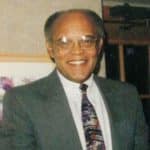
First, who was Dr. Cubert Smith? In plain words, he was a Renaissance man from St. Albans. He was ahead of his time. Globally-thinking. A community leader. Educator. Abstract sculptor. Husband. Father. His work is unapologetically bold. One-of-a-kind.
Here’s the thing: You can count on one hand, the number of abstract West Virginia-born sculpters. There are that few. Even less have public work. And even less, international collaborations. Dr. Smith could manipulate steel and bronze, sculpt wood, glass and marble. They called him the “one-man-show.”
Dr. Smith passed in 2018, but his legacy shines loud and large in the Kanawha Valley. In addition to being a Renaissance sculptor, Smith was an educator, city councilmember, and visionary.
Love them, dislike them, one thing is certain: when you see Dr. Smith’s work it will elicit an opinion. Likely a strong one. And that is the point of art, right? To make you think. Puzzle.
Over his lifetime, Dr. Smith created more than 200 works, including many paintings. Beyond the studio, he served on Charleston City Council, championing the arts and advocating for human rights. He was also a philosopher-thinker. In a 2016 public lecture, he reflected, “Some things occur on your journey that are bigger than you.” His work is—quite literally—bigger than us. And so was his global vision.
In 1980, Governor John D. Rockefeller IV recommended him for the prestigious American Academy in Rome. His honors also include Outstanding West Virginian and recognition as an Ambassador of Art for the State of West Virginia.
So follow the Dr. Cubert Smith trail—it’s worth the trip. His towering sculptures reflect sky-high ambition and fearless imagination. They’re a reminder that when vision meets determination, remarkable things rise from rock.
Dr. Smiths’ work reflects his commitment to bringing abstract sculpture into public and community spaces. Four of his well known works are:
- Unity: Haddad Riverfront Park, Charleston
- Sound and Beyond: Yeager Airport, Charleston
- Burial Attendants: South Charleston Burial Mound
- La Vista : West Virginia State University
A One-Day Abstract Pilgrimage
Haddad Riverfront Park – Charleston: Unity

Start along the Kanawha River. Here you’ll find Unity, Smith’s large abstract sculpture. Dr. Smith saw art as a universal language. Of course, he was right. The sculpture’s name is fitting. It was a collaboration with a Russian artist. This was controversial then. And now. Russia and America are not exactly considered best of friends.
Art exists in every culture. Collaboration is rarer. In a state where travel can be slow and flights limited, it is that much more striking that Dr. Cubert Smith took the extra steps to travel. And then, also, to bring students along the journey.
In the late 1950’s, few traveled abroad from West Virginia. But Smith did. His ambition refused to stop at the border. He studied at the University of Guanajuato in San Miguel, Mexico. Later, as a professor, he led students there.
Before one trip, a hesitant student asked what he would learn. Smith replied, “I can’t tell you what you’ll learn there. I can tell you you won’t come back the same. What you learn will be determined by how big the bucket of your soul is, and how you see it.”
Unity was created with Russian artist Vladimir Smirnov through Charleston’s Sister City Program with Korolev, where Dr. Smith served as director. The piece was installed in 1998. It is made from stainless steel, a study material. It symbolized long-lasting bonds. Timelessness. Endurance.
A plaque at its base presents the title in Russian and English. Each sculptor is credited in their native tongue.
You’ll notice that most of Smith’s pieces are public installations. His art is democratic–open to all. There is no financial barrier to access. There is no admission fee. No fences. No closing hours.
Yeager Airport: Sound and Beyond

Before or after a flight to Charleston, visitors encounter Sound and Beyond. Like all his pieces, it is bold. Abstract. The sculpture is fifteen-feet tall. It was created from sandblasted aluminum in 1989. It weighs over three thousand pounds. It curves and arches upward, mimicking an abstract aircraft. Flight. Motion. Smith didn’t want the aluminum to reflect sun, he wanted it to absorb the light.
The name pays homage to Chuck Yeager. He was the first pilot to exceed the speed of sound. Yeager was from Charleston and is for whom the airport is named.
Even the piece itself is in motion. It is only meant to be seen through the car window when driving past, not parked. If going specifically to see the sculpture, keep driving and the airport road will loop you back out to exit.
Sound and Beyond is a metaphor for Smith’s own improbable life trajectory. How an artist growing up on the poor side of town in St. Albans could rise to be an artist. And not any artist. A sculptor. One using some of the most expensive materials in the world.
Smith was also a prolific painter, though we know him for his public sculptures. In 2016, during “The Block, Speaker Series,” Smith gave a presentation called, “African American Life: A Personal Perspective.” One audience member asked if teams worked with Smith to make his enormous pieces. Smith said no, almost never. Due to lack of funds he made almost everything solo. Extraordinary, considering his work’s epic size. He worked on his pieces on their side. Only this way, could he manage their heft. He then hired cranes to move them.
During his 2016 speech, Smith remarked, “I know there is an opening somewhere in the cosmos where my mind and soul may soar and in a moment achieve oneness.” This sculpture seems to personify exactly that: oneness.
South Charleston Mound: Burial Attendants
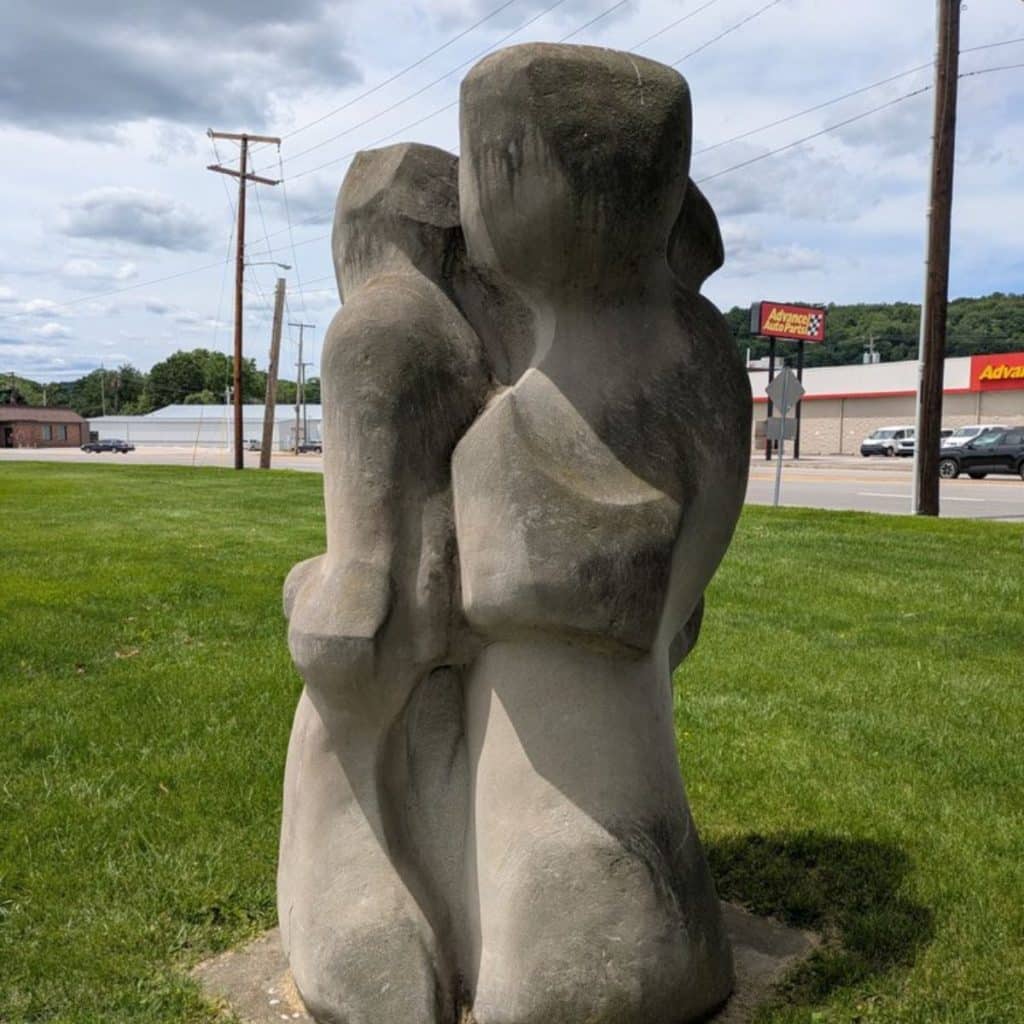
One of Smith’s most powerful pieces is also likely the most overlooked. Why? Because its 8 ½ foot height is overshadowed by what it stands beside: a 2000-year-old, 35-foot-tall Adena burial mound, created by the Mound Builders. They were Indigenous peoples once living in the Kanawha Valley. Burial Attendants (1979) pays homage to that history.
It depicts three abstracted, connected figures. They move in a ritualistic dance, or hug. They watch over the South Charleston Mound. Also known as the Criel Mound, thirteen Indigenous peoples were buried there along with ritual belongings before excavation. It is located in downtown South Charleston. It is now preserved as a public park.
Tragically, this is one of the few of the recorded 424 burial mounds remaining in West Virginia. Dr. Cubert Smith’s sculpture is a celebration. It is also a nod to tragedy. Solidarity mixed with sorrow. It is a painful twinning and symbology. Slavery and Indigenous genocide are America’s two original sins. In both cases, Black and Indigenous lives were seen as expendable. Bones and graves of Black and Indigenous ancestors have similarly been treated with contempt and disregard. Disrupted, uprooted, walked upon. The Burial Attendants are comforting figures. Witnesses. They say, “we see.”
Burial Attendants forever watches over this sacred earth. To protect. Bear witness. It shows the power of art to heal. To reclaim. Burial Attendance contains added symbolism because it was chiseled from local stone. Six tons of limestone, from the 12 ton piece, were carved out of rock along Route 60.
Before heading on to your next destination, explore the South Charleston international food scene. Some of the Valley’s best restaurants are located here. Fortify yourself and continue along on your WV sculpture adventure.
West Virginia State University: “La Vista”
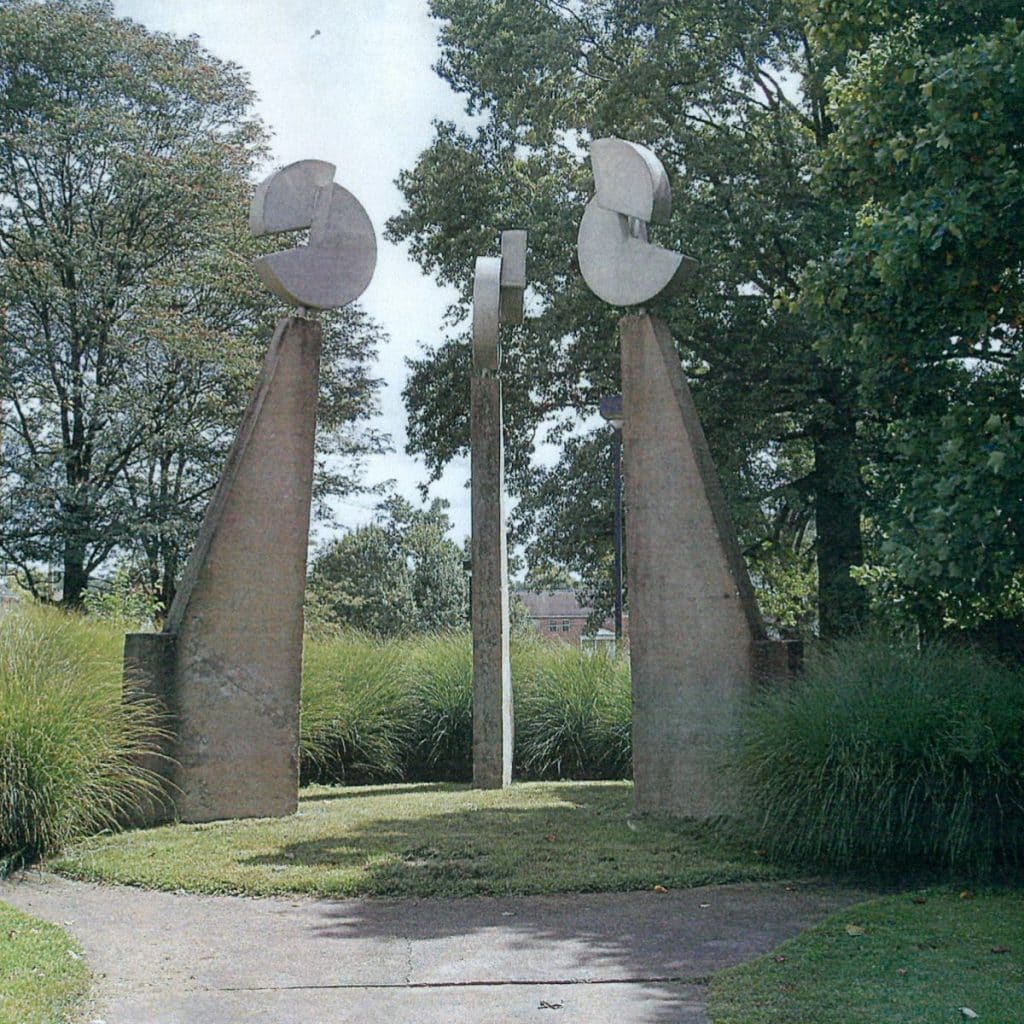
The next stop on your journey takes you to West Virginia State University, where you can see Dr. Smith’s La Vista. It is located beside the Drain-Jordan Library.
Dr. Cubert Smith graduated from WVSU in 1960. He returned as an Associate Professor and Chair of the Art Department for 20 years. Smith was a multi-disciplinary artist. He used materials from plexi-glass to wood. He began as a 2D artist.
The art bug landed early. As a youth he sold beer and pop bottles. He used the money to purchase his first set of oil paints.
One of his earlier paintings was of Jesus, and showed the face and hands in an abstract, cubist style. To describe his style he once said in a WV Archives and History public lecture, “I didn’t want to copy nature, I wanted to take it in, dissect it and put it in my mind and in my soul so that it was nothing that had been created before.”
La Vista achieves just that. It is singular. The piece was erected in 1986 on the occasion of the 30th anniversary of integration at WVSU. “La Vista” is Spanish, or French, for “The Vision.” He made the work with the help of five art students.
This work features three 22-foot high sections. Each has a concrete base and a four-foot aluminum circular disk at the top. Each section weighs four tons. A third of each disk is out of place. Askance. According to Smith in the Block Speaker Lecture, the disks are purposefully incomplete. Here’s why: even though laws required equality, this did not heal the human heart. It is each individual’s responsibility to overcome racism. Only we can do that. The work continues.
“Everything is in threes,” Dr. Smith explained on the university website, “Each step is a decade. Society is also moving toward complete integration of women and the elderly. We still have a bit yet to do. You cannot mandate another man’s heart.”
While here be sure to say hello to another wonderful statue: the realist bronze Katherine Johnson sculpture. She was an extraordinary mathematician. So incredible that she was nicknamed “the human computer.” She was beautifully crafted by renowned area Black sculptor Frederick Hightower.
Parking note: A visitor’s parking lot, clearly marked, is available on the right-hand side of the road adjacent to Wallace Hall (a nine story building.) Visitors need to check in with Public Safety (Security) and receive a visitor’s parking pass. From Wallace/parking lot, the Drain-Jordan Library is approximately 50 yards southeast.
With that concludes your journey. Congratulations, you have seen some of our city’s most significant areas and landmarks through the lens of Dr. Cubert Smith’s art. What were your thoughts? If these sculptures made you think, Smith achieved his goals.
For BBG Travel & Tourism, art such as The Dr. Cubert Smith Sculpture Trail are destinations—places where visitors can connect with Black Appalachian history beyond guidebooks and postcards. If you’re building a West Virginia itinerary that includes culture, context, and community, this trail belongs on your list.
Want more places like this? Subscribe to the Black By God: The West Virginian Travel & Tourism newsletter for murals, landmarks, and stories worth stopping for across the state.
If you appreciate BBG's work, please support us with a contribution of whatever you can afford.
Support our stories
Related Articles
‘The Garden of Dooley’ – Remembering a WV Trailblazer
Explore the ‘Garden of Dooley’ mural by Tat Plug at Charleston’s YWCA, honoring civil rights leader and attorney Katherine ‘Kitty’ Dooley.
Martha’s Vineyard Honors Della Hardman Every Year. More West Virginians Should Know Her Name.
Charleston-born artist and educator Della Hardman taught at West Virginia State before building an enduring cultural legacy in Oak Bluffs.
A 150-foot jump and millions of views: ‘America’s Viral Bungee’ is located in West Virginia
Dubbed ‘America’s Viral Bungee,’ The Great Bungee Company in Harpers Ferry offers a 150-foot drop that turns regional tourism into viral content creation.