John Henry Days Festival: a broad celebration of a shared cultural icon, or a whitewashing of Black history?
By Matthew Young
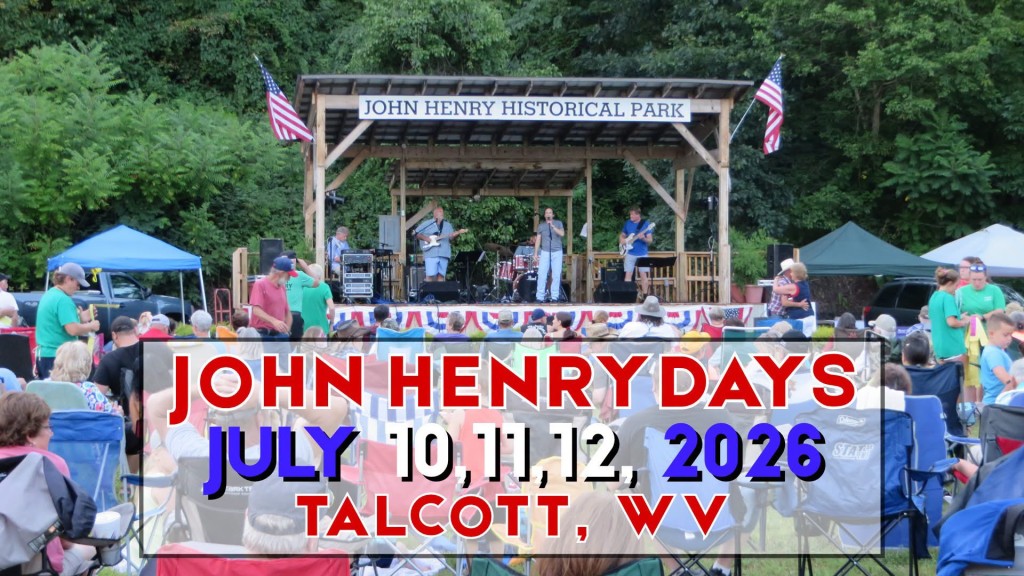
A long-overdue conversation took center stage on social media over the weekend; one which questioned the history and legacy of a rural, unincorporated community in the heart of Summers County.
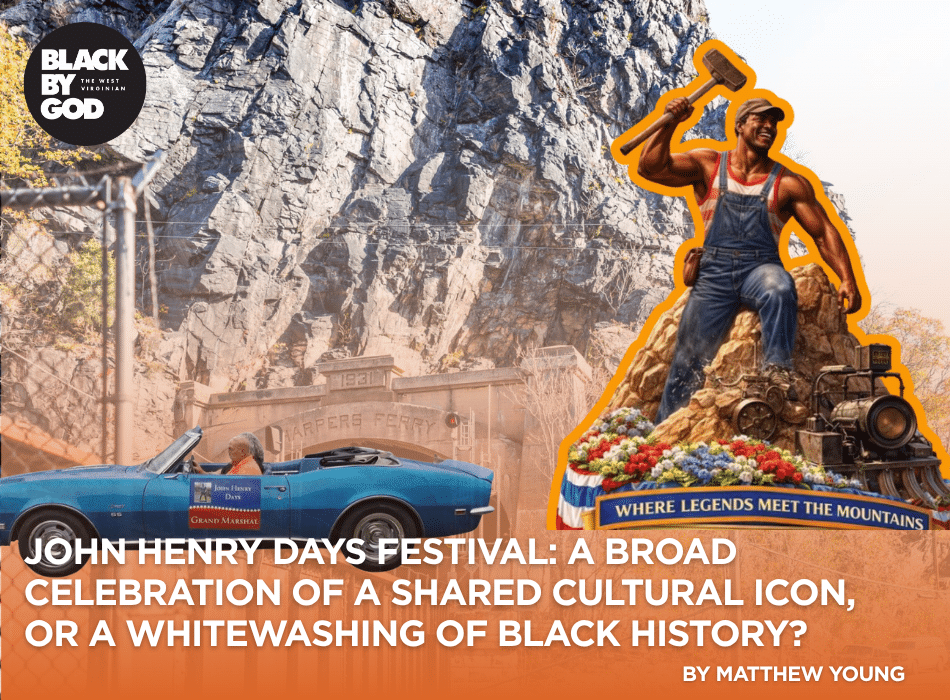
As it has since its conceptualization, John Henry Days – the annual festival which celebrates the legendary African-American steeldriver who bested a steam drill while working on the Great Bend Tunnel – took place over the second weekend of July outside that very same tunnel. And over the more than 150 years since the tunnel’s completion, the mythology of the Talcott icon has grown in both reach and fantasy.
The blurring of fact and fiction regarding the legend of John Henry can be attributed, at least in part, to the United States Postal Service (USPS). In July 1996, the USPS commissioned a 32-cent John Henry stamp as part of their “Folk Heroes” collection. The collection lumped the very-real steam drill-conquering Henry in with the likes of Pecos Bill and Paul Bunyon, thus paving the way for additional lore which has never been verified.
However, for the residents of Talcott – and the Mountain State as a whole – Henry is not simply a “folk hero.” His mythical defeat of the steam drill did happen, and has been confirmed by both historians, and those who were present when it occurred.
A conversation three decades in the making
Crystal Good, founder and publisher of BBG, on Saturday, approached the online community regarding a report she’d received which indicated that “no Black people” were in attendance at the John Henry Days festival. The replies to Good’s post on Facebook were both fast and frequent, with most claiming that reports of “no Black people” were inaccurate.
However, the conversation quickly turned from confirming the headcount of Black attendees, to a debate whether Talcott’s White population appropriated the Legend of John Henry, and are excluding Black West Virginians – be it intentionally or otherwise – from participation in the festival.
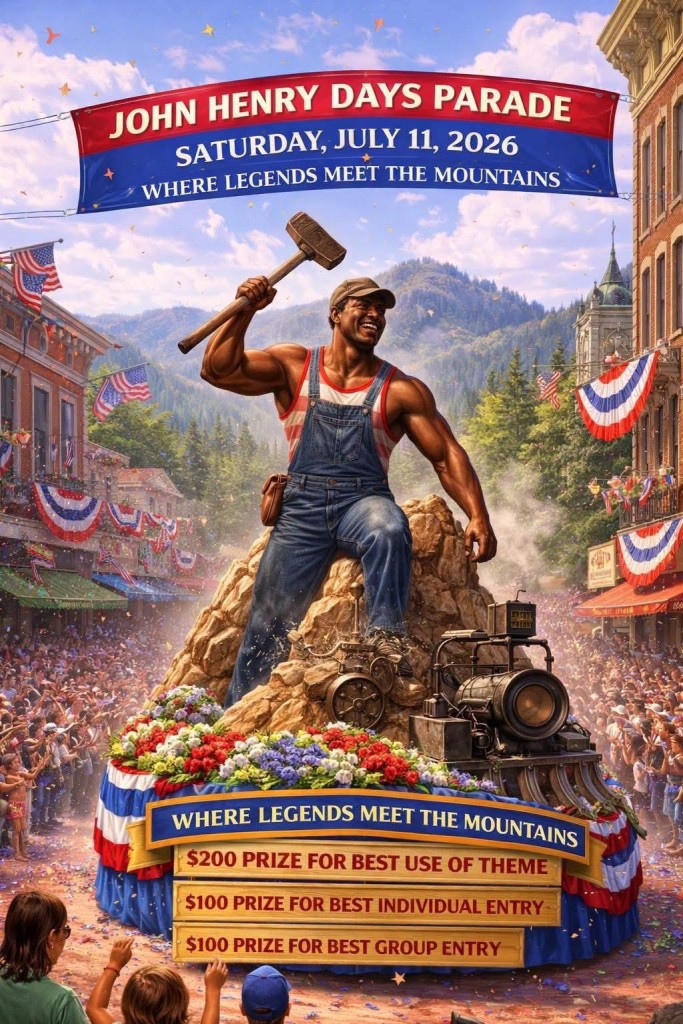
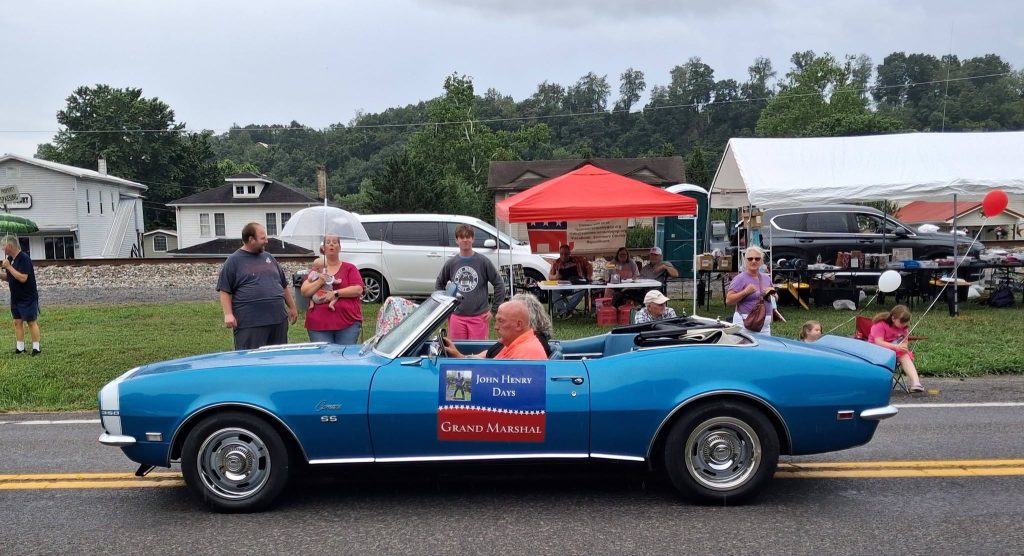
The identities of those instrumental in establishing the John Henry Days festival were also called into question. In response to Good’s post, Doris A. Fields stated that it was her friend, Ed Cabell (Folklorist and historian Edward J. Cabbell), who founded the festival before it was “basically taken away from him.”
“That’s when it became white centered,” Fields wrote. “I’ve never seen any Black performers advertised for this event. This is actually one of my WV pet peeves that I’m probably one of a few that would be concerned about it. West Virginia is great at being racist by omission!”
“West Virginia is great at being racist by omission!”
According to the now deceased Cabbell’s biographical information available through noteablefolkloristsofcolor.org, in 1973, while serving as a member of Concord College’s (now University) faculty, Cabbell “established the John Henry Memorial Foundation, which produced a blues record and photographic exhibit among its projects, [and] instituted the John Henry Awards to recognize individuals working to ensure minority inclusion.” It is further stated there that he “founded and directed an annual festival celebrating West Virginia’s African American folk hero, John Henry.”
Available records at WVU’s West Virginia and Regional History Center, both in physical and digital format, contains programs, brochures, and correspondence to and from Cabbell which identifies him as festival director. The records also contain documentation of the John Henry Center’s – parent company of the John Henry Festival – involvement in the 1982 World’s Fair in Knoxville, Tennessee, which directly contradicts the assertion that the festival was only first conceived in 1996.
The West Virginia Encyclopedia makes no mention of the original organizers. However, both Beckley-area television networks, WVVA-TV and WVNS-TV – as well as the official John Henry Park website – attribute the festival’s original founding to former Talcott Postmaster John “Bill” Dillon, in partnership with the volunteer John Henry Days Committee. All three sources once again place the establishment of the festival in 1996.
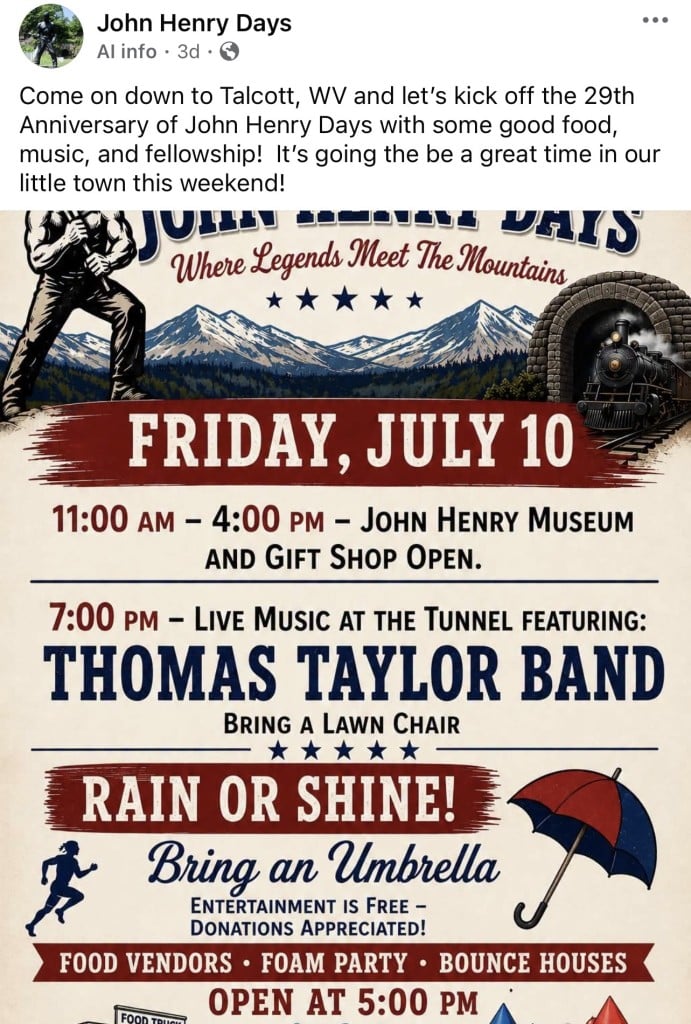
Despite contradictory claims and timelines regarding the creation of the festival, Field’s mention of the advertising options chosen by current festival planners seemingly leave no doubt as to the desired attendee pool..
Former West Virginia House of Delegates member Danielle Walker, D-Monongalia, joined the online discussion, inquiring about the individual responsible for the marketing of the festival, noting that “the invite was inclusive from some views, the reality is there was a barrier.”
Brehana Raekell noted her belief that “it’s almost like the organizers don’t want Black communities to attend.”
“The best they could come up with for last night’s entertainment was The Thomas Taylor (country music) Band comprised of six white men?” Raekell rhetorically asked. “Black representation at John Henry Days has to be better presented than the key figure being a formerly enslaved Black man who killed himself to prove his worth by outworking ‘the man.’”
How the John Henry Days festival was promoted
Summers County resident Abby Lee Smith, also in response to Good’s initial post, said, “Most people show up on Saturday but by the rare chance you did miss our people of color you should know the actual committee has several African American members who work hard all year round to bring an amazing celebration to our community and they never miss.”
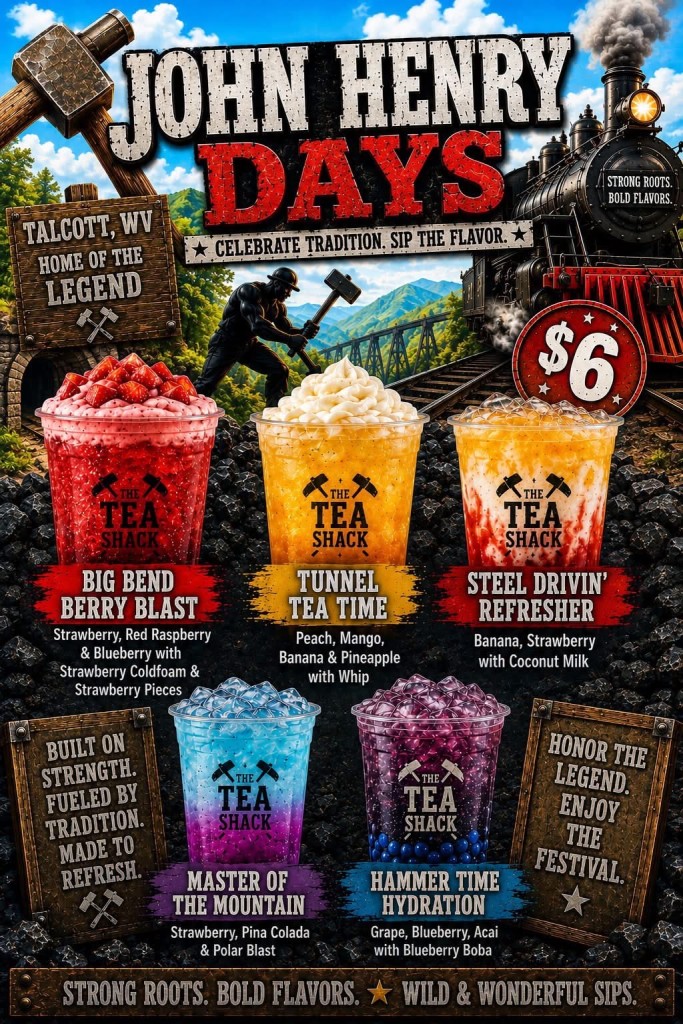
“Our community isn’t as populated with African Americans as it once was but we cherish the ones who remain and we all show up to celebrate together,” Smith added. “There is no room for judgement or assumptions of hate in our area.”
Smith’s reference to Talcott’s diminished Black population is accurate. Of the community’s 529 residents, only 5% – approximately 26 people – are Black. And while it appears the festival was marketed heavily in the Talcott area, as well as on both Beckley television stations, efforts to market the event to Black communities beyond the borders of Talcott and Beckley were seemingly nonexistent. As of 2024, there were approximately 6,500 Black residents in Beckley, who have been exposed to the same advertising effort year-after-year. Conversely, the City of Charleston is home to little over 4,500 Black residents, and have had no marketing or advertising for the festival directed toward them. And while the approximate 50 mile distance from Beckley to Talcott is considerably closer than the 120-or-so mile distance from Charleston, multi-day festivals are typically also viewed as economic drivers for local shopping, restaurants, and hotels, making Charleston a seemingly logical advertising option.
Colson Whitehead and Facebook’s impact on community journalism
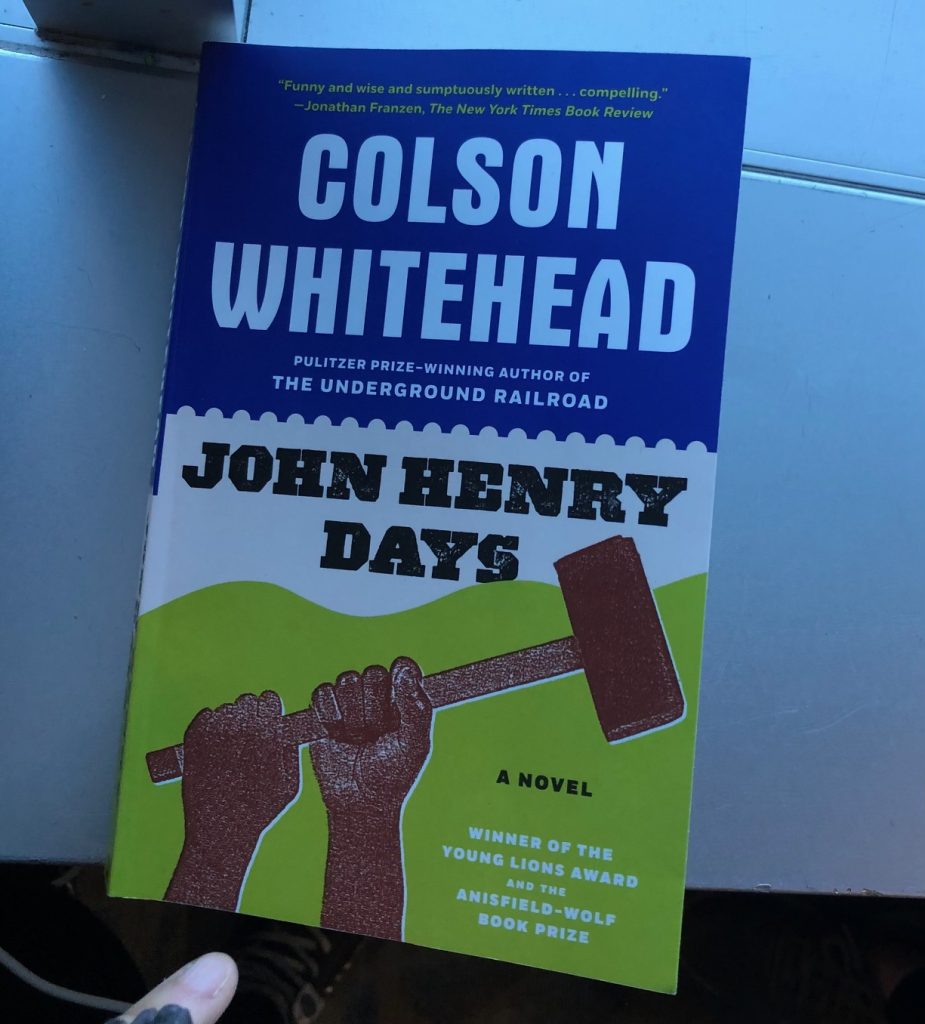
In 2001, Pulitzer Prize-winning novelist Colson Whitehead released his book, “John Henry Days,” to rave reviews, including his first Pulitzer Prize shortlisting. In the book, Whitehead delivers a fictionalized retelling of the first John Henry Days Festival in 1997, in which the main protagonist learns that the myth of John Henry is more important to modern culture than the actual man ever was, and his folk hero status is used to diminish the reality of his martyrdom within the Black community. In a sadly poetic foreshadowing of real world future events, the protagonist of Whitehead’s story is, himself, a journalist.
More than 100 Talcott residents, as well as West Virginians throughout the state, engaged with Saturday’s conversation, and the number continues to grow, demonstrating that community journalism requires combined with that level of social media engagement can be of great value. And while openly and honestly discussing the decisions made throughout our history as a state and a nation is frequently unpleasant, the realities of our communities’ past and present must not be ignored.
While people of good conscience may disagree on the legacy, the indisputable facts can be the starting point. The legend of John Henry tells us that he challenged an industrial machine to a physical contest in the hopes that he would save the jobs of his coworkers in the Talcott community; and the myth suggests that he gave his life in that effort. Nowhere in either the legend or the myth does it tell us the skin color of every man whose job he saved.
If you appreciate BBG's work, please support us with a contribution of whatever you can afford.
Support our stories
Related Articles
Black Farmers in West Virginia Nearly Disappeared. This Is How Some Are Bringing the Land Back
From 504 Black-owned farms a century ago to just 31 today: Black By God examines how Black West Virginians are reclaiming farmland, legacy, and food systems.