
Students, Win $250 to Tell the Story of 200 Years of the Black Press. Enter by Nov. 20.
Students in K-12 and college can win $250 in the Woodson Lyceum’s free 2027 Black History essay and poster contests on 200 years of the Black press. Enter by Nov. 20.
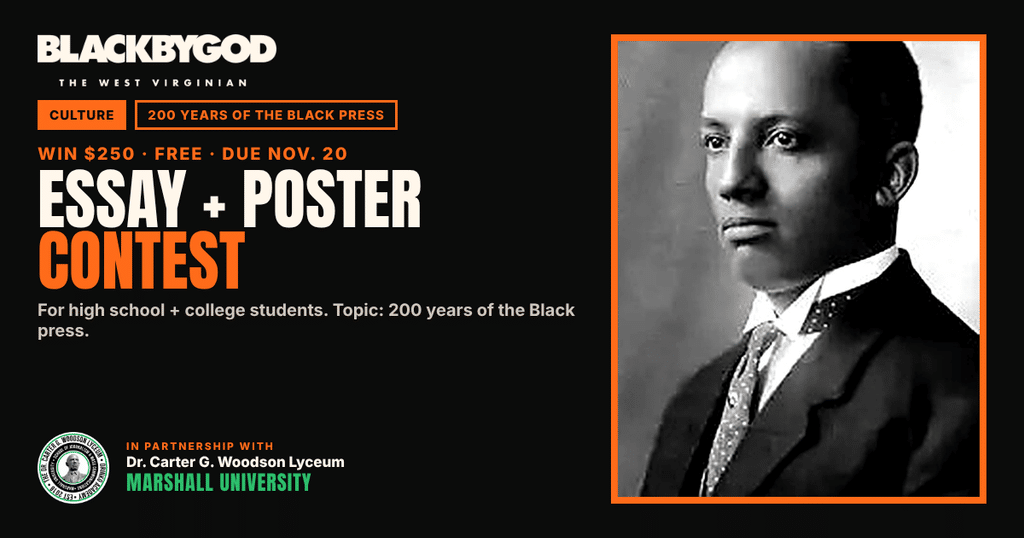
The Woodson Lyceum’s free 2027 Black History essay and poster contests are open to West Virginia students from elementary school through college. The winning poster becomes the official Black History poster. Entries are due 5 p.m. Nov. 20.
By Black By God Staff
In 2027, the Black press turns 200. West Virginia students can help tell that story, and win $250 doing it.
The Dr. Carter G. Woodson Lyceum at Marshall University has opened its 2027 Black History Essay and Poster Contests. They’re free to enter. Essays are open to grades 10–12 and college. Posters are open to every grade, elementary through college. Entries are due 5 p.m. Nov. 20.
The theme is “Celebrating the Bicentennial of America’s Black Press, 1827–2027: From Black Print Culture to Digital Blackness.” First place in each contest wins $250, and the winning poster becomes the Lyceum’s official Black History poster.
This contest carries a West Virginia legacy. Dr. Carter G. Woodson, a former coal miner and Huntington high school principal, celebrated 100 years of the Black press in 1927. At Black By God, we are a Black press in West Virginia working in that same line. Our publisher, Crystal Good, chairs the essay competition this year.
Enter here: College essays · Grades 10–12 essays
Quick facts
- Essay contest: Grades 10–12 and college
- Poster contest: Elementary, middle, high school and college
- Deadline: 5 p.m., Nov. 20, 2026
- Prize: $250 to the first-place student. Essay winners’ teachers receive $150.
- Cost: Free
Why this matters to us
America’s first Black newspaper, Freedom’s Journal, began publishing in 1827. One hundred years later, Woodson marked that anniversary.
Woodson worked in West Virginia’s coal mines as a young man. He graduated from Huntington’s Douglass High School in 1896 and later returned as its principal. In 1926, he launched Negro History Week, the forerunner of Black History Month.
He said the Black press made it work. “The unusual success was due in the first place to the warmhearted support of the press,” he wrote in 1928. He went on to write hundreds of columns for Black newspapers himself.
After that first Negro History Week, one teacher wrote to him: “The celebration improved my children a hundred percent. I wish we could have Negro History Week throughout the year.”
That is still the work. Today the Black press lives in print, on websites, in podcasts and on our phones. It also faces new questions about artificial intelligence and who gets to tell our stories. This year’s theme asks students to take all of that on. We can’t wait to read and see what they make.
Write an essay
The essay contest is open to high school students in grades 10, 11 and 12, and to college students.
- 1,000 words or more, in a Microsoft Word file
- 12-point Times New Roman, double-spaced, 1-inch margins, numbered pages
- Your name and grade at the top left of each page
- File name in this style: Lastname_BlackHistoryEssay_2026
- A separate page labeled “STATEMENT,” at least 100 words, on what you learned
- A signed consent form, scanned and attached as page 1
Judges look at how well the essay expresses the theme, its organization and argument, grammar and spelling, and the quality of the research. Citations are encouraged.
Enter here: College essays · Grades 10–12 essays
Make a poster
The poster contest is open to elementary, middle, high school and college students, one entry per student.
Posters should be 11 x 14 inches. Use any media: digital tools, paint, markers, collage, photography, letterpress, silkscreen, stitching or a mix. Scan or photograph hand-made work to submit it.
Each poster needs a statement of at least 100 words describing your research, what you learned and your design choices.
Judges score the theme, the statement, social impact, visual impact and originality. If you use generative AI at any stage, you must say how and cite it, following Marshall’s AI policy.
The first-place poster becomes the Woodson Lyceum’s official Black History poster, reproduced and shared with the public. Winners are expected to attend the awards program.
Enter here: K-12 posters · College posters
Before you submit
Students 18 and older, or a parent or guardian for younger students, must sign the consent form. Students may enter both contests.
Woodson believed the Black press and our schools could carry Black history together. We still believe that.
Follow Black By God’s year-long series marking 200 Years of the Black Press at blackbygod.org.
If you appreciate BBG's work, please support us with a contribution of whatever you can afford.
Support our stories
Related Articles
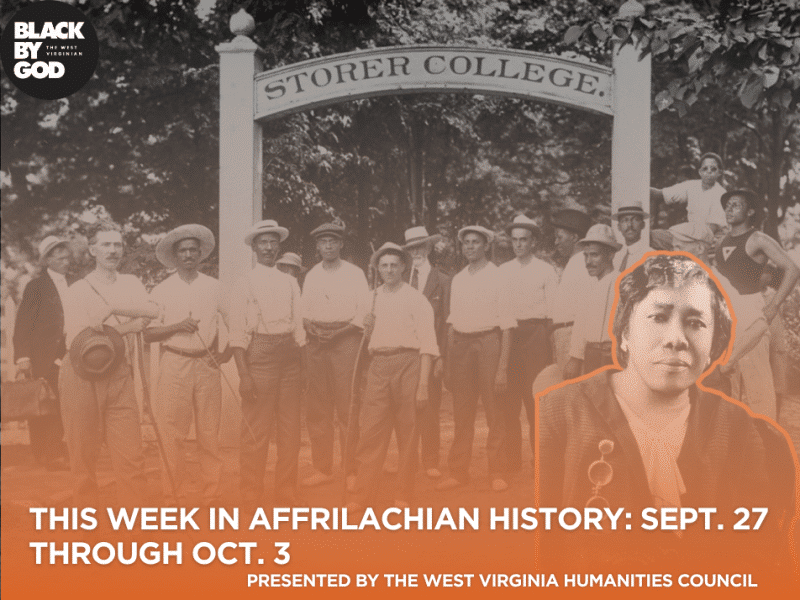
This week in Affrilachian history: Sept. 27 through Oct. 3
Discover key milestones in Affrilachian history: educator Fannie Cobb Carter’s birth and the founding of integrated Storer College in Harpers Ferry.
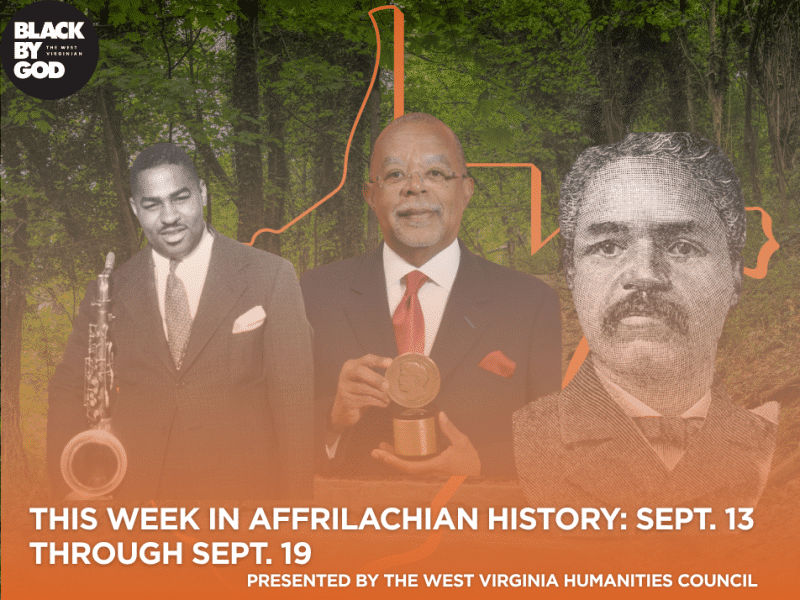
This week in Affrilachian history: Sept. 13 through Sept. 19
Discover key mid-September milestones in Affrilachian history: pioneer lawyer J. R. Clifford, jazz legend Chu Berry, and scholar Henry Louis Gates Jr.
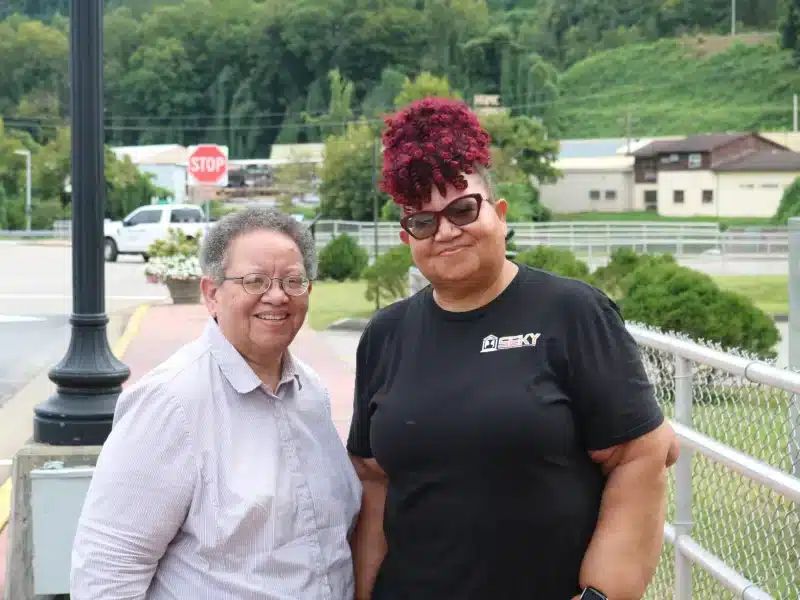
Eastern KY artists celebrate America’s 250, Black history with ‘pursuit of liberty’ quilt
The Southeast Kentucky African American Museum unveils its ‘Pursuit of Liberty’ community quilt project in Hazard, honoring Black history and Appalachian roots.