
Court Watch: New Supreme Court tool sheds light on rising county jail bills
Uncover why county jail bills are surging in West Virginia: Sara Whitaker analyzes how high cash bail, court dashboards, and legislative mandates drive pretrial incarceration.
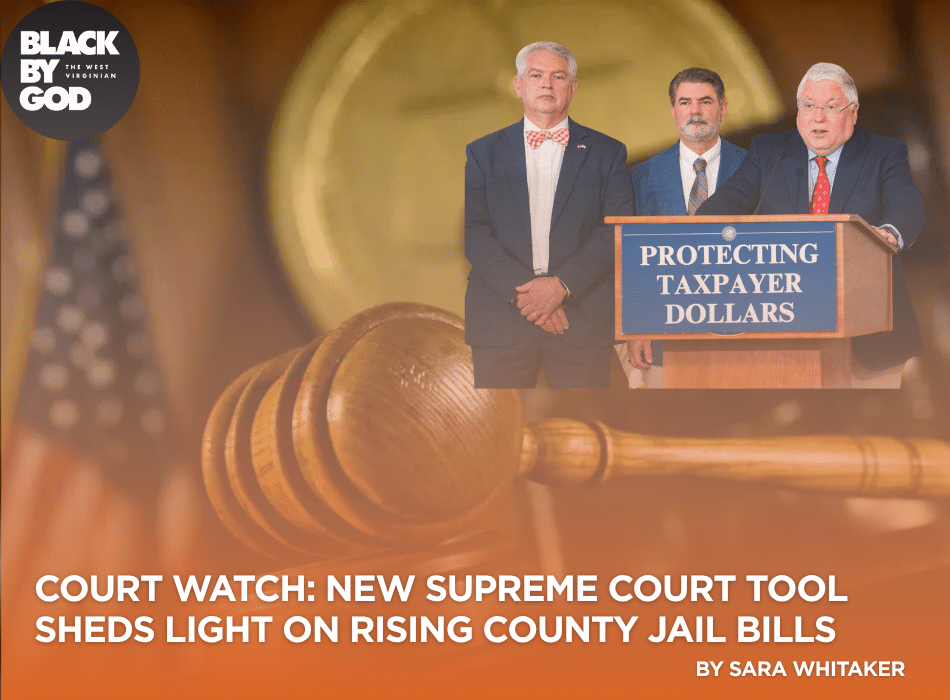
By Sara Whitaker, WV Center on Budget & Policy
Counties are “pushing the panic button” over their jail bills. Over the last several months, county officials have gone on the record to describe how skyrocketing jail bills have forced them to cut necessary services, freeze opioid settlement grants for prevention programs, and delay infrastructure projects. County task forces are popping up around the state, often focused on who pays the jail bill.
But a new tool from the West Virginia Supreme Court may shift the focus to the underlying cause of why the jail bills continue to grow. On July 1, the court launched an online, interactive dashboard with aggregated statistics from circuit courts around the state.[1]
Circuit courts handle (mostly) felony criminal cases – that is, offenses that carry a possible sentence of more than one year in prison. Felonies cover a range of crimes, from acts of violence (e.g., unlawful assault) to property offenses (e.g., destruction of property) to drug possession charges.
Felonies are also the key to reducing county jail bills.
When a county detains a person who has not been convicted, the county pays the state a daily rate for the cost of that pretrial incarceration. On any given day, most people in West Virginia jails (55.9 percent) were in a pretrial status – legally innocent but unable to afford the bail amount that was set. Four out of five of those people (79.3 percent) face a felony offense.
Felony cases take an average of 255.2 days to resolve, compared to just 165.7 days for misdemeanors. Thus, the people most likely to be detained pretrial – people accused of felonies – are also likely to spend more time waiting for their case to resolve.
Counties that want to reduce jail usage must focus on felony charges.
This is where the new court dashboard is instructive. For the first time ever, the public can see real-time data on the amount of bail set in felony criminal cases.
In Fiscal Year 2025, the average bail amount set in state circuit courts was $35,046.57. Then in Fiscal Year 2026, the average bail amount increased by 10.8 percent to $38,823.76. In both years, courts used personal recognizance bonds in less than one in seven cases. Instead, 85 percent of the time, the court required the bail amount paid in cash, property, or through a bail bondsmen.

This article was researched and prepared by Sara Whitaker, senior criminal legal policy analyst with the West Virginia Center on Budget & Policy. Prior to joining the Center, Sara spent nine years in the Kanawha County Public Defender’s Office, where she had the privilege to represent, and learn from, hundreds of West Virginians accused in state court. A native of Los Angeles, Sara has a bachelor’s and law degree from Northwestern University. Email Sara.
For more information, visit wvpolicy.org.
This cost may not seem like much to the circuit court judges who set these bail amounts. They receive an annual salary of $138,600. (And thanks to a West Virginia Senate bill passed this year, that salary will increase by $10,000 over the next two years.)
But most people charged with a felony in West Virginia – roughly nine in 10 – are deemed too poor to afford an attorney and therefore qualify for court-appointed representation.[2] To qualify for a court-appointed lawyer, an accused person in a household of three people must earn less than $27,150 per year.
The average bail amount set by circuit court judges routinely exceeds the annual income of nearly every person charged with a felony offense. If freedom depended on posting a bail that exceeded a year of earnings, most of us would find ourselves awaiting trial from a regional jail.
It is notable that half of the time, courts have required a surety bond posted by a bail bondsmen – those third party agents who post some part of the bond in exchange for a non-refundable payment from the accused person (or their loved ones). As of July 15, there were 128 licensed bail bondsmen across the state.
When people can afford their bonds, these 128 businesses cannot make money.
Over the last few years, there have been multiple legislative proposals to limit pretrial freedom and to increase bail amounts (see here, here, here, here, here, here, here, etc.).
In 2026, the legislature passed House Bill 4606, compelling magistrates to set a money bond in a wide swath of cases. Increasing the number of people required to post a money bond will increase the number of accused people who will be forced to turn to bail bondsmen for their freedom. In a Judiciary committee debate on the bill, one senator responded to concerns about pretrial detention with, “That’s how bondsmen make their money.” (Senate Judiciary hearing, timestamp 4:12:20).
Not every person will have the luxury of paying a bail bondsman for their release, which means more people will be sent to jail on the county dime. The new law, which went into effect in June, will not hit counties’ wallets until the current fiscal year.
We have already seen the effects of higher bail amounts. In Fiscal Year 2025, counties were billed a total of 953,632 days for their jail usage (51,741 more days than the previous year). In FY 2026, counties continued to use the jail even more – for a total of 972,283 days.
While higher bail amounts correlate with more pretrial detention, there is no evidence that warehousing people in overcrowded jails makes us safer. It is certainly not safer for the 15 people who died in jail awaiting trial in the last year. And despite the rhetoric, fair pretrial release policies do not threaten community safety. (For more evidence-based bail analysis, visit here.)
Which is why an independent audit touted by Governor Morrisey’s office recommended West Virginia courts reduce the use of cash bail – a policy which could result in a 25 percent reduction in pretrial detention.
The purpose of bail is to ensure that people go to their court hearings and comply with the law while awaiting trial. Bail is not intended to be a punishment.
But it has clearly become one. And one disproportionately suffered by Black West Virginians. Black households in the state have $13,000 less income annually than white households and Black people have lower home ownership rates than white people (47.5 percent vs 75.3 percent).
When a person’s freedom depends on the cash or property they can access, Black West Virginians will be disproportionately harmed. Last year, Black people made up 12.0 percent of the regional jail population, despite representing only 3.9 percent of the state’s population. Meanwhile, all of West Virginia’s 80 circuit court judges are white.
Some elected officials believe the answer to rising costs is to find new dollars to pour into a $600 million jail and prison system. This carceral system has already pulled money away from educating children, feeding families, providing child care, and any number of additional needs.
But there is increasing chatter about allowing counties to implement a sales tax to offset their jail bills. They would rather add to their constituents’ already-heavy financial burdens than take a hard look at bail setting practices.
It’s time to set aside profit-motivated myths about bail and safety, and act urgently to reduce harmful, unnecessary, and costly pretrial detention.
- The Supreme Court cautions that the interactive dashboards contain “near–real-time data” but “[b]ecause this data is preliminary and subject to revision, it may not reflect final or official statistics.”
- Data regarding percentage of people charged in West Virginia who qualify for court-appointed counsel, provided to author by Dana Eddy, Executive Director of Public Defender Services.
If you appreciate BBG's work, please support us with a contribution of whatever you can afford.
Support our stories
Related Articles
David Fryson: Courageous leaders must resist anti-DEI policies (Opinion)
Former WVU VP for DEI David Fryson calls on university presidents and corporate executives to defend equity and inclusion against political attacks.