WV house committee advances bill that would limit opportunity for low-Income students
House Bill 4587 would prohibit state funds, including student aid, from going to “low-earning” degree programs.
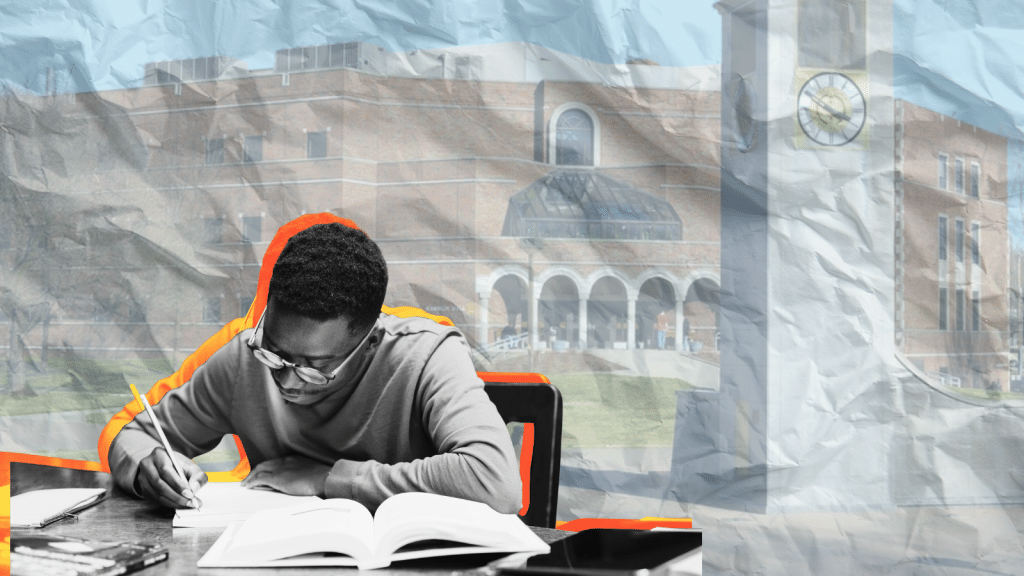
CHARLESTON- Yesterday, the House Education Committee held a hearing on a bill that would prohibit “public funds from supporting low-earning outcome postsecondary degree programs.” HB 4587 would prohibit any state funds, including financial aid, instructional funding, grants and facilities funding from going directly or indirectly towards “low-earning degree programs.”
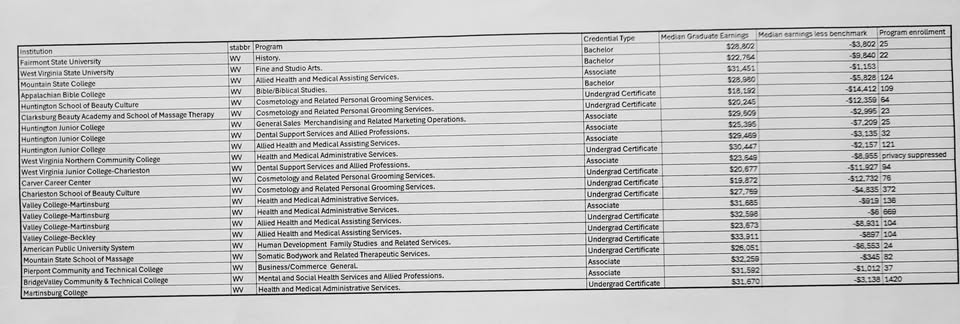
The bill also comes with a list of 22 “low-earning” programs at 18 colleges, technical schools and beauty schools. That list includes several cosmetology programs, Fairmont State University’s history program, West Virginia State University’s fine and studio arts program and several health-related programs at community colleges.
If HB 4587 becomes law, students in these programs would become ineligible to receive state funding. A collective 3,663 students are currently enrolled in impacted programs.
The bill’s funding restrictions would also apply to West Virginia’s merit-based Promise Scholarship and Higher Education Grant, aimed at low-income students. The programs provide students with $5,500 and $3,400 of aid per year, respectively.
We’ll bring the best from BBG right to your inbox. You can easily unsubscribe at any time.
Sign Up for our Newsletters!
The bill’s sponsor, Del. Adam Burkhammer, R-Lewis, argued that HB 4587 would ensure that the state gets a good “return on investment” with its financial aid programs.
“We’ve done a lot in this body, and we’re continuing to do a lot, to build a workforce out into the future,” Burkhammer said. “And I think this is another prudent step in ensuring that when we’re making those investments as a government, that it has return on investment for those students.”
HB 4587 ties its definition of low-earning programs to provisions in the One Big Beautiful Bill Act (OBBBA), signed by President Donald Trump on July 4, 2025. OBBBA established the “Do No Harm” standard, which would cut off federal student loan access for students attending postsecondary programs where graduates earn less than someone with only a high school diploma, four years after graduation. Full details on how “Do No Harm” will work are still being developed by the Department of Education.
Matt Turner, vice chancellor of the West Virginia Higher Education Policy Commission, pointed out that the changes to federal law only impacted federal student loans and not grants.
“That is limiting the amount of federal subsidized loans that you can take out toward a degree, not Pell Grant, and certainly not state financial aid,” Turner said.
He also emphasized that HB 4587 would go further than changes in federal law.
Multiple delegates raised concerns about the determination of a degree as “low-earning,” especially at the four-year post-graduation mark.
Del. Mike Pushkin, D- Kanawha, said it is unclear if the “low-earning” designation accounts for students going to graduate school, which is often unpaid, after completing their undergraduate degree.
Del. Anitra Hamilton, D- Monongalia, worried that, by denying state financial aid to certain students, HB 4587 would incentivize young West Virginians to leave the state. She provided the example of a student hoping to study cosmetology–which would be considered a “low-earning” program under HB 4587.
“I can get funding in another state, because I’ll get paid more, and it passes the threshold …” Hamilton said. “I might as well move there to get educated there and live there, since I’ll be making more, since West Virginia won’t support my education services.”
HB 4587 comes at a time when many state legislatures are trying to cut funding to “failing” programs, or programs that lawmakers do not feel provide a good enough “return on investment.” Similar bills have been introduced in Indiana, New Hampshire and Nebraska. Indiana introduced a bill that would not only deny these programs state funding, but end them entirely.
Preventing students in certain programs from receiving state aid will have a larger impact on low-income students that cannot afford to pay for their educations out-of-pocket. This will disproportionately affect Black students, 80.6 percent of whom receive some form of financial aid, compared to 70.4 percent of white students and 71.5 percent of all undergraduate students.
HB 4587 would be effective immediately on passage. It is unclear how current students would be impacted if this bill were to pass, or how a student would be impacted if their program were added to the low-earning list mid-program.
Burkhammer did not respond to a request for comment by the time of publication.
HB 4587 has been advanced to the markup and passage stage of the committee process. To become law it would have to pass the House of Delegates and Senate and be approved by the governor.
If you appreciate BBG's work, please support us with a contribution of whatever you can afford.
Support our stories
Author

Related Articles
Varian Cunningham: Carrying WVSU’s Homecoming Traditions Into the Next Generation
More than just a single football game, Homecoming is the sound of the step show, the energy of the tailgate, and the familiar faces returning to Institute year-after-year.
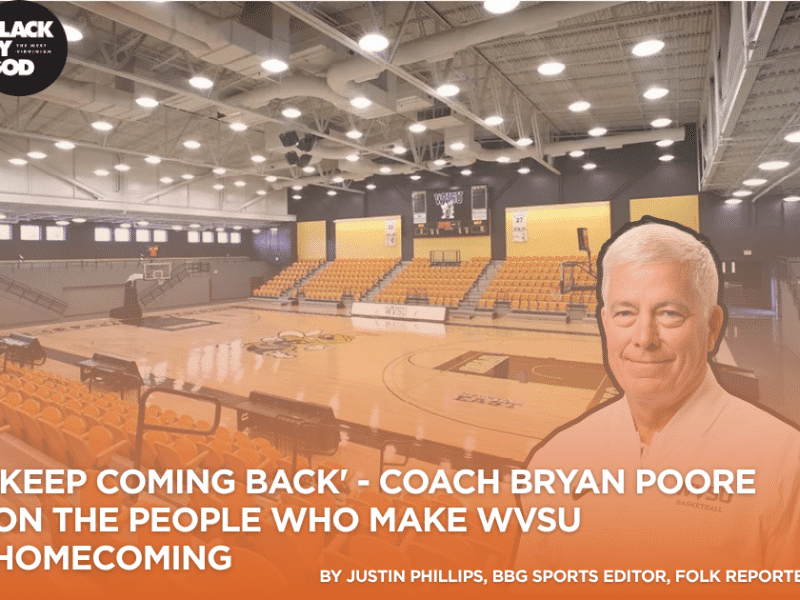
‘Keep Coming Back’ – Coach Bryan Poore on the People Who Make WVSU Homecoming
The longtime West Virginia State University basketball coach reflects on early-arriving motor homes, the step show, former players, Earl Lloyd and the relationships that keep Yellow Jackets coming home.

Coming Back to the Yard: Why WVSU Homecoming is Bigger Than Football
Trey Jones says Homecoming lives in the memories, rituals and people who keep Yellow Jackets returning to State.