Katherine Johnson’s Math Touched the Moon
By Paula Kaufman
Black WV Arts Map Project
Location: West Virginia State University (WVSU) campus
Artist: Frederick Hightower (Black West Virginian)
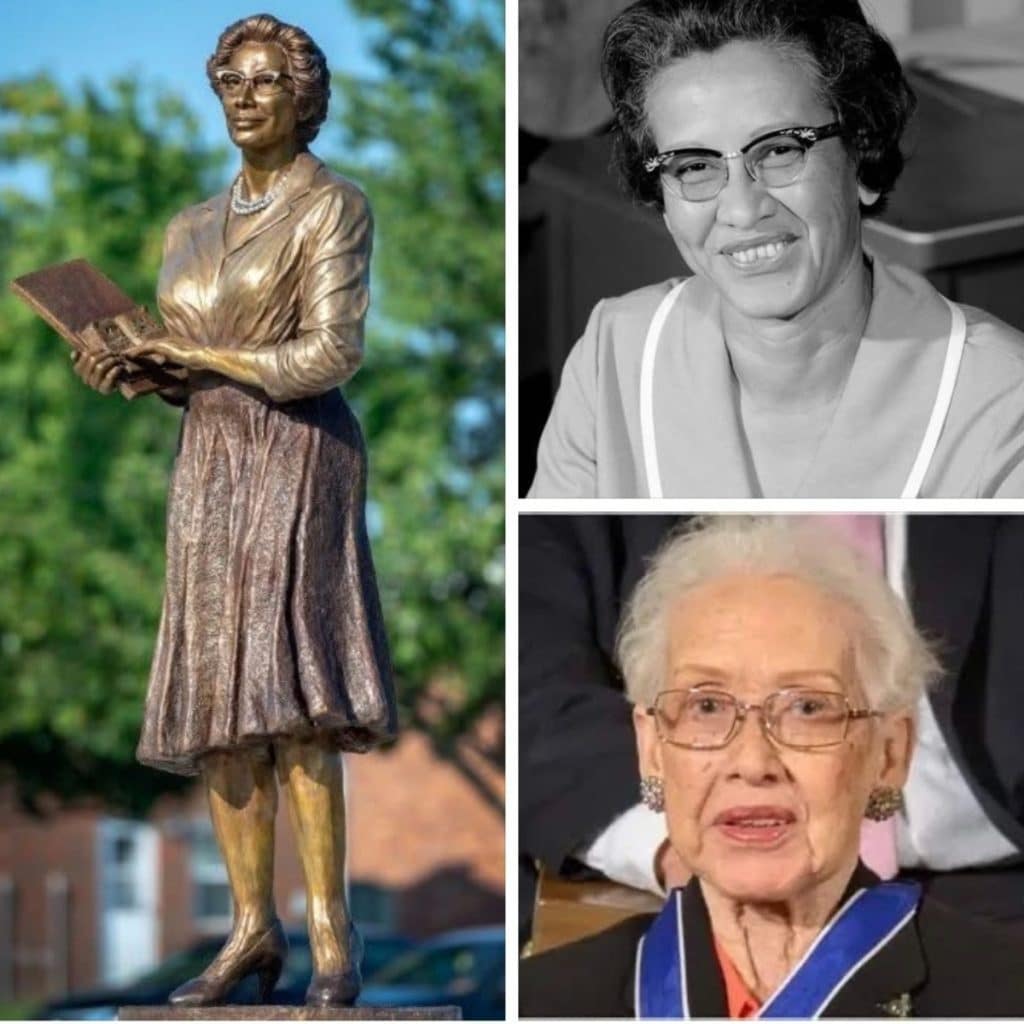
Did you know a Black West Virginian helped win the space race and cement the United States as a world super power? Her name was Katherine Johnson. She was an extraordinary mathematician and computer programer. And her story was nearly erased. Fortunately she was able to see a life-size bronze statue erected in her honor, and witness her story become a book and major motion picture, Hidden Figures. She also received the Presidential Medal of Freedom. She died just five years later, at age 101.
Ms. Johnson is worth a photo-op. Her statue is on the WVSU campus. She stands in the quad area between the Cole Complex and Dawson Hall. This plaza was created especially in her honor.
Born in 1918, she grew up under segregation. Her school only went to eighth grade. But Katherine wanted to keep learning, so traveled from her home in White Sulphur Springs to WVSU each day (it also had a high school then.) That’s 100 miles. You read that right. One hundred miles roundtrip.
Johnson was a math prodigy. She graduated high school at 13. At 14? She started college. She double majored in mathematics and French. In the 1930s, fewer than 5% of American women of any race earned college degrees.
After her studies she married, had three children and joined NASA. It was the 1950’s. She was called a “human computer,” before the era of computers. She solved complex calculations guiding pilots and rockets by hand along with many other Black women.
When electronic computers arrived, Johnson was so good, she was asked to double check their results. In 1962, astronaut John Glenn refused to launch aboard Friendship 7 until she confirmed the computer’s numbers.
Johnson worked on Project Mercury and the Apollo program. Mercury put Americans into orbit. Apollo put them on the Moon.
But this wasn’t just science. It was geopolitics, too. The US was in a Cold War contest with the USSR. The Space Race was about dominance—technological power, military strength, global prestige. Johnson’s math helped make America rise above competing nations.
For decades, few outside NASA knew her name. That changed in 2016 with the book Hidden Figures by Margot Lee Shetterly and the film, starring Taraji P. Henson. The nation finally recognized her.
Johnson’s story reminds us how vital it is for historians—and everyday people—to preserve stories. Out of curiosity, one person happened to do research and write a book uncovering Johnson’s story. This shows the power of one to amplify a buried history. It is only because of this that we know Johnson’s name. Thankfully, she will not be forgotten.
A bit of WVSU history: WVSU is West Virginia’s only HBCU—Historically Black College or University. There are roughly 100 HBCUs in the US. They continue to play a vital role in advancing educational excellence, leadership, and cultural achievement.
Johnson’s statue was crafted by renowned West Virginia sculptor and Black artist, Frederick Hightower. He is one of the few artists in the state who specializes in life-sized bronze sculptures. If you liked Johnson’s sculpture, take a trip down to Beckley to see Bill Withers strumming a guitar–another one of Hightower’s masterpieces.
Other art on the WVSU campus includes the Earl Lloyd Statue– honoring the WVSU alumnus and NBA pioneer, located inside the Walker Convocation Center on Campus. As well as the sculpture La Vista (“The Vision”) by Dr. Cubert Smith, a West Virginia native and Black artist.
Parking note: A visitor’s parking lot, clearly marked, is available on the right-hand side of the road adjacent to Wallace Hall (a nine story building.) Visitors must check in with Public Safety (security) and receive a visitor’s parking pass.
For BBG Travel & Tourism, statues like Katherine Johnson are destinations—places where visitors can connect with Black Appalachian history beyond guidebooks and postcards. If you’re building a West Virginia itinerary that includes culture, context, and community, this stop belongs on your list.
Want more places like this? Subscribe to the Black By God: The West Virginian Travel & Tourism newsletter for murals, landmarks, and stories worth stopping for across the state.
If you appreciate BBG's work, please support us with a contribution of whatever you can afford.
Support our stories