
Who Gets to Imagine West Virginia? Black Faith, Creative Resistance, and the Future of Home
The intersection of faith and culture
By Rev. Donte’ L. Jackson
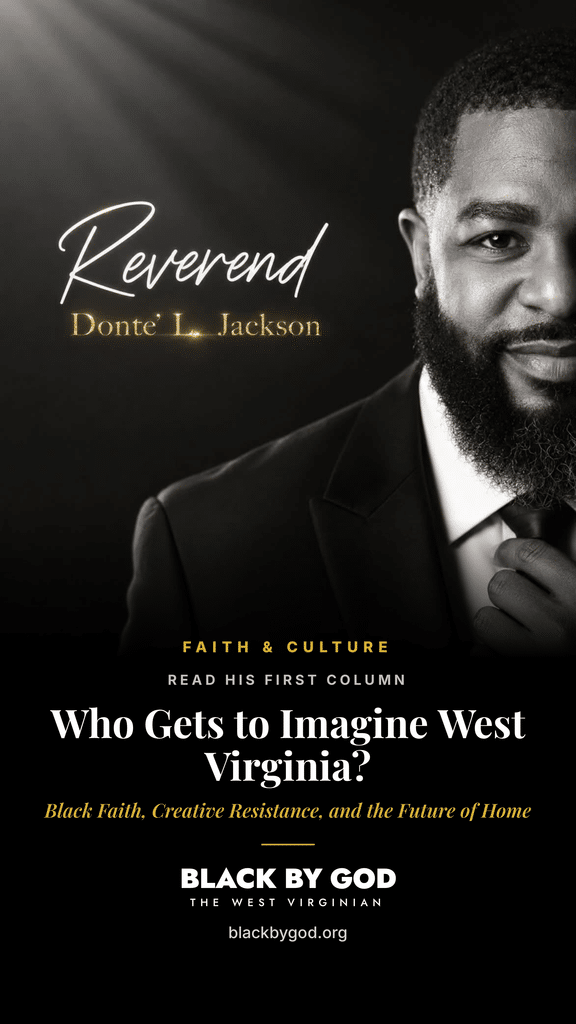
I was born and raised in Rand, West Virginia.
For me, West Virginia has never simply been a place on a map. It is home. It is where I discovered music, learned the language of faith, found community, and first began imagining what my life could become.
As a young musician, I had the privilege of growing up under the direction of Dr. Ethel Caffie-Austin, a West Virginia gospel legend whose influence reached far beyond music. Under her leadership, I saw what it looked like for someone with extraordinary gifts that was from West Virginia use them for West Virginia. “West Virginia is a calling…” She would often say to me…
We’ll bring the best from BBG right to your inbox. You can easily unsubscribe at any time.
Sign Up for our Newsletters!
I also watched someone who could have taken those gifts anywhere remain deeply connected to home.
That left an impression on me.
As a young person, I imagined following in her footsteps in a sense. I always envisioned staying in West Virginia and making a difference here. I dreamed of creating something that would draw people to West Virginia, not just so people would experience the giftedness of its people, but to make meaningful connections with them.
I imagined a place where faith, gospel music, Black excellence, creativity, and community could flourish together.
Then life took me somewhere else.
As my ministry developed, another city began calling me. While it wasn’t what I had planned when I was a young drummer playing behind choirs and in Churches in Rand, but sometimes mission and vocation takes us places we didn’t expect to go.
I left West Virginia in 2018.
And leaving taught me something about home:
You can leave a place without leaving it behind.
“I imagined a place where faith, gospel music, Black exellence, creaivity, and community could flourish together.”
– Rev. Donte’ L. Jackson
A people in motion
Black West Virginians have always been a people in motion. Some came here looking for work and opportunity. Some built families, churches, businesses, and communities and stayed. Others eventually left for opportunities elsewhere. Some returned. Some never did.
Black preachers were part of that movement.
Mordecai Wyatt Johnson came to Charleston and served as Pastor of First Baptist Church before eventually leaving West Virginia to become the first Black president of Howard University. His story reminds us that movement does not necessarily erase connection.
When Black people leave West Virginia, what do we carry with us, and what do we leave behind?
We carry the music, the preaching, the faith, the resilience, the imagination, and the people.
We carry the lessons learned in sanctuaries and kitchens. We carry the sound of choirs, the wisdom of elders, the stories of communities, and the determination of people who learned how to make something significant out of what most would consider limited resources.
And sometimes, after leaving, we begin to understand home differently. We realize that the place that formed us can continue to shape us, even when we’re miles away.
We are still here
What we can’t ignore is that West Virginia is changing. Communities and what we loved about them have experienced loss of people, population, and maybe even promise. Anchor institutions that Black communities depended on have changed. Young people often leave in search of educational, professional, and economic opportunities elsewhere.
But that is not the whole story.
There is another story happening at the same time.
Black West Virginians are still creating
Artists are telling stories. Musicians are making music. Photographers are documenting people and places. Entrepreneurs are building businesses. Writers are reclaiming history. Young people are finding new ways to tell an old story.
The question, then, is not simply what West Virginia has lost.
It is also:
“Artists are telling stories. Musicians are making music. Photographers are documenting people and places. Entrepreneurs are building businesses. Writers are reclaiming history. Young people are finding new ways to tell an old story.”
– Rev. Donte’ L. Jackson
What can we create?
That question matters because creativity is not merely entertainment. For communities, creativity can become a way of remembering, resisting, gathering, imagining, and building. When people tell their own stories, they also make claims about who belongs and what the future can look like.
What Does Faith Do With a Changing Place?
Jeremiah 29 tells God’s people to seek the welfare of the city where they have been sent.
Build. Pray. Plant. Contribute.
Nehemiah looks at a broken Jerusalem in chapter 2 of the book ascribed to his name and says, “Let us rise up and build.”
Maybe that is also a word for West Virginia.
Real faith does not require us to pretend that home hasn’t changed. Genuine, and authentic faith invites us to ask what faithfulness looks like in changing times.
What if our churches, artists, entrepreneurs, educators, musicians, and young people connected their gifts to imagine something new together?
What if we stopped asking only how to preserve what we had and started asking what we could build from what we have now?
The Black church has historically been more than a place of worship. It has been a place where people learned, organized, encouraged one another, raised leaders, preserved memory, and imagined possibilities. That legacy gives today’s church a responsibility. We may not solve every problem, but we could participate in the flourishing of the communities around it. A heralded preaching voice of the ages that I love to listen to says it like this: “The way to the solution of your own problems is to lose yourself in the problems of others.” – Rev. Dr. William A. Jones
“The Black church has historically been more than a place of worship. It has been a place where people learned, organized, encouraged one another, raised leaders, preserved memory, and imagined possibilities.”
– Rev. Donte’ L. Jackson
What If We Built Here?
Not everyone has to stay.
I left.
Leaving can be faithful. Staying is faithful too.
The question is whether we can create a West Virginia where those who choose to stay can see a future worth building, and where those who leave can still find meaningful ways to invest in the place that formed them.
I keep coming back to this question…
What if we built here?
Perhaps home is not only the place we inherit.
Perhaps home can also be the place we help become.
Not because we can recreate the past, but because we can honor what shaped us while giving the next generation something new to inherit, imagine, and build.
About the author: Donte’ L. Jackson is a husband, father, preacher, and native West Virginian writing for Black by God; The West Virginian, on the intersection of Faith and Culture. His work seeks to spark honest conversations about how belief shapes everyday life, especially within Appalachian communities and the Black Church tradition.
If you appreciate BBG's work, please support us with a contribution of whatever you can afford.
Support our stories
Related Articles
Morgantown Celebrates Departing City Councilor Brian Butcher
The City Council also discussed the Greenmont Neighborhood Project, the upcoming Urban Bow Hunt, and a $4.6 million water project.
OP-ED: How we should actually spend that $276 million in Hope Scholarship funds
The solution to the education needs gap isn’t going to come from a scholarship that cannot serve all children in need.
