Planting A Legacy: Girl Scouts Put Down Roots At Mear Mae’s Meadow
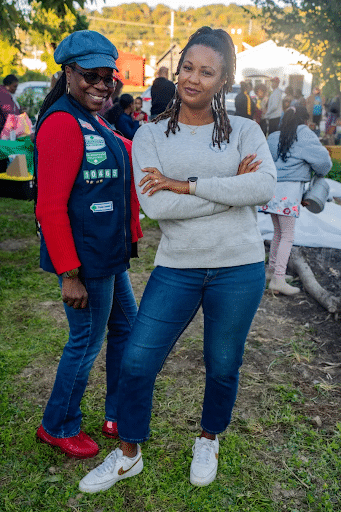
Dr. Octavia Cordon and Dr. ShaOn on an urban farm named for a grandmother from Charleston, she moved to Rand later in life. Dr. Octavia Cordon and Dr. Shanequa Smith’s Girl Scouts dedicated two apple trees and joined a gardening story that runs from Savannah to Nashville to the Kanawha Valleynequa Smith’s Girl Scouts dedicated two apple trees and joined a gardening story that runs from Savannah to Nashville to the Kanawha Valley
The visit
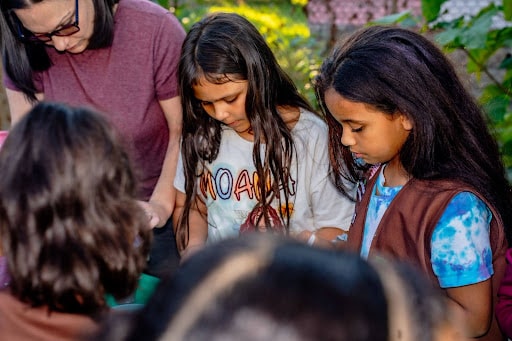
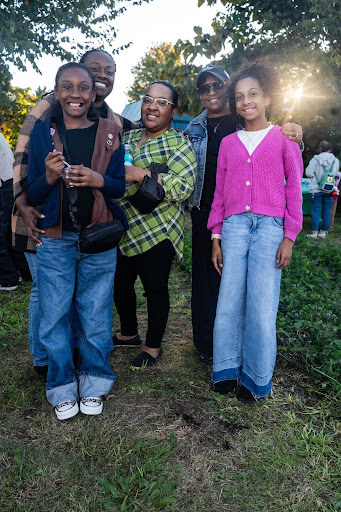
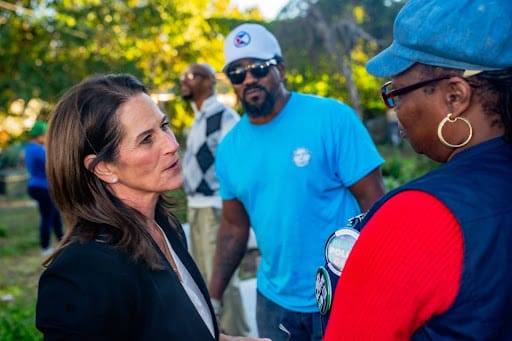
On Thursday, October 22, Troop Leader Dr. Shanequa Smith accompanied 17 girls from Charleston’s multi-level Girl Scout Troop 10465, including Daisies, Brownies, Juniors, and a Cadette, on a visit to Chamear Davis’s urban farm on Charleston’s West Side.
Davis had been getting ready all week. A few days before, she stopped by the USDA Service Center in the Keystone Professional Building, home to the Farm Service Agency, the Natural Resources Conservation Service and the Capitol Soil Conservation District. Dawn Lemle and the Capitol Conservation District crew loaded her up with resources, including a USDA coloring and activity book, Mighty Mini Microbe’s Tale: The Underground Adventures of Soil’s Superheroes. The girls, she wrote on Facebook, “are going to love this.”
Every Scout went home with a canvas tote stamped with the Meadow’s seal and “Est. 2024,” packed so the lesson could keep going at the kitchen table: the soil-microbe book, a container gardening guide, a Forest Food Wheel, a make-your-own edible soil layers activity, a children’s activity book on the spotted lanternfly, and a packet of seeds. Davis said she was grateful to send them home with souvenirs, resources and activities to share with their families.
The tree dedication
The girls planted two apple trees, one Granny Smith and one red apple variety, to encourage cross-pollination and help both trees produce fruit. The trees are planted on the northeast corner of the lot and are to establish a lifelong connection between the Girl Scout Troop and Mear Mae’s Meadow.
Girl Scout Tree Dedication:
With gentle hands and open hearts,
We give these trees a brand new start.
May your roots run deep and strong,
In this meadow where you belong.
May you blossom, grow, and bear sweet fruit,
As Girl Scout stewardship takes root!
Grow strong, little trees!
“I love that we as sisters got to do yet another activity together it shows that we could do so much more for the community as long as we do it together and having the new girls there made it so much better.”
– Troop 10465 alumna, now Troop volunteer
This isn’t the troop’s first garden trip. In August 2022, the girls visited the BTV Empowerment Garden at the invitation of Johnna Bailey, where they filled window boxes with soil and seedlings.
For Davis, the visit was the point of the whole project.
“Mear Mae’s Meadow is all about providing a space with in reach in where community members especially our youth can connect with the land and each other,” Chamear Davis said. “Having the Gril Scouts here planting trees is a literal dream come true!”
To understand why a few hours on a city lot matters, it helps to know how long Black girls have had to fight to be in the Girl Scout uniform at all.
Where the Girl Scouts began
The movement started in Savannah, Georgia, in March 1912, when Juliette Gordon Low gathered the first troop of 18 girls. She had been inspired by Robert Baden-Powell’s scouting work in Britain and wanted American girls to have the same chance to camp, learn skills and serve their communities.
On paper, Low’s organization was open to all girls. In practice, she worried that a firm national stance welcoming Black girls would drive Southern troops out, so she left the question to state and local councils. That decision meant that for decades, whether a Black girl could be a Girl Scout depended on where she lived.
Black girls who wouldn’t wait
Black girls were in the movement almost from the start. They were members of only the third troop formed in the country, in New Bedford, Massachusetts, in 1913, and the first all-Black troops were organized in 1917, most likely in the New York area.
The South was slower. The first chartered Black troop south of the Mason-Dixon Line, Bird Troop No. 34 in Richmond, Virginia, did not come until 1932.
In Nashville, Josephine Groves Holloway refused to accept no. She trained under Juliette Low herself in 1924 and began organizing girls at Nashville’s Bethlehem Center. When she asked the local council to register a troop for her daughters in 1933, it said no, citing the cost of separate facilities. So she ran unofficial troops anyway, recruited other Black women to start more, and kept petitioning. By 1942 there were so many Black troops that the council had to recognize them. Holloway became the council’s first Black professional staff member, and in 1955 she opened a camp for Black Girl Scouts that still bears her name.
By 1956, Girl Scouting was part of the early civil rights story. That year Dr. Martin Luther King Jr. called the organization “a force for desegregation.” In 1975, Dr. Gloria D. Scott became the first Black national president of the Girl Scouts of the USA.
Black Girl Scouts in West Virginia
West Virginia has its own chapter of this history, and much of it happened in and around Charleston.
In 1946, a Girl Scout troop at the West Virginia Schools for the Colored Deaf and Blind in Institute welcomed a remarkable visitor: Lady Baden-Powell, widow of the scouting movement’s founder. A photograph in the Black Diamond Girl Scout Council collection at the West Virginia State Archives shows her seated with a Scout on her lap, alongside troop leader Minnie Holly. The school, which opened in 1926 because the state had no place to educate Black deaf and blind children, closed in 1955 after integration.
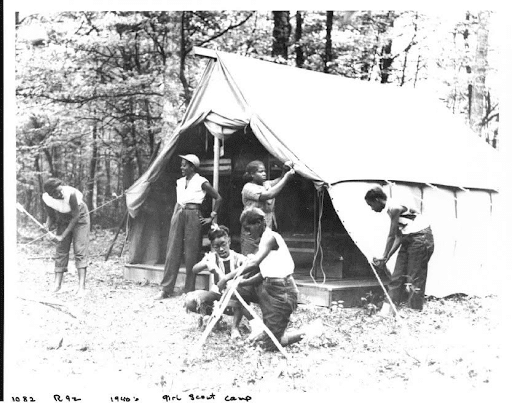
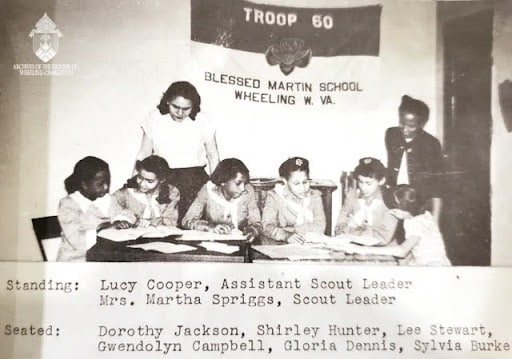
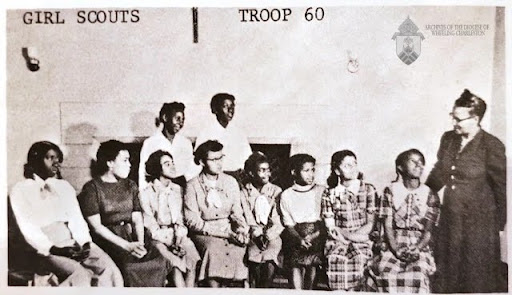
Charleston businesswoman and civil rights leader Elizabeth Harden Gilmore, the first woman licensed as a funeral director in Kanawha County, also fought for Black girls in scouting. In the early 1950s, around the same time she was pushing to integrate the state’s schools and public places, she got her Black troop admitted to Camp Anne Bailey near Lewisburg. Her Troop 230 is credited as the first Black troop to graduate from Girl Scouting in West Virginia.
In the coalfields, Memphis Tennessee Garrison carried the same work. The McDowell County teacher, who organized the Gary branch of the NAACP in 1921 and later served as a national NAACP vice president, moved to Huntington in 1952 and soon helped establish a Black Girl Scout troop there.
What Girl Scouts do
The council describes its mission as building girls of courage, confidence and character who make the world a better place. That happens through troop meetings, camping, service projects, the famous cookie sale (which began in 1917) and badges, earned by completing hands-on steps in everything from robotics to cooking to the outdoors.
Farms and gardens are a natural fit. Younger Scouts can earn gardening patches, and Juniors work toward a Gardener badge by planning and planting. The highest honor, the Gold Award, asks older Scouts to identify a community problem and lead a lasting solution.
Girl Scouts have always gardened
Gardening is nearly as old as Girl Scouting. When the United States entered World War I in 1917, Juliette Gordon Low asked her Scouts to volunteer in hospitals, sew for the Red Cross and grow vegetables. That year Girl Scouts dug a victory garden behind the DAR Hall in Washington, D.C. In 1918 a Scout named Helen Tew earned an award for conserving food, then wrote to Girl Scouts across the country urging them to grow and preserve their own.
They did it again in World War II. By 1944, about 20 million American families had planted victory gardens, growing roughly 40 percent of the country’s fresh fruits and vegetables, and Girl Scouts were part of the national push to get children digging.
Trees have their own place in the tradition. In 2021, Girl Scouts launched the Girl Scout Tree Promise, a pledge to plant 5 million trees by 2025. Troops often plant a tree around Founder’s Day, Oct. 31, Low’s birthday, which Girl Scouts have marked since 1920. The Meadow’s tree dedication came nine days before it.
The written record of Black Girl Scouts gardening in West Virginia is thinner.
Why Mear Mae’s Meadow
Davis named the Meadow for her grandmother, Mae Henri Thomas, who lived in Rand, as she told BBG in our AgriCULTURE Spotlight. On a single city lot, she grows microgreens that sell at Miss Ruby’s Corner Market on the West Side. Last fall she and her husband planted more than 260 garlic cloves by headlight, a story she told in her own BBG column, Beneath the Surface. She is a founding member of Black Girls Grow, part of the Afro-Lachian Food Network, and a mentor in the Food Systems Leadership Network. Her plan for the Meadow borrows from the high-value, small-footprint model she wrote about in Lessons from Farmer Cee.
That makes her rare. Only 31 of West Virginia’s 23,622 farms are Black-owned or operated, according to Civil Eats, down from roughly 500 a century ago. Most of the girls in Troop 10456 had likely never met a Black woman farmer, let alone one working land in their own city and named for her grandmother.
That is why this trip mattered. Josephine Holloway once said that integration lessened her girls’ exposure to examples of Black strength and pride. On a Charleston lot, a Black woman farmer showed a troop of Charleston girls exactly that: land can be ours, food can be ours, and the knowledge to grow it can be handed down.
“Mear Mae’s Meadow and Girl Scout Troop 10465 are building a more resilient community, planting proof that our roots run deepest when we grow together,” Davis added.
For more information about the history of Black Girl Scouts in West Virginia, or to find a Troop near you, the following sources have been cited in this article:
- Smithsonian: Girl Scouting Was Once Segregated
- Tennessee Encyclopedia: Josephine Groves Holloway
- The Contributor: A Growing Legacy (Camp Holloway)
- BET: This Day in Black History, March 12, 1917
- WV Archives: Deaf and blind Girl Scout troop, Institute, 1946
- WV Archives: Camp Maynor Day Camp photo
- NPS: West Virginia Schools for the Colored Deaf and Blind
- Wikipedia: Elizabeth Harden Gilmore
- Girl Scouts of Black Diamond Council
- Girl Scout History Project: WWI victory garden, DAR Hall, 1917
- Library of Congress: Helen Tew and Girl Scout gardens
- Iowa History: Girl Scouts planting a victory garden, 1943
- GSUSA: Juliette Gordon Low and the Three Keys
- City of Dubuque: Girl Scout Tree Promise proclamation
- National Women’s History Museum: Juliette Gordon Low (Founder’s Day)
- WV Folklife: Thomas Toliver interview
If you appreciate BBG's work, please support us with a contribution of whatever you can afford.
Support our stories
Author