
David Fryson: Courageous leaders must resist anti-DEI policies (Opinion)
Former WVU VP for DEI David Fryson calls on university presidents and corporate executives to defend equity and inclusion against political attacks.
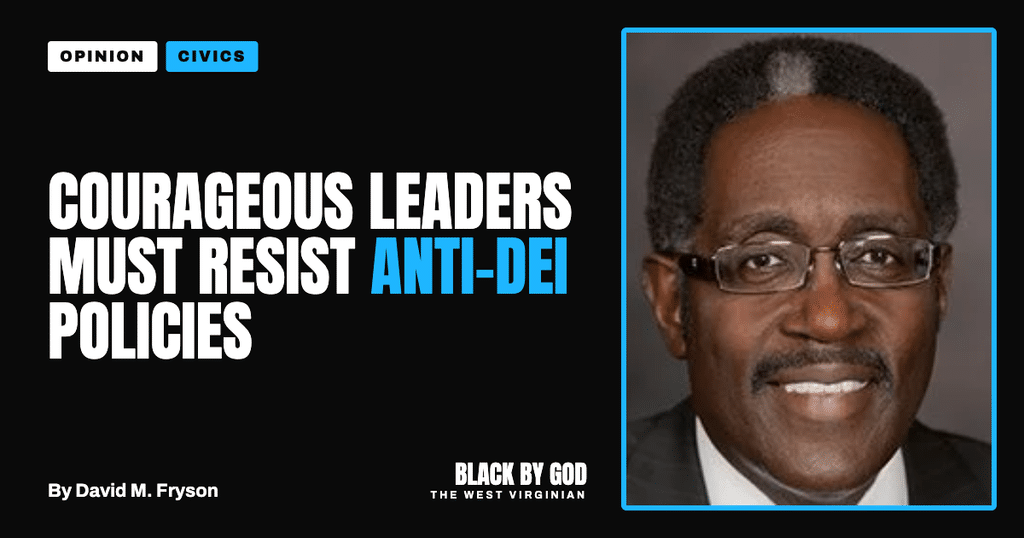
By David Fryson
This article was originally published by Charleston Gazette-Mail, a major, independent, award-winning news service based in Charleston.
University presidents and corporate executives stand at a critical historical juncture.
As federal policies under the Trump administration continue to target and dismantle diversity, equity and inclusion initiatives, institutional leaders face a choice between continuing the recent pattern of passive compliance or develop a principled resistance. Genuine leadership demands the courage to protect DEI — not only as a social justice imperative, but also as essential to institutional excellence, economic competitiveness and democratic stability.
Throughout my DEI career, I have been privileged to work with many university presidents and corporate leaders. Nearly all made informed decisions to support DEI as an institutional priority and source of pride. Yet, few have had the courage to defend equity and inclusion against the Trump administration’s unethical, unfounded and unsustainable claim that DEI is incompatible with meritocracy.
Stepping backward
In recent years, this wave of political pressure has forced an anxious retreat across corporate boardrooms and college campuses. Diversity, equity and inclusion principles once heralded as essential for progress, have been systematically dismantled, stripped from mission statements and abandoned under the threat of political blowback and funding cuts.
This regression is a failure of nerve rather than a triumph of meritocracy. Authentic leadership displays courage and, in this instance, acknowledges that diversity is an operational obligation, not an optional luxury. To regain their competitive edge, American businesses and higher education institutions must find the courage to reverse course.
When institutional leaders fail to fearlessly fight against the anti-DEI movement, they lose sight of why these initiatives existed in the first place. DEI was developed to optimize talent, foster innovation and accept the challenges of a changing world. By abandoning DEI, we are choosing to leave talent on the table and ignore the realities of a global economy. The consequences of this retreat are no longer hypothetical; we have blatant examples.
The damage done so far:
Consider the U.S. military. Under unqualified Defense Secretary Pete Hegseth, the Pentagon has aggressively eliminated diversity initiatives, dismantled DEI offices and blocked promotions for senior leaders within an institution long regarded as a cornerstone of equity in America.
The military’s anti-DEI strategy is presented as a return to pure “lethality” and merit, but the reality is far more troubling.
By challenging race-conscious admissions policies at service academies — even though the current conservative Supreme Court allowed them to stand — using alienating rhetoric, obstructing the advancement of highly qualified officers from diverse backgrounds and most recently terminating senior officers, the Trump administration is actively undermining military readiness.
A modern fighting force cannot operate effectively when its leaders neither understand nor represent the troops they command.
Trust, cohesion and recruitment — which depend on drawing personnel from every segment of American society — are being severely compromised.
Hegseth’s effort to replace DEI with a rigid, exclusionary monoculture will not strengthen the military; it will make it more fragile and alienate it from the population it protects. Although the safety of our troops is paramount, this troubling lack of leadership is made evident in our deeply flawed prosecution of the war in Iran.
Problems closer to home
A parallel failure is playing out at the state level in West Virginia. Upon taking office, Gov. Patrick Morrisey prioritized an aggressive crackdown on DEI, issuing sweeping executive orders and championing Senate Bill 474 to ban these programs across state agencies and public universities. Morrisey proudly declared DEI “dead in the Mountain State.”
The fallout of this ideological crusade is a state that continues to lag economically and socially. In an area that already faces severe population decline and a brain drain of young talent, signaling that diversity and inclusion is unwelcome is counterproductive.
Modern corporations looking to relocate or invest are looking for states with inclusive environments and dynamic, culturally competent workforces. By restricting classroom speech, dismantling university inclusion offices and stripping away basic equity guardrails, West Virginia’s leadership is driving away the exact demographic and economic investments needed to revitalize its economy. The anti-DEI blueprint does not generate growth, cohesion, or true merit. It generates division, stagnation and institutional weakness.
Higher education must remember its fundamental purpose. Universities are meant to prepare students for a diverse and complex world. Erasing diversity frameworks from curricula and student life does not protect students; it leaves them fundamentally unprepared to lead in a global workforce. Universities and businesses must recognize that short-term compliance to avoid political noise yields long-term mediocrity. Innovation thrives from diverse perspectives.
Leaders must push back now –
The current administration’s climate of racism, xenophobia, sexism and homophobia will eventually end, but the cowardice of university leaders and corporate executives will leave a lasting stain. Retreating from DEI for fear of partisan litigation or public-relations backlash is a shortsighted strategy that threatens long-term institutional health. Restoring DEI practices, even under different names, will require the courage to resist political posturing and defend the proven value of an inclusive culture.
Equity is essential to meritocracy, just as inclusion is essential to readiness. Now is the time to step forward, rebuild what has been dismantled by this shortsighted administration, and boldly pursue a more equitable and competitive future.
David M. Fryson is a retired lawyer and former VP of DEI at WVU. He serves as senior pastor of the New First Baptist Church of Kanawha City. As a national DEI consultant since 2021, he has served in interim vice-presidential roles at Brandeis University, Quinnipiac University and SUNY Plattsburgh NY.
If you appreciate BBG's work, please support us with a contribution of whatever you can afford.
Support our stories
Related Articles

Why I protested Education Secretary Linda McMahon’s visit to West Virginia
Parent Sarah Harris responds to Education Secretary Linda McMahon’s Barboursville visit, calling for federal support for West Virginia public schools.

Solar energy is building a resilient future for West Virginia
For nearly two centuries, working-class people have built West Virginia’s economy as a coal-producing powerhouse. So why do we pay for some of the most unaffordable electricity in the country?