
Solar power, climate resilience and the new civil rights movement, part two
Resilience and the sector
In this three-part series, reported with support from The Ohio River Valley Participatory Fund, BBG’s Abraham Mwaura explores the damage that decades of neglecting the now-crumbling utility infrastructure has done to Charleston’s West Side neighborhoods, and highlights those attempting to pick up the pieces.
Click HERE to catch up on Part One: The rupture and the sanctuary.
Resilience
“When our utility systems fail, having local on-site power is one foundational element to be able to ride through that kind of systemic failure or disaster with a little less pain and suffering,” says Autumn Long, Director of the Appalachian Solar Finance Fund.
Long is using her broad portfolio to spark a clean energy transition in Appalachia, working across state lines to foster innovation and financing of renewable energy technologies. She has worked with towns, local organizations and startup businesses in coal impacted regions to secure grants, technical assistance, and flexible financing to develop solar-plus-storage microgrids.
We’ll bring the best from BBG right to your inbox. You can easily unsubscribe at any time.
Sign Up for our Newsletters!
Long has spent years navigating the financial and structural barriers to renewable energy in coal country. The terrain is unforgiving. The West Side disaster shows how climate emergencies and breakdowns in infrastructure can have ripple effects into every aspect of community life.
“Power is only one part of the hierarchy of needs alongside water and shelter, but if you don’t have access to power, there’s a lot of things that are simply not possible,” she explains. An unpowered oxygen machine, or spoiled insulin quickly turn into life and death situations.
The neighborhood sits along the sprawling ‘Chemical Valley,’ in Charleston, WV along the banks of the Kanawha River. It is seen as an important artery for extracting wealth from Appalachia, and symbolic of an industry that has impacted the health and well being of many frontline communities and workers. These communities often experience the first and most severe consequences of environmental hazards, pollution, and climate change.
In the Chemical Valley, the boom and bust of the extraction and production of fossil fuels has cast a long shadow of pollution, frequent disasters, unemployment and failing infrastructure.
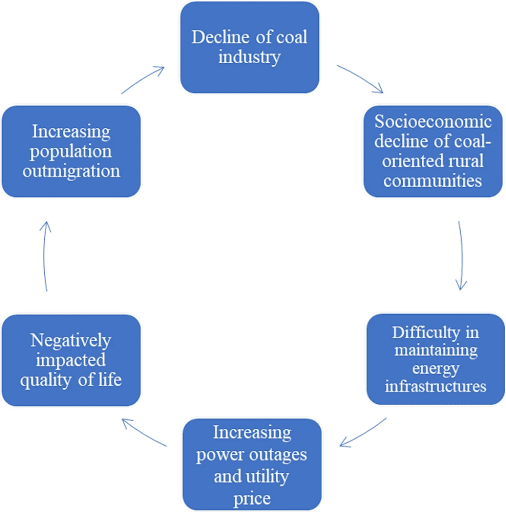
According to researchers from University of Tennessee, the heavy reliance coal production in West Virginia has led to a vicious cycle, with rising energy costs, poorer quality of life, increased outmigration, and substandard infrastructure. As individuals in coal communities get sicker, or are exposed to constant crises, they miss school and professional training, or lack the physical energy to work, creating a downward spiral into deepening poverty in coal producing areas.
Living in fenceline communities impacts health. Black Americans are five times more likely than average to end up in the ER due to an asthma attack from exposure to air pollution, and 15% of Black adults in West Virginia reported being diagnosed with asthma.
According to the US Centers for Disease Control and Prevention, almost 12% of residents suffer from COPD in Kanawha County, WV, the heart of Chemical Valley, far above the national average of 9%. Rates of heart disease, stroke and diabetes also tend to be higher in communities exposed to air pollution. State flood mapping also shows Kanawha County has the most number of buildings in the state in high-risk 100-year floodplains.
“Organizations on the West Side of Charleston are working in really difficult circumstances on a daily basis in the best of times. So when basic infrastructure fails, whether through a weather related event or whatever the cause, you’re very easily pushing people over the line,” says Long.
“Within that context, distributed on-site resilient power as a form of mutual aid is a way that communities can provide for each other and look out for their own residents in an unfortunate situation where the responsibility is not being addressed elsewhere in our governance structures.” Long argues that building resilience in Appalachian communities requires shifting from a reactive to a proactive form of energy mutual aid.
The West Side project already has one basic ingredient, community trust, without which even technically sound plans will fail. “It’s not just making the technology available, but making a plan ahead of time and identifying who’s in charge of what in terms of distributing resources.”
The neighborhood sits along the sprawling Chemical Valley, in Charleston, WV along the banks of the Kanawha River. It is seen as an important artery for extracting wealth from Appalachia, and symbolic of an industry that has impacted the health and well being of many frontline communities and workers. These communities often experience the first and most severe consequences of environmental hazards, pollution, and climate change.
With billions of dollars in funding earmarked at the time, many advocates believed that the Inflation Reduction Act of 2022 would transform the development of renewable energy projects and help build climate resilience in communities such as this. That changed with the new administration which has cut renewable energy programs.
The sunsetting of federal solar tax credits on December 31, 2027, means the Church has a deadline to beat. These incentives significantly reduce the cost of installing solar and other renewable energy systems.
“We could absolutely get the project constructed and placed into service before the solar tax credits sunset at the end of next year. It is an important milestone to meet because the project essentially becomes 40% more expensive if it doesn’t get done within that timeline,” said Long.
There are bottlenecks in the financing of clean energy both in the hallways in Congress as well as the lobbies of neighborhood banks.
“There’s also a lack of existing financial products available at local lending institutions that people know and work with and trust that would allow them to take on a loan for a renewable energy project.” According to Long, “Your local bank or credit institution doesn’t necessarily have a clean energy financing product to offer you.”
The sector
State lawmakers seem to understand the need for electricity in a disaster. “If the power goes down, you need a place that’s going to have electricity that’s going to be able to help people for a couple weeks, help people access heat in the winter or air conditioning in the summer,” says Del. Evan Hansen, a scientist turned West Virginia state legislator.
The irony of West Side communities going dark for weeks in Chemical Valley, the heart of fossil fuel country, is not lost on him.
An environmental scientist and founder of Downstream Strategies, Hansen has spent his career bridging technical water and energy evidence with environmental policies.
Transforming his scientific knowledge into a political arsenal to fight for clean water and a clean energy transition which protects the health and interests of West Virginians, he traded his name from technical reports onto ballots and bills.
Motivated by the 2014 Elk River chemical spill which left 300,000 residents without potable water, and witnessing the laws being chipped away, he decided to run for the West Virginia House of Delegates.
“When the water crisis happened… they started chipping away at the bill that myself and so many other people put so much time and effort into helping get through the legislature. And some of my local delegates were voting to chip away at that bill and it pissed me off. I decided I would run.”
“We’re one of the most flood prone states in the country because so much of our infrastructure, homes and businesses are located in and close to flood plains,” says Hansen.
He explains that the 2016 West Virginia State Resiliency Fund was finally funded 10 years after it was created in response to devastating flooding which led to a state of emergency in 44 of West Virginia’s 55 counties.
“The legislature never put a penny into that fund. And meanwhile flooding keeps occurring and you always find the money to do the flood recovery but never find the money to actually do the resiliency work ahead of time.”
With West Virginians facing the highest average utility costs in the nation, Hansen argues that renewable energy offers an economic lifeline. He has led an effort to pass a law establishing a community solar program for subscribers to gain credits against their utility bills. This would allow community based solar microgrids, significantly reducing residents dependence on established fossil-fueled utilities.
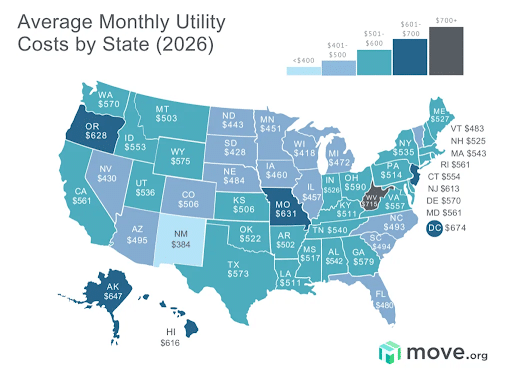
On average West Virginians pay $715 in monthly utility bills
The costs have been partially driven by the Distribution System Improvement Charge (DSIC), a monthly surcharge that allows utility companies to fund the replacement of aging infrastructure. Approved by the PSC, this fee bypasses the rate-case process, shifting the costs of upgrading failing systems onto the consumer.
In August of this year the PSC passed another crippling rate hike pushing consumer energy bills up by another 5.6%. All this while House Bill 4111 to establish a community solar program that would reduce costs has been stuck in committee.
Solar developers are “poised to invest millions of dollars into West Virginia if we were able to pass this bill, and to basically guarantee lower electric bills for West Virginians who opt in and purchase a subscription to these projects because they could generate electricity cheaper than the utilities can,” he says.
“More often than not, you’re not going to win a debate or pass a bill based on facts and data. People’s stories… How something impacts their lives,” Hansen reflects on his position as a scientist and lawmaker dealing with the limits of cold facts and data in political debates. He plans to reintroduce the Community solar bill.
Much like Bishop Haley who believes the burden of blight is deliberately put upon the community, according to Hansen, vulnerability is manufactured. Behind every legislative stalemate or unfunded emergency plan lies a stark reality: “Any kilowatt hour of electricity generated by solar is one less kilowatt hour that might be generated by coal. That’s what it’s all about. The coal industry wants nothing except coal,” says Hansen.
The West Side community is not waiting for changes in the law. According to Hansen, “If a facility like a church wants to put solar and battery storage on their building, they can do that under current state code. Changes in state code are not needed to create resilience hubs.”
This means a More Excellent Way Life Center Church can legally produce and store solar energy over their carport, but as soon as they want to draw a lifeline to the community, power the medical equipment of the elderly or warm the homes of the most vulnerable during a blackout they hit a legislative wall.
“The challenge, what is not allowed in state code, is to do the batteries and solar and connect multiple homes or businesses to that. Then you’re getting into microgrid territory where the microgrid is not a single entity. But it’s multiple end users of the electricity. And then we come across some issues in state law,” says Hansen.
Del. Hansen explains that in September 2022 “A special session was called to change the code to carve out to allow microgrids in two locations; the first slot was given to Berkshire Hathaway. It required 100% renewable energy for the microgrids and some other safeguards.”
Fifty miles north of Charleston’s West Side, the giant investment firm proposed building a $500 million titanium melt plant to produce materials for the aerospace industry in Jackson County, WV. This state-of-the-art facility demanded independent, reliable power and planned to build a 106-megawatt solar array and a huge battery storage system.
As if jolted into action by an inner relay switch, lawmakers scrambled to cut through red tape to allow the company to develop a solar energy microgrid without Public Service Commission (PSC) oversight, and to set their own rates.
In April 2025, legislators took this original carve-out and passed “House Bill 2014 the data center microgrid bill… the very controversial data center bill,” Hansen explains. “They removed the requirement for the microgrids to be powered by renewables, expanded the number and tied microgrids to powering data centers.”
The legislation also preempts local authorities from decision-making on these projects, making them exempt from local standards on noise, light, air and water pollution. Hansen put it bluntly, lawmakers had passed a “whole other chunk of new state code related to bringing data centers into West Virginia.”
Public comments on House Bill 2014 and the Certified microgrid Program submitted for the PSC hearing reveal concern over the siting, pollution, ratepayer bills and the level of contempt local communities were being met with.
“Why were local communities offered zero meaningful input before HB 2014 removed local control?” said Frank Muth of Inwood, WV. “Interestingly, the data center proponents are requiring our elected officials to sign non-disclosure agreements. This is not only a huge conflict of interest, but it reduces local trust to near zero.”
The testimony also revealed how the most vulnerable people were facing some of the worst consequences. “The Jefferson/Berkeley Data Center (aka ‘project Carmel’) is located next to Hospice,” according to Muth. “Will the noise generated from this facility impact Hospice patients? Has anyone bothered to evaluate that impact?”
Citing ‘national security’ the WV Legislature codified energy independence for corporations, and not for West Virginians. The rush to roll out the red carpet for microgrids, would extend to tech company data centers, not to local communities.
Bishop Haley’s church is not melting titanium or cooling AI servers, so they cannot function as a community microgrid, which would classify it as a public utility subject to PSC rules. “That part of state code would not allow a church to generate electricity and provide that electricity to homes in the neighborhood or say key businesses in the neighborhood,” Hansen points out.
“It was not designed for resilience when the grid goes down. It was designed more for self-generation of industrial facilities that didn’t want to be regulated as a utility by the Public Service Commission,” concludes Hansen.
This story was reported with support from The Ohio River Valley Participatory Fund.
If you appreciate BBG's work, please support us with a contribution of whatever you can afford.
Support our stories
Related Articles
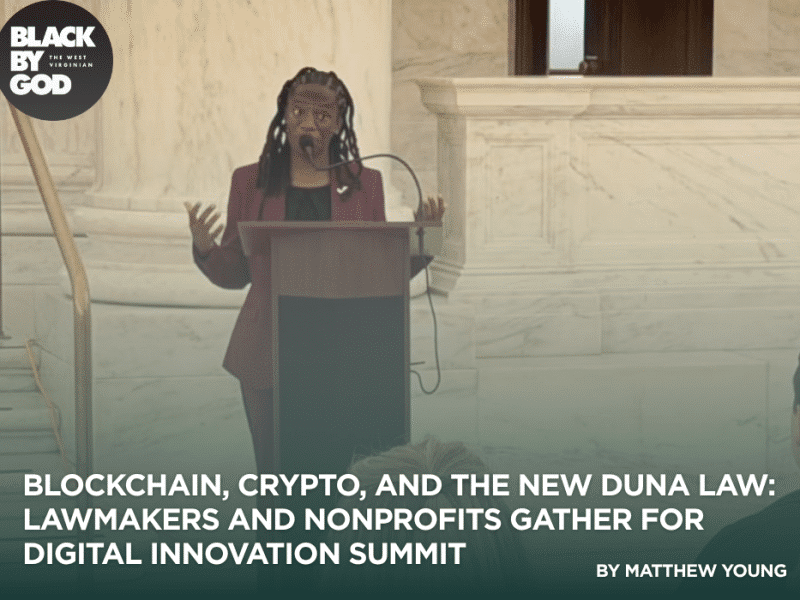
Blockchain, crypto, and the new DUNA law: lawmakers and nonprofits gather for digital innovation summit
Despite low broadband ranks, West Virginia lawmakers passed the DUNA Act and debated stablecoin bills. Learn how blockchain legislation aims to spur economic growth.