
He Started With a Wagon and Chickens in Charleston — Tony Brown Became a TV Pioneer, Dies at 93
Reflecting on Tony Brown’s legacy: From his childhood in Charleston, WV, to organizing MLK’s Walk to Freedom and hosting PBS’s longest-running Black series.
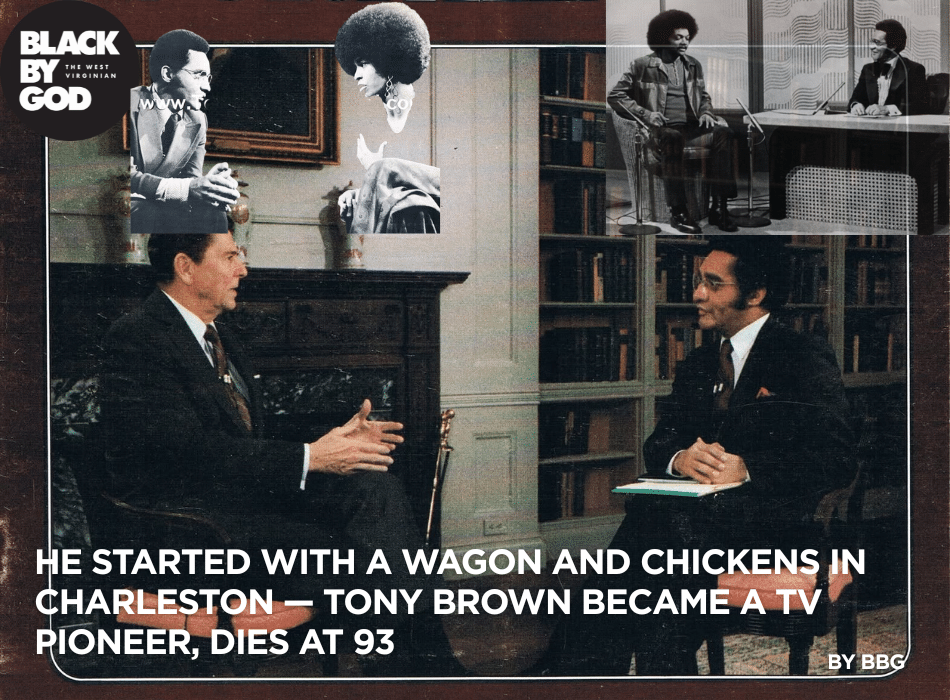
By Robin Caldwell, BBG
The questions on Tony Brown’s about page on his website are no different than the questions he asked thousands of guests during the 40-year history of the Emmy award-winning Tony Brown’s Journal/Black Journal. He would ask people who they were, what they believed and how they lived out their purpose. He asked nothing less of himself.
“Q. What do you love about being Black?
A. The inspiring opportunities that my heritage makes possible, which includes my ability to Educate, Inspire and help Equip Black people with the skills for Self-Empowerment and to help build a competitive community. My life’s work continues to focus on encouraging African Americans to develop their economic and intellectual potential.”
Tony Brown was a man who knew himself, and spent the better part of his professional life getting to know his people.
As reported on the Tony Brown Journal Facebook page, “Tony Brown, host and Executive Producer of Tony Brown’s Journal, the longest-running series in the history of the PBS network, made his peaceful transition on June 17, 2026, at his home in Newport News, Virginia. He died of coronary heart disease.”
Born William Anthony Brown in Charleston, West Virginia to Royal Brown and Catherine Davis Brown. Brown was a graduate of Garnet High School, class of 1951. He was an athlete-scholar excelling in track and academics with a particular interest in drama and English. From 1953–1955, Brown served in the U.S. Army. In 1959, he received a BA degree in sociology from Wayne State University followed by a MA degree in Psychiatric Social Work.
Journalism called and Brown embarked on a career trajectory that took him from being the Detroit Courier’s drama critic (1962) to become executive producer (and sometime host) of the monthly TV program Black Journal on National Educational Television (NET). In 1977, Black Journal was renamed Tony Brown’s Journal, and transitioned to commercial television, returning to public television on PBS in 1982, running on the air until 2008 with a brief revival in 2018.
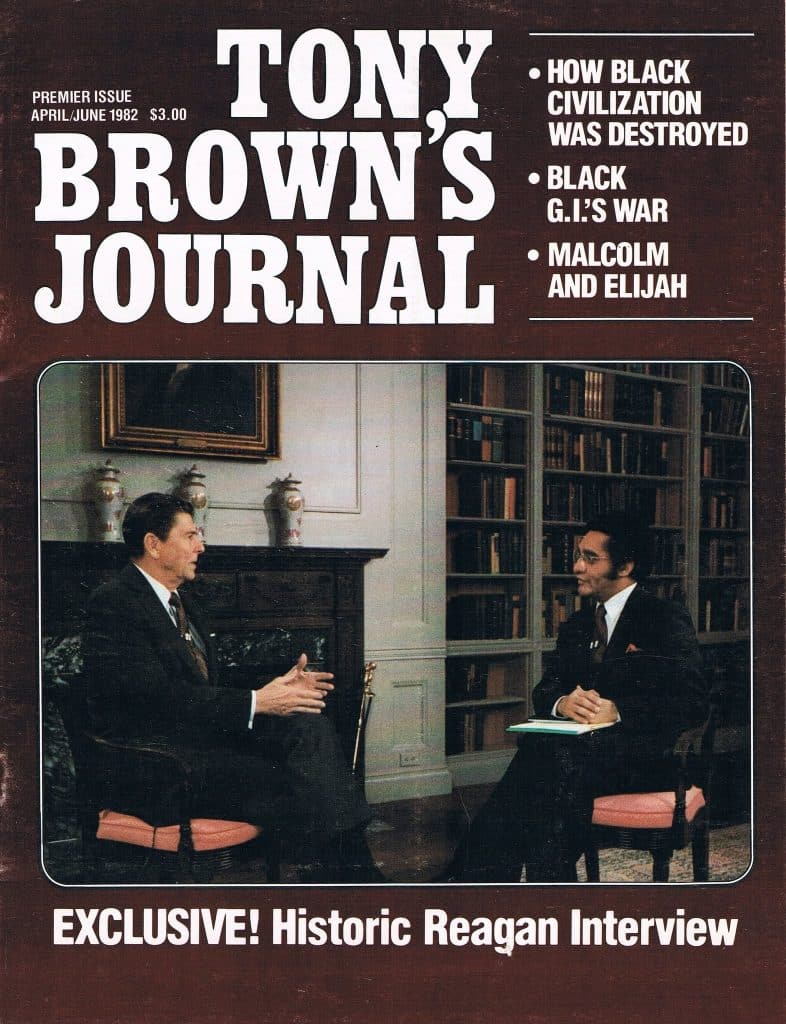
Black Journal/Tony Brown’s Journal was considered radical for its time, often reflecting the issues and topics important to Black communities nationwide. Guests, some controversial, included notables from politics, sports and entertainment, and business.
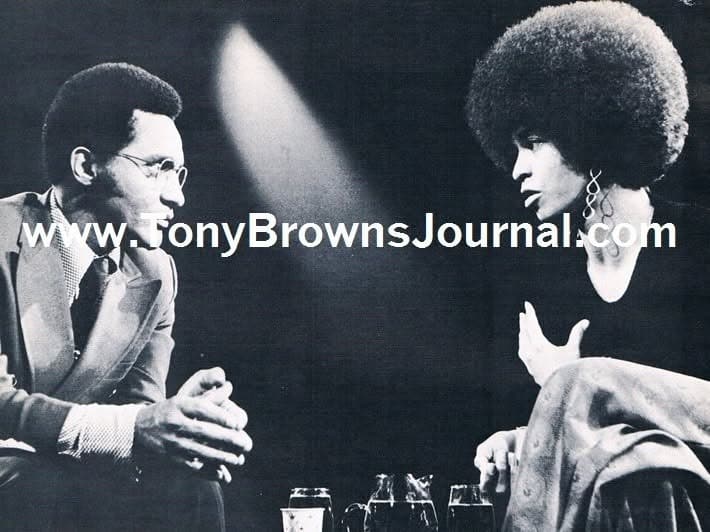
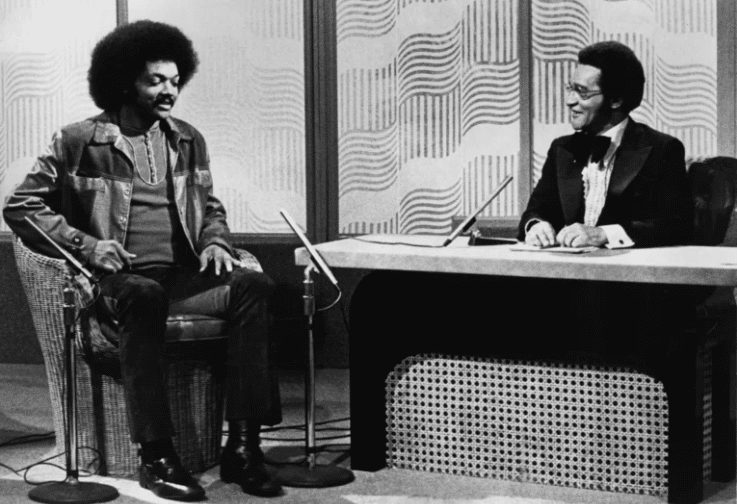
A few featured guests were James Brown, Louis Farrakhan, Danny Glover, Alex Haley, and Bobby Seale. WNET noted “One program in particular from the 1972-73 season featured a round-table discussion with Angela Davis, Fannie Lou Hamer, Kwame Ture (formerly known as Stokely Carmichael), to name a few.”
Helmed two HBCU schools of communication and journalism
Tony Brown’s career in journalism was an entrance into academia, when in 1972, he became the founding dean of Howard University’s School of Communication. According to the School’s website, “Under Dean Brown, the School established one of the first annual career fairs that continues to help industry managers interview and hire young Black media professionals. The School’s birth coincided with the debut of Howard University’s commercial radio station, WHUR-FM. Student-run radio station, WHBC-AM, was established in 1974.” In 2004, he became the dean of Hampton University’s Scripps Howard School of Journalism and Communications. He held the position until 2009, when he stepped down.
Brown’s activism and politics often clashed, sometimes proved prophetic and rarely drew a line between his outreach and his duties as a journalist
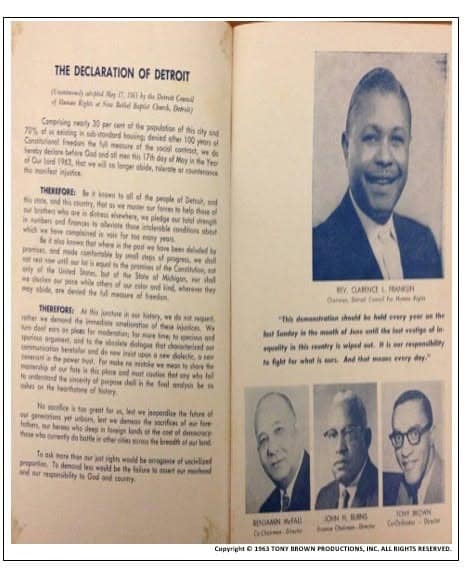
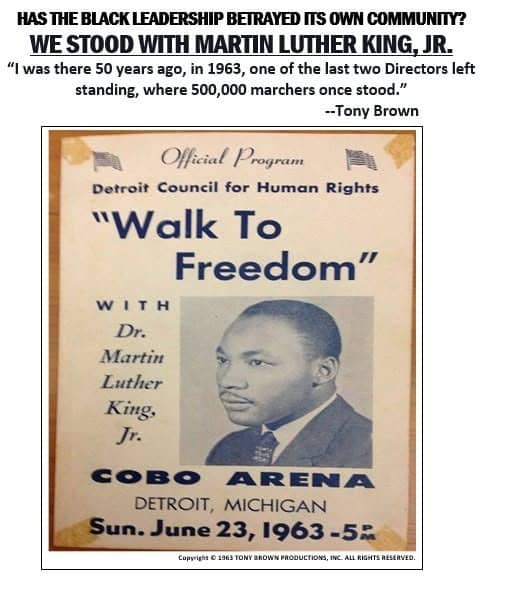
Called “Television’s Civil Rights Crusader,” Brown was often presented as a study in contrast. For example, he wore the Black Power crowning symbol of the times: an afro. Yet, he was a self-described conservative that happened to found the Council for the Economic Development of Black Americans (CEDBA) which encouraged African American consumers to patronize black merchants who displayed the “Freedom Seal” and actively supported community issues. In a 1984 interview, Brown famously warned Black America to be suspicious of the Democratic Party, an admonition that could be ripped from current events. He drew criticism but in the same interview he called Black Americans to also be suspicious of Republicans – his own affiliation. And before fame came to him as a TV producer and host, he was an organizer and coordinator of the Detroit Council for Human Rights’s “Walk to Freedom” featuring the Reverend Dr. Martin Luther King, Jr., who delivered his “I Have a Dream” speech at Detroit’s Cobo Hall on June 23, 1963, two months before he repeated it at the Lincoln Memorial in Washington, D.C. at the March on Washington.
Made in West Virginia
It stands to reason for all of his many accomplishments, Brown never forgot his humble beginnings in West Virginia. West Virginia was never his “last but not least” or a footnote in an extensive résumé. Detroit was his great migration, but West Virginia was his muse. In a segment on his show, where he stood in a classroom at his alma mater Garnet High School, he introduced viewers to his high school English teacher Mrs. Ruth Stevenson Norman (Charleston’s first graduate of Howard University). Brown described her as a “mountain of knowledge.” His remembrance: her motto. “Love plus knowledge equals growth.”
In the caption under his video, he states, “I was born Black and not into the middle class, but I was never taught that I was poor; I never lived with my father, but I was never taught that that fact made me any less of a man. I went to all-Black schools in a segregated system, but I never learned that we were inferior because we were together, instead, we were taught to be proud of our heritage and motivated to learn so we could succeed in life.”
He grew up in a poor section of Charleston, West Virginia, where he was raised by family friend Elizabeth Sanford and her daughter, Mable Holmes. Brown realized early on that money could break the cycle of poverty that surrounded him in the community. After raising some money by selling soda pop bottles, Brown bought a hen and a rooster to start his own little poultry farm. It wasn’t long before he was peddling eggs and chickens to his neighbors. “I was first on the block to buy my own wagon,” he told Thomas. “But more importantly, I was doing something good for myself and for my community. We were all profiting.” This sense of dedication to the black community stuck with him. [Source: Encyclopedia.com, reference to interview with Keith Thomas, Chicago Tribune, January 8, 1989]
Little is known about his personal life other than what he revealed, and perhaps, that’s not a bad thing in a society that thrives on the personal life of its notables. What we do know is that Tony Brown joins the hall of fame of Black publishers like J. R. Clifford and John William Dunjee, and Black media producers like Dr. Carolyn Foster Bailey Lewis, and journalists like Angela Dodson. He was a storyteller in the grandest of West Virginia form.
William Anthony Brown will be sorely missed by many but if the West Virginia in him has its way, he will never be forgotten and his work, forever appreciated.
If you appreciate BBG's work, please support us with a contribution of whatever you can afford.
Support our stories
Related Articles

A Viral Songwriting Challenge Shines a Spotlight on the Tradition of Hip Hop in West Virginia
This spring, the community media organization Black By God challenged West Virginia artists to write a lyrical love letter to the state, breathing new life into the state’s hip hop scene
This week in Affrilachian history: Sept. 6 through Sept. 12
Explore key September moments in Affrilachian history: WV’s first Black legislator, Harlem Renaissance author John Matheus, and John Henry’s legend.