
College presidents talk education partnership, how WVSU is positioning itself for the future at Chamber Business Summit
By Autumn Shelton, BBG
West Virginia State University (WVSU), a Historically Black College and University (HBCU) founded in 1891 in the unincorporated community of Institute in Kanawha County continues its long history as a public land-grant university, rich in agriculture education, as it looks to the future of higher education and economic development in the Mountain State.
On Friday, during the final day of the 90th annual WV Chamber Business Summit, an event held in White Sulphur Springs at The Greenbrier, WVSU President Dr. Ericke Cage joined Dr. Jim Nemitz, president of the West Virginia School of Osteopathic Medicine (WVSOM) to discuss an ongoing partnership between the two institutions of higher learning, and to discuss ways WVSU is positioning itself to build a stronger future for all West Virginians.
Four years ago, WVSU and WVSOM entered into an agreement to provide WVSU students with a pathway for admission into osteopathic medical school through the WVSOM Pre-Osteopathic Medicine Program (POMP).
According to Dr. Nemitz, this agreement provides a way for West Virginia students to stay in the state while providing a “pipeline” for future osteopathic physicians.
“We work with institutions like West Virginia State University and other institutions throughout West Virginia,” Nemitz explained. “This is an early admission guaranteed program. So, if a student is doing what they’re supposed to be doing, getting the grades they’re supposed to be, showing that they are competent to do medical education work, they can be accepted into our institution.”
Since the agreement was signed, Dr. Cage noted that 11 WVSU students are either currently enrolled in the POMP program or have already started their medical education at WVSOM.
“We were very, very glad to be a part of what is a very successful program that is bringing together institutions of higher education to excel in the work of producing physicians to serve our state,” Dr. Cage said. “It really is the story of higher education in West Virginia. It’s all about coming together, leveraging our shared strengths, our shared resources, and targeting them toward the important work of preparing the next leaders of our state.”
“We look forward to our ongoing relationship,” Dr. Cage added.
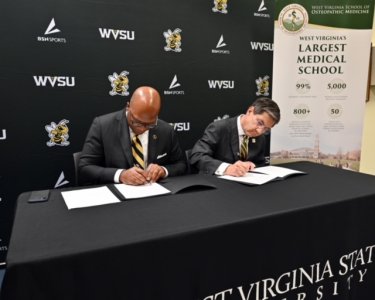

In addition to the POMP program, Dr. Cage added that WVSU is committed to the students of West Virginia.
“When you look at our undergraduate population, 89% of our students are from West Virginia,” Dr. Cage said, adding that 67% of WVSU’s students continue to work in West Virginia four years following graduation.
“That number just happens to be the largest of any four-year public institution in the state. So, I like to say all the time that West Virginia State University is West Virginia. That is who we are and that is who we will continue to be, because we understand our role, our mission quite frankly, again to prepare the leaders who will move this state forward into the future and years to come,” Dr. Cage stated.
Dr. Cage explained that WVSU is “leaning” into their mission as a land-grant university, which means focusing on agricultural heritage.
“Through our agricultural work, we literally, right now, are in our local high schools working with our K-12 teachers through our NextGen grant helping to develop agricultural curriculum that high school students can undertake to get them excited, to get them prepared to accept jobs in the agricultural space, to go on to colleges and universities like West Virginia State like West Virginia University (the state’s other public land-grant university) and other institutions that are focused on agriculture to get the education that they need to transition into the agricultural workforce.”
Dr. Cage also discussed the ongoing partnership between WVSU and the West Virginia Department of Agriculture (WVDA).
In 2024, the West Virginia Legislature approved $50 million in funding to be used for the construction of a state-of-the art agricultural laboratory to be housed on WVSU’s campus in Institute. The facility will have space available for both WVSU students and faculty through the new Purdy School of Agriculture, Food, and Natural Resources and for the WVDA, according to Dr. Cage.
“It gives us an opportunity to bring together two great institutions to leverage synergies which will enable us to not only educate the next generation of agricultural leaders, but to also allow them to work hand in hand with WVDA to prepare them to go into the jobs in the agricultural sector in West Virginia,” Dr. Cage said, adding that the future of agriculture is food security, which leads to national security, and this will “help propel the state forward.”
Lastly, Dr. Cage explained that WVSU was the only institution in the state to receive a $1 million grant from Google. The funding established the WVSU Cybersecurity Clinic which educates students and allows those students to help small businesses.
The facility opened in March 2025.
“Right now, our cybersecurity students are out in the community, working with small businesses mom and pop shops – helping them to assess their IT infrastructure, looking for vulnerabilities to protect them from attack from bad actors, because we know in many cases cybersecurity attacks, ransomware attacks can be debilitating for any business large or small, but surely for small business it hits really hard.”
Dr. Cage explained that students sit down with business owners, at no cost, to identify vulnerabilities in their systems and provide solutions to keep them online.
“We are excited about the role we play at West Virginia State and we are looking forward to our next chapter,” Dr. Cage said, adding that higher education will continue to play a role in the future of the state.
Although Dr. Cage noted that challenges face higher education – including affordability concerns and the current debate surrounding the continued relevance of a higher education – the fact is that education still matters, and that West Virginia institutions are working to ensure that academic programs meet the needs of the future.
“We want to make sure that students come to our institution, they get the knowledge that they need and they walk off with a degree in one hand and a job in the other,” Dr. Cage said.
If you appreciate BBG's work, please support us with a contribution of whatever you can afford.
Support our stories
Related Articles

Gail Taylor appointed to Morgantown City Council vacancy
‘My goal is bringing consensus. I think it helps to have seven people who can get on the same page’
McDowell County Public Records: Sept. 23 through Oct. 6
Official McDowell County public records filed Sept. 23–Oct. 6, 2026, including municipal land transfers, marriage licenses, death certificates, and coal heritage metrics.