
OPINION: The Quiet Giants in our midst right here
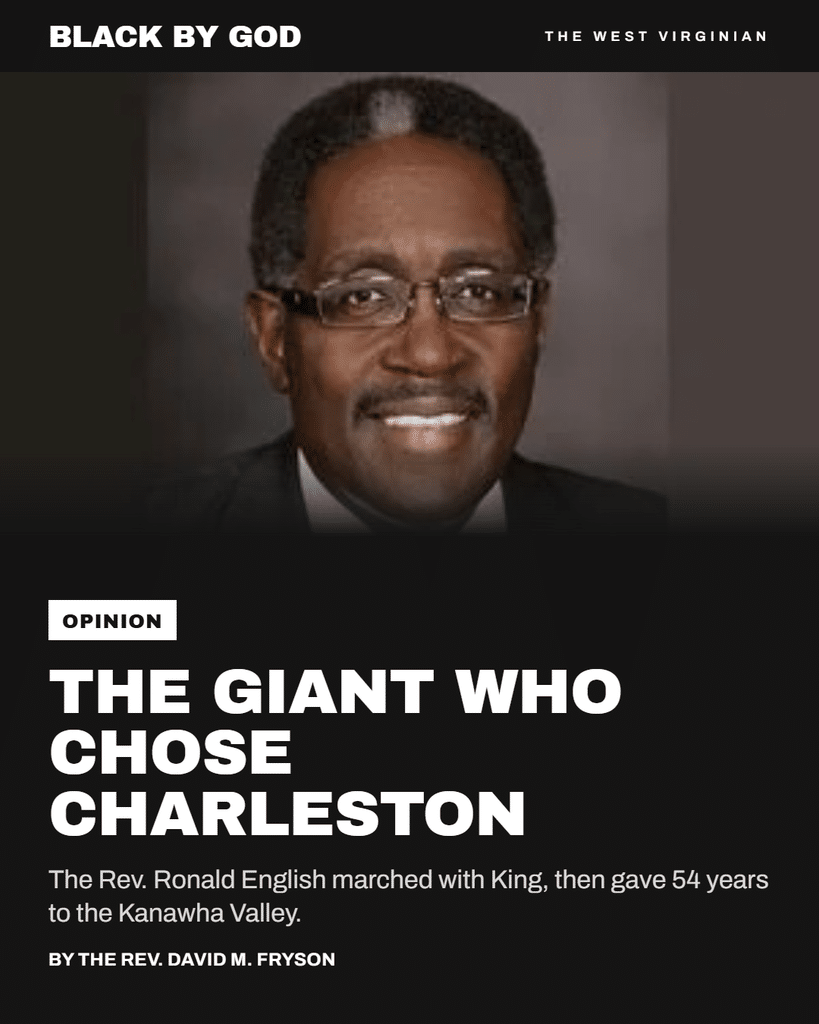
By. Rev. David M. Fryson,
We live in a culture obsessed with distant icons.
We look to national stages, viral videos and history textbooks to find our heroes, often operating under the assumption that true greatness belongs only to the past or to faraway zip codes. In doing so, we fail to recognize the immense, transformative power of the giants walking right beside us.
In West Virginia, we are particularly impressed with those from the Mountain State who achieved national prominence. We admire national icons like Booker T. Washington, Carter G. Woodson, the Rev. Leon H. Sullivan, Louis Skip Gates and Bishop TD Jakes, who ascended from the obscurity of Appalachia to the recognition of a world audience.
However, greatness does not always require a national spotlight. It can also be found in a lifetime of steady, courageous and proximate service. There is perhaps no greater example of this truth in West Virginia’s history than the Rev. Ronald English, who recently died at the age of 82.
For many, the Civil Rights Movement is a textbook chapter defined by legendary figures. Nevertheless, for decades, Charleston residents had a living connection to that history in English.
Reared in the community of Atlanta’s historic Ebenezer Baptist Church, he grew up close to the King family. He graduated from Morehouse College, joined the Rev. Martin Luther King Jr. for the 1963 March on Washington and served as a trusted young ministerial assistant to both Martin Luther King Jr. and Sr.
In 1968, as the nation grieved King’s assassination, the young English delivered the final prayer at his funeral.
“We live in a culture obsessed with distant icons.”
– Rev. David M. Fryson
With such a distinguished background, English could have pursued any prominent pulpit or national platform in America. Instead, his calling led him to West Virginia in 1972 to pastor Charleston’s prestigious First Baptist Church. According to some historians, Martin Luther King Sr. had hoped his son would consider serving there to escape the dangers of the fight for Civil Rights in the South.
For 54 years, English poured that legacy directly into the soil of the Kanawha Valley rather than into a national spotlight. He arrived during a tense city garbage workers’ strike, stepping straight into the friction. When the Kanawha County textbook controversy erupted in 1974, threatening to tear the community apart along cultural and racial lines, English was there. He did not stoke the fires of division; instead he listened, defended the rights of Black writers to be heard and practiced a rare form of intellectually serious, deeply empathetic ministry.
His greatness was active, tangible and local.
English was a charter member of the Religious Coalition for Community Renewal, building low-income housing in downtown Charleston. He launched the city’s first Black Heritage Cultural Series. Later in life, he stepped up to lead the Charleston NAACP and worked closely with state leaders to guide conversations around equity, unity and healing during times of national racial tension.
My family’s connection to English is not unlike the hundreds of other ministerial influences he developed in the Charleston area. My wife Joy’s family members were parishioners at First Baptist when he arrived, and though she and I later became members of a different denomination, he ministered to all of us when she experienced a near fatal brain aneurysm in her late teens.
After the operation, when she was suffering from the aftereffects of the surgery, he employed her as his secretary and gently helped guide her to overcome the residual cognitive deficits.
Unfortunately, if you lived in Charleston and never sat in his pews during a sermon, you might not have known that a man of his stature, who helped carry the mantle of the American Civil Rights Movement, was living quietly in South Charleston.
This is the tragedy of how we define heroics. We wait until the giants leave us to finally look up and realize how tall they stood. While we tend to judge up-close greatness harshly because of the frailty of our shared humanity, he was a kind, well-read, deep-voiced intellectual gentle giant who chose a life of neighborhood-level devotion.
Charleston, and communities like it across the state, are richer because people like English chose to make them their home. But his life challenges us to open our eyes to the living history and quiet excellence that remains in our community. We must stop looking past our neighbors to find inspiration and recognize the greatness among us.
Over the past couple of years, I had the opportunity to witness English’s influence across the generations.
While serving as interim vice president for inclusive excellence at Quinnipiac University in Connecticut, I brought him on campus to speak on his connection to Martin Luther King Jr. and the Civil Rights Movement. It was an overwhelming success.
The students, faculty and staff gravitated toward him as a living icon. Later, we introduced him to the campus at SUNY Plattsburgh State University, New York, in the same role and with the same impressive result.
English was known to quote a line that King loved: “When it is dark enough, you can see the stars.”
He was one of those stars, burning brightly and steadily in West Virginia, even in our darkest hours. Let us honor his memory not just by mourning his loss, but by actively recognizing, celebrating and supporting the other quiet greatness that remains in our midst. The community organizers, pastors, teachers, coaches and mentors who quietly hold our communities together are the real giants of our society.
The Rev. David M. Fryson is the senior pastor of the New First Baptist Church of Kanawha City and is a retired lawyer and higher education administrator. He also currently serves as a national diversity consultant.
If you appreciate BBG's work, please support us with a contribution of whatever you can afford.
Support our stories
Related Articles
David Fryson: Courageous leaders must resist anti-DEI policies (Opinion)
Former WVU VP for DEI David Fryson calls on university presidents and corporate executives to defend equity and inclusion against political attacks.