
In the era of rural health transformation, one nonprofit is determined to change the story for Appalachia
By Emily Blevins,
The research is clear: when it comes to health and well-being, nurture often trumps nature. Where you live and work, your community’s economic makeup and social connectedness, and the quality of the air you breathe and the water you drink have a bigger impact on one’s health than just about anything else. Appalachians know this all too well.
How decades of federal underinvestment, the collapse of physically and environmentally risky industries, and the overprescription of opioids and the rise of pill mills pushed the region to the knife’s edge is a familiar story. Less known, however, is the story of what comes next.
That’s because across the 13 states that make up the Appalachian region, grassroots and nonprofit organizations and advocates are actively writing that chapter for themselves. They’re pushing the boundaries, testing new ideas, and finding innovative ways to flip the script for the places they call home. Community Education Group is one of those organizations, and their Syndemic Summit is how they’re rewriting the region’s narrative.
“Appalachia should be defined by more than its history,” says CEG Founder and Executive Director A. Toni Young. “And Appalachians, and all of rural America, should be responsible for defining what the future needs to look like for themselves. That’s why we’re here, and that’s why we started the Syndemic Summit three years ago.”
A more than 30-year-old nonprofit, CEG has spent the last decade rooted in Lost River, West Virginia but stretching their arms across the region’s 423 counties. Young has spent her entire career focused on expanding resources to HIV prevention and treatment programs. A 2015 report in the Wall Street Journal moved her to act. “The report outlined some of the most vulnerable counties in the nation,” she says. “All of West Virginia was included in that list.”
Young saw the writing on the wall. The region’s challenges with rising rates of substance use and rising rates of viral hepatitis (known colloquially as Hep C) could only lead to one thing. “There’s a train roaring through Appalachia. At the front is coal, followed by environmental degradation, challenges around workforce and economic development, and then the opioid epidemic,” says Young. “Hep C had already joined the train and HIV was coming next–and I wanted CEG to help build the infrastructure that could stop this crisis in its tracks.”
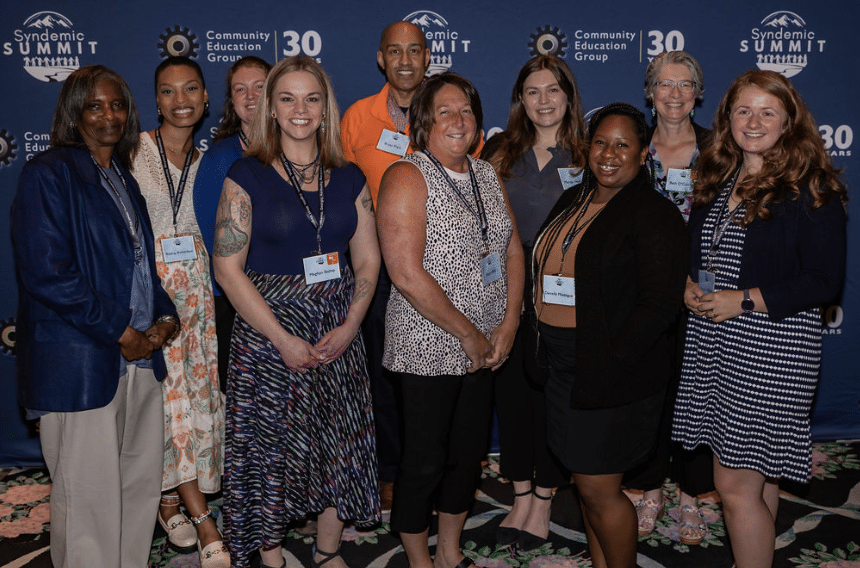
In the intervening years, CEG brought CHAMPS, their paid community health worker training program, to West Virginia. They focused on recruiting individuals with lived experience around drug use and addiction, housing insecurity, and justice system involvement for the program. “You have to meet people where they’re at,” says Young. “If you’re trying to treat a population that’s classified as ‘hard to reach,’ your best bet to make an inroad is to work with someone who knows how to reach that community.”
The training program was just the start. Then there were grassroots re-granting and capacity building programs, followed by multi-state consortiums and research initiatives that brought Appalachian health to the world stage. The Syndemic Summit was their next chapter.
“The Syndemic Summit is how we break down silos, build cross-county and cross-state collaborations, learn about how public policy impacts our communities, and discuss what we need to do to ensure that Appalachia’s future can be the healthiest and brightest it can be,” says Lee Storrow, CEG Senior Director of External Affairs.
Now in its third year, the Syndemic Summit gathers hundreds of advocates, health professionals, nonprofits, public servants, and representatives from county health departments and state agencies for an event that brings national voices to the region and solutions to the forefront. Each year, CEG works with a broad multi-state partnership to coordinate the Summit; partners include rural health associations, overdose prevention organizations, and groups specifically focused on HIV prevention. “The substance use disorder, HIV, and Hep C syndemic doesn’t recognize county or state lines,” says Young. “To address it, and to strengthen the health, workforce, and economic vitality of the region, our efforts shouldn’t recognize those lines either.”
Last year, CEG shifted the Summit’s date and location to align with another major event dedicated to changing Appalachia’s story. “Hope in the Hills puts on the Healing Appalachia music festival every year,” says Young. “They bring together thousands of Appalachians who, like us, believe that the region’s brightest days are still ahead. Working with Hope in the Hills and aligning the logistics of our events just made sense.”
At Healing Appalachia last year, CEG offered HIV and Hep C testing to festivalgoers. “There were attendees whose tests were reactive who didn’t know that they could’ve been at risk for any of these health conditions,” says Young. “We were able to educate them about their risk and connect them to further resources.” This year, CEG and Hope in the Hills are hosting a reception during the Summit at Marshall University’s Memorial Student Center. The reception features live music from Huntington’s Brad Goodall and opportunities for networking and community discussion.

The primary issues CEG focuses on–substance use disorder, HIV, and Hep C–are heavily influenced by federal policy, and that landscape has shifted significantly in the time since the last Syndemic Summit. “We’re in a new era,” says Young. “The Rural Health Transformation Program has changed the game, and it’s important that the people and organizations who have been working to transform Appalachia’s health outcomes know and understand how that landscape has shifted and ways they can adapt.”
This year, the Syndemic Summit opens with a plenary session on the changing landscape and what’s next in West Virginia. Dr. Carrie Jeffries, the director of the West Virginia Rural Health Transformation Program, is a featured speaker during that session. The next day, Kristin Roha, a senior advisor at the federal Substance Abuse and Mental Health Services Administration, is sitting down for a fireside chat with Young to talk about how this new policy era impacts substance use disorder treatment and changing access to behavioral health resources.
“Oftentimes, Appalachia gets left out of national conversations, and many of the people and organizations who attend the Summit are even left out of state-level conversations,” says Young. “So at the Syndemic Summit, we bring those conversations to them.”
Registration to the 2026 Syndemic Summit, held September 9-11 at the Hilton DoubleTree in Huntington, is still open and will remain open through the event. “You don’t have to be a public health professional to care about or change the health of your community,” says Young. “Everyone has the ability to shape this next era for Appalachia and all of rural America.”
Young believes that the region is full of promise, and it’s because of the people who show up to the Summit year after year. “We’ve seen how partnerships formed during this event have opened doors and shifted the narrative,” says Young. “It just proves that together, there’s nothing Appalachians can’t do.”
If you appreciate BBG's work, please support us with a contribution of whatever you can afford.
Support our stories
Related Articles

This week in Affrilachian history: Sept. 6 through Sept. 12
Explore key September moments in Affrilachian history: WV’s first Black legislator, Harlem Renaissance author John Matheus, and John Henry’s legend.
For some West Virginians, a historic $450M Chemours settlement over forever chemicals is too little, too late
Parkersburg residents react to Chemours’ historic $450M PFAS settlement as federal drinking water protections face potential rollbacks and long-term health harms linger.
BSU removes Martin, names Cathy Deeb ‘Acting President’
The Bluefield State University Board of Governors voted to withdraw Dr. Darrin Martin’s contract extension over severe financial and operational concerns.