
Carlo Petrini and the Great Remembering Through Food
By Jim Embry, May 25, 2026
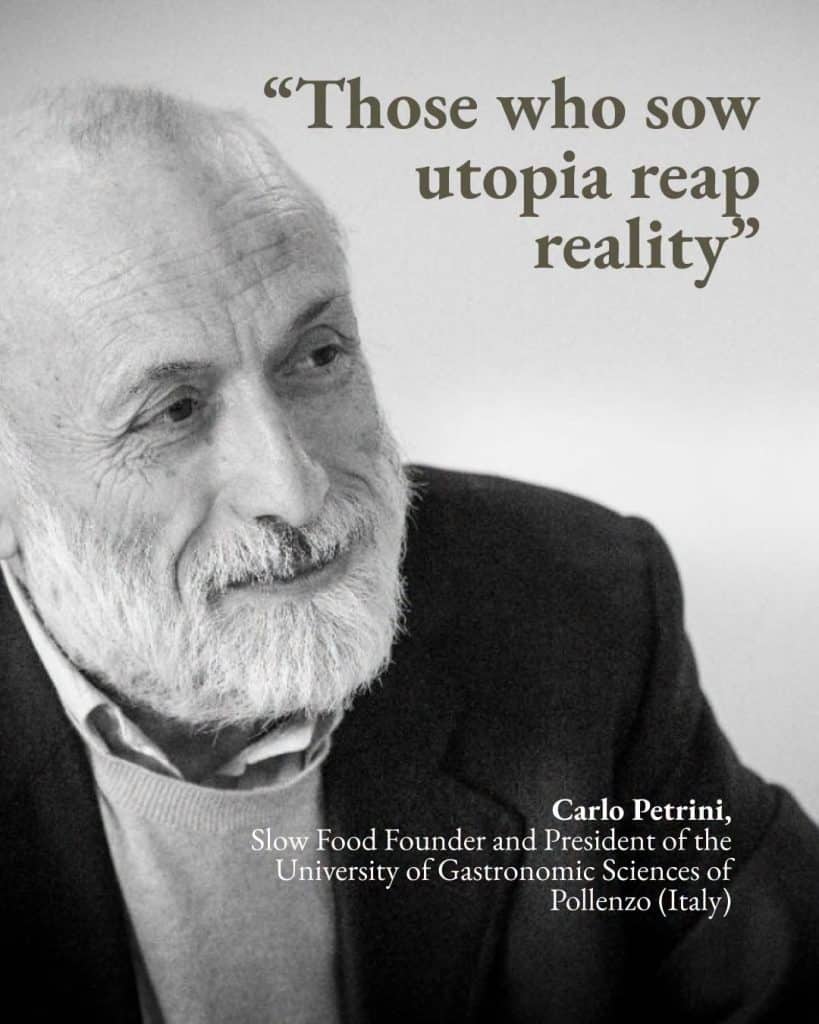
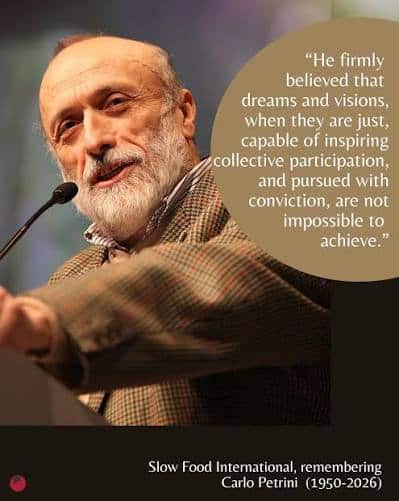
A few days ago, the world lost one of its great cultural visionaries. Carlo Petrini, founder of the international Slow Food movement and architect of Terra Madre, died in Bra, Italy—the small Piedmont town where a global revolution in food culture quietly began.[1]
For millions around the world, Carlo was a movement leader, philosopher, and advocate for biodiversity, small farmers, Indigenous food traditions, and the dignity of local culture. For me, he was also a dear friend, mentor, teacher, visionary leader, and fellow traveler in the long journey toward a more just and sustainable future.
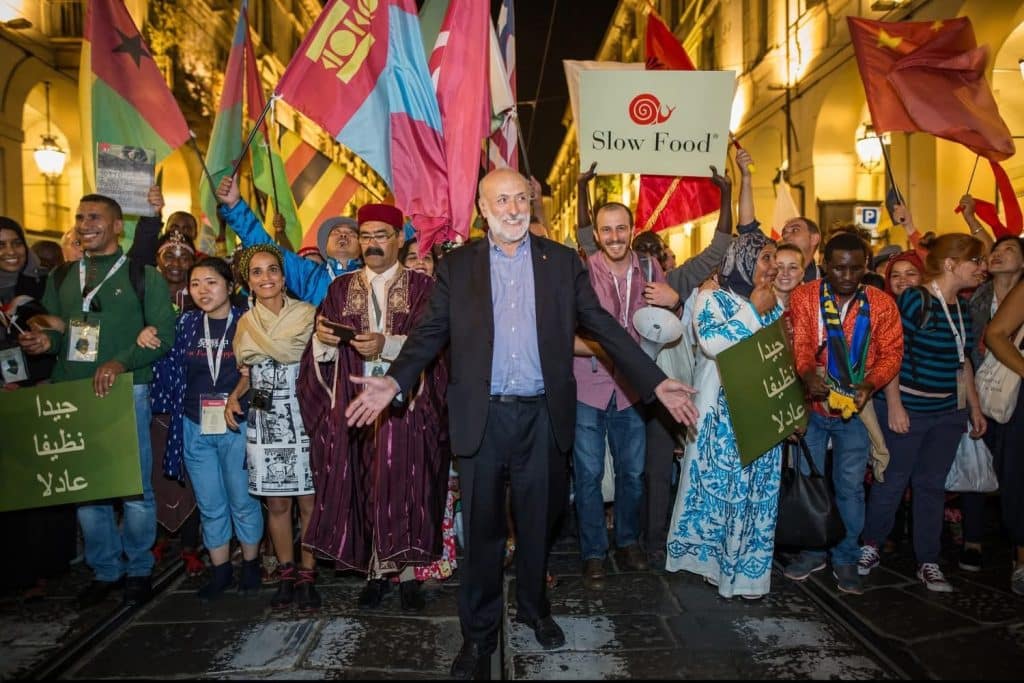
I first met Carlo in 2008 during my first journey to Torino, Italy, for Terra Madre Salone del Gusto, the biennial gathering that brings together farmers, seed keepers, cooks, scholars, Indigenous leaders, youth, and food activists from around the globe.[2] I could not have imagined then that I would return eight times as a delegate, nor that our conversations would continue across nearly two decades and through two Slow Food International Congress gatherings.
We’ll bring the best from BBG right to your inbox. You can easily unsubscribe at any time.
Sign Up for our Newsletters!

Over the years, Carlo and I spoke often about food—not simply as cuisine or consumption, but as culture, ecology, memory, justice, and transformation. We shared a belief that food systems sit at the center of humanity’s future. Agriculture is not merely an economic sector; it is the fulcrum upon which environmental sustainability, public health, democracy, culture, and peace all rest.
Coincidentally, Carlo and I were born the same year—1949—and less than two months apart—April 23 and June 22. We also emerged from similar political foundations as left-leaning youth activists while remaining deeply connected to our agrarian roots and food cultures. During the 70s, as Carlo was writing culinary and political essays in leftist journals in Italy, I was helping found Good Foods Co-op Lexington KY in 1972—one of the early natural foods cooperatives in our region.[3]
Good Foods Co-op was literally grounded in the principles of local, organic, and healthy food that closely parallel Carlo’s later Slow Food framework of “good, clean, and fair.” Across different continents and cultural contexts, we arrived at remarkably similar conclusions: that food is sacred; that biodiversity matters; that communities must reclaim local knowledge and regional food traditions; and that industrial systems disconnected from land, people, and spirit inevitably generate ecological destruction and social alienation. For me, joining Slow Food USA and attending my first Terra Madre Salone del Gusto in 2008 was not a departure, but a natural organic extension of my Black Appalachian agrarian roots, decades of food justice activism already rooted in those same values.
Carlo and I shared more than a birth year and radical beginnings. We shared a belief that food could serve as a catalyst for cultural renewal, ecological healing, and a necessary species-level transformation in how humanity relates to the Earth and to one another.
In many ways, my own “Six Pathways to a Sustainable Future” framework (developed over decades) was strengthened and affirmed through my experiences with Carlo and the global Terra Madre network.[4] The framework emphasizes 1) Earth-centered and woman-centered worldviews, 2) Indigenous ecological wisdom, 3) the agrarian philosophy of George Washington Carver and African American ethos, 4) the essential role of youth and art, 5) seed sovereignty and the Terra Madre network, and 6) the necessity of a transformative vision.

It is my premise that our global Terra Madre network embodies all of these pathways simultaneously through such organizational elements of: Indigenous Terra Madre network, Slow Food Youth Network and University of Gastronomic Sciences, Ark of Taste, emphasis on biodiversity, Earth Markets and much more. These pathways demonstrate that food is not merely about consumption, but about relationships—between people and land, culture and ecology, memory and future generations. Carlo helped create a living global laboratory where these interconnected pathways could be seen, practiced, and shared across continents.
One of the most meaningful moments in my journey with Carlo and the global Slow Food movement came during the 2012 Slow Food International Congress in Turin, Italy. Delegates from every corner of the world gathered as the grassroots Terra Madre network was formally integrated into the governance structure of Slow Food International.[5] It marked a pivotal moment in the movement’s evolution—from an organization centered largely around gastronomy and regional food culture into a truly global alliance linking farmers, Indigenous communities, seed keepers, youth activists, scholars, cooks, and ecological visionaries across continents.
During that historic assembly, I, along with a few others, was given five minutes to address the international gathering. Five minutes is not a long time, but it is enough to speak a profound truth.
Standing before that extraordinary tapestry of cultures, languages, and food traditions, I asked a simple but foundational question: What is the best first local food?
The answer that I exclaimed was “BREAST MILK”.
Breast milk is humanity’s original local food. It requires no transportation, creates no waste, is perfectly adapted to the needs of the consumer, and is produced entirely within the local ecology of the mother’s body. In that moment, I sought to connect Slow Food’s guiding principles of “good, clean, and fair” food to the very beginning of human life itself. Food sovereignty begins at birth. Before markets, before globalization, before industrial agriculture, humanity’s first nourishment emerged through relationship, reciprocity, care of women—our mothers as extensions of Mother Earth or Terra Madre, and the wisdom of the body itself. I wanted to re-member and reorient women and breast milk back into our conversation about food, agriculture, joy with justice, gastronomy and our principles of good, clean and fair.
As I looked across the hall that day—surrounded by farmers, Indigenous leaders, chefs, scholars, and activists from around the world—I felt a profound sense of belonging and purpose. I was also looking directly at Carlo Petrini, seated on the speaker platform behind me, listening intently as delegates reflected on the future of Slow Food and Terra Madre.

In that moment, speaking not only to the assembly but also directly to Carlo himself, I made a declaration that remains true today:
“I love Slow Food and Terra Madre, and I will continue to attend Terra Madre forever.”
For me, “forever” was not rhetorical. It was a covenant. Terra Madre represented something increasingly rare in modern life: a global community rooted in biodiversity, cultural memory, ecological responsibility, conviviality, and hope. Carlo Petrini had created a space where humanity could imagine itself differently—not as competitors in a global marketplace, but as caretakers within an interconnected living system.
As I stepped down from the speaker platform and began to exit the stage, Carlo stood up and greeted me with one of his warm, unmistakable embraces. Looking directly at me, he smiled and said:
“Entrambi amiamo lo Slow Food per sempre.”
(We both will love Slow Food forever.)
That moment has stayed with me ever since. It captured Carlo’s humanity, warmth, and extraordinary ability to build relationships rooted in shared values and shared joy. He understood that movements are sustained not only through ideas and institutions, but through affection, trust, fellowship, and love.That global vision extended beyond Italy. In 2017, I also participated in the Slow Food International Congress in Chengdu, China, another powerful reminder that Terra Madre had become a truly planetary movement.[6] There, once again, Carlo demonstrated his extraordinary ability to build bridges across nations, cultures, political systems, and food traditions. The Congress in Chengdu reflected his understanding that the future of humanity depends upon international cooperation rooted in biodiversity, cultural respect, and ecological responsibility.
Carlo often reminded the world that Slow Food was never simply about gastronomy. It was about resisting a culture of speed, extraction, disposability, and homogenization. Slow Food became a global call to protect “good, clean, and fair” food systems—food that nourishes both people and the Earth while honoring those who grow it.[7]
Carlo also understood that food movements must continually evolve to address deeper questions of equity, inclusion, and justice. His vision for Slow Food was never static. Just as the original Slow Food Manifesto of 1989 challenged the accelerating culture of “Fast Life” and industrial food systems, Carlo encouraged the movement to grow in moral depth and social consciousness as new challenges emerged.[8]
Inspired by the original Slow Food Manifesto written by Folco Portinari, I helped lead an effort within Slow Food USA to develop an Equity, Inclusion, and Justice Manifesto in 2018. As co-chair of the Slow Food USA Equity, Inclusion, and Justice Working Group alongside Charity Kenyon, I encouraged our group to prepare a manifesto that addressed racial inequities, food injustice, land access, labor, representation, and the need for a more inclusive Slow Food USA movement. I was honored to serve as the primary author of that document, much as Portinari had authored the founding manifesto nearly three decades earlier.[9]
My words resounded:
Jim Embry, farmer and food activist, led the Equity, Inclusion and Justice Manifesto Working Group and said, “This needs to be the sacred work of every state chapter of Slow Food USA if we are to manifest the spirit of Terra Madre and reach the potential that is meant to be part of our destiny.”[10]
That same year, Slow Food International invited us to present the EIJ Manifesto during the Terra Madre gathering in Torino. For me, that moment represented another affirmation of Carlo Petrini’s leadership and openness to transformation. He understood that “good, clean, and fair” food must also include dignity, belonging, and justice. In many ways, the Equity, Inclusion, and Justice Manifesto reflected the same principles embodied in my “Six Pathways to a Sustainable Future” framework: that ecological sustainability and social justice must always walk together.
In 2018, our Slow Food USA Equity, Inclusion, and Justice Working Group launched the “Joy and Justice” campaign, an initiative inspired by the belief that food activism must nourish both human dignity and collective hope.[11] As part of the campaign, bracelets bearing the words “Joy and Justice” were created by students at the Mungere School in Kenya, symbolizing the global interconnectedness that Carlo Petrini envisioned through the Slow Food movement and Terra Madre network.[12] More than a slogan, the phrase became a reminder that food justice work must remain rooted not only in resistance to exploitation and ecological destruction, but also in celebration, beauty, culture, relationship, and shared humanity.

Carrying this spirit forward, in 2022, while serving as a self-proclaimed Slow Food “ambassador”, I embarked upon my first “Joy and Justice Journey,” traveling across twenty-five cities in fifteen states during the month of June. During this journey, I visited twelve Slow Food chapters, ten food cooperatives, numerous urban and rural farms, Indigenous reservations, universities, and community organizations. Along the way, I distributed more than five hundred packages of Ujamaa seeds[13] together with Southern Exposure Seed Exchange catalogs,[14] transforming the trip into both a cultural pilgrimage and a mobile seed-sharing initiative inspired by George Washington Carver and his Jessup Wagon. Much like Terra Madre itself,[15] the journey emphasized relationship-building across geography, race, class, and generation while reaffirming the importance of biodiversity, local food systems, and community resilience.
Since 2022, the Joy and Justice Journeys have expanded into an ongoing national practice woven throughout my yearly work. As I now give approximately thirty presentations annually, collaborate with more than seventeen colleges and universities, participate in conferences across the country, and continue developing manuscripts and public scholarship, these journeys have become a living extension of Carlo Petrini’s vision.[16] They represent an American adaptation of the Terra Madre ethos—linking seeds, storytelling, agroecology, cooperatives, Indigenous knowledge, Black agrarian traditions, and youth engagement into a traveling network of cultural and ecological exchange. This evolving work was further reflected in my 2026 Ohio State University lecture, “Terra Madre as Culture, Interdisciplinarity, and Collaboration: Lessons Learned from Turtle Island and Torino,” which explored Terra Madre not simply as a food gathering, but as a global framework for cultural exchange, ecological thinking, and systems transformation.[17] In this sense, Joy and Justice became not merely a campaign, but a pathway for cultivating the relationships and imagination necessary for a regenerative future.
In many ways, Terra Madre became one of the great democratic experiments of the modern era. Long before terms like “food sovereignty,” “regenerative agriculture,” and “agroecology” entered mainstream discussions, Carlo created a living international network where farmers from Appalachia could sit beside Indigenous leaders from the Amazon, African seed keepers, Asian rice farmers, European cheesemakers, and youth activists from every continent.
For me, as an African American food and farming activist from Kentucky and Appalachia, Terra Madre offered something profoundly important: a recognition that local struggles are connected to global movements. The work of Black farmers in Appalachia, seed savers in Kentucky, urban gardeners in Detroit, and youth organizers in New Orleans all belonged within a much larger human story about land, culture, resilience, and justice. Carlo understood this deeply.
He also understood storytelling. Carlo knew that movements survive not only through policy and economics, but through memory, relationships, rituals, music, and shared meals. Around countless tables in Torino, Bra, Chengdu, and beyond, he modeled a form of leadership rooted not in ego or hierarchy, but in conviviality—the ancient human practice of building community through food and fellowship.
One of Carlo’s favorite songs was Cielito Lindo, the beloved Mexican folk song whose joyful refrain reminds us:
“Ay, ay, ay, ay,
Canta y no llores.”
(Sing and don’t cry.)
The song continues:
“Porque cantando se alegran, cielito lindo, los corazones.”
(Because through singing, beautiful one, the hearts rejoice.)
In many ways, that song captured Carlo’s spirit perfectly.[18] Even in difficult times—amid ecological destruction, climate crisis, war, displacement, and the industrialization of food—Carlo insisted on joy, music, fellowship, beauty, and celebration. He believed that resistance without joy could not sustain a movement. Like the song itself, Carlo taught us to sing rather than surrender to despair; to gather around tables rather than walls; and to nourish the human spirit while healing the Earth.
What made Carlo extraordinary was his ability to connect intellectual rigor with joy. He could speak passionately about biodiversity loss, corporate agriculture, climate change, and disappearing seed varieties while simultaneously celebrating the beauty of bread, wine, gardens, laughter, and regional traditions. He taught us that pleasure itself could be political—that caring for the Earth and caring for one another were inseparable acts.
At a moment when humanity faces ecological collapse, social fragmentation, and deep spiritual disconnection, Carlo Petrini’s vision may be more important than ever.[19] He challenged us to slow down enough to listen—to the Earth, to farmers, to seeds, to elders, and to one another.
His work also affirmed my belief that sustainability is not merely technical. It is cultural, spiritual, relational, and ecological. Through Terra Madre, Carlo helped cultivate all six pathways necessary for a sustainable future: reverence for the Earth and the feminine principle of nurturing life; respect for Indigenous and ancestral wisdom; commitment to regenerative agriculture and biodiversity; investment in youth, creativity, and cultural expression; protection of seeds and local food traditions; and the courage to imagine new institutions capable of sustaining both people and planet.
In September 2026, I plan to make my ninth journey to Terra Madre in Torino. That pilgrimage will now carry a different emotional weight. Carlo’s physical presence may be gone, but his spirit will remain embedded in the farmers markets, shared meals, seed exchanges, conversations, songs, and communities he helped nurture around the world.
Today, I realize that I must now carry this love in my own heart—and in the hearts of the millions around the world whom Carlo inspired. Though he is no longer physically with us, his love for Slow Food continues to live through every seed saved, every farmer protected, every shared meal, every act of ecological stewardship, and every community working toward a more just and regenerative future.
And perhaps, when we look upward into the night sky, we may still see Carlo’s spirit there—his eyes twinkling among the stars[20] above the Earth he loved so deeply. And perhaps somewhere beyond our sight, Carlo is still singing softly:
“Ay, ay, ay, ay… canta y no llores.”
I have decided to dedicate my forthcoming book: Terra Madre-A
Journey of Food, People and Possibilities[21] to Carlo Petrini.


It is a small gesture of gratitude for a man whose ideas transformed not only global food culture, but the lives of countless individuals—including mine. Carlo helped the world remember that food is never just food. It is identity, memory, ecology, justice, and love made visible.[22] In an age of speed, he taught us the revolutionary power of slowing down. And in a fractured world, he reminded us that another future is still possible—one meal, one seed, one community at a time.
Sources
[1] Asimov, Eric. “Carlo Petrini, Whose Slow Food Movement Transformed How We Eat, Dies at 76.” The New York Times, May 22, 2026. https://www.nytimes.com/2026/05/22/dining/carlo-petrini-dead.html.
“Carlo Petrini, Founder of Slow Food, Passes Away at 76,” Slow Food, May 22, 2026, https://www.slowfood.com/blog-and-news/carlo-petrini-founder-of-slow-food-passes-away-at-76/. https://www.slowfood.com/insights/biography-of-carlo-petrini/
[2] “Impressions from Terra Madre in Turin, Italy,” Grist, November 1, 2008, https://grist.org/article/quick-thoughts-on-slow-food/.
[3] https://smileypete.com/community/good-as-gold/. https://www.goodfoods.coop/. https://www.kentucky.com/news/business/article281031738.html.
[4] Jim Embry and Jennifer Bailey, “Six Pathways to a Sustainable Future,” Systems Transformation Partnership framework materials, 2023–2026. “Systems Transformation Partners,” Systems Transformation Partners, https://sites.google.com/view/systemstransformationpartners.
If you appreciate BBG's work, please support us with a contribution of whatever you can afford.
Support our stories
Related Articles
WV farmers question Trump’s decision to import beef
Local beef producers doubt the move will lower prices and believe it undercuts American farms.
Black Farmers in West Virginia Nearly Disappeared. This Is How Some Are Bringing the Land Back
From 504 Black-owned farms a century ago to just 31 today: Black By God examines how Black West Virginians are reclaiming farmland, legacy, and food systems.