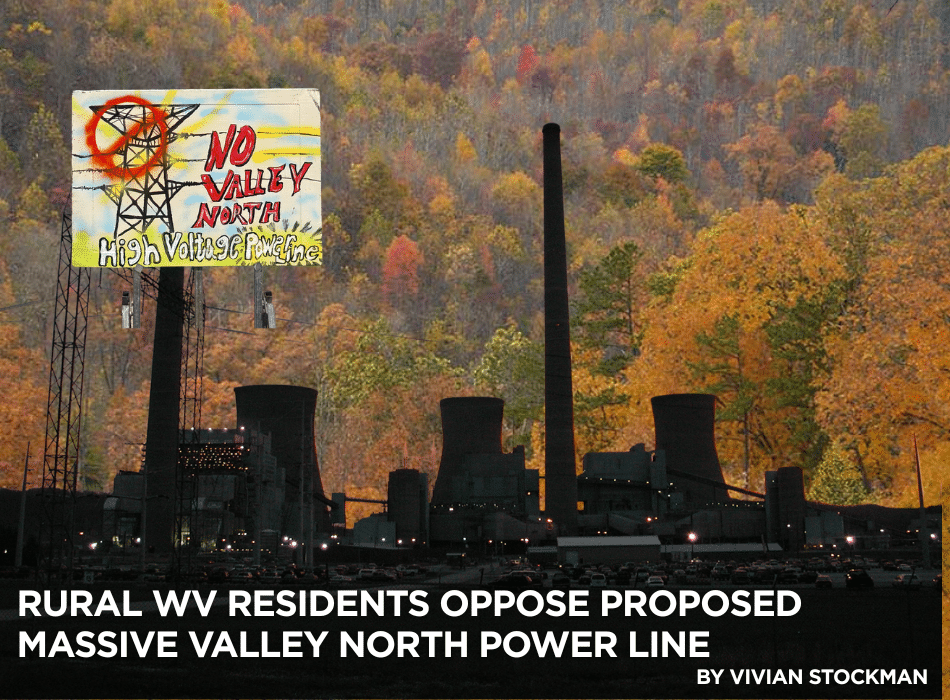
Rural WV Residents Oppose Proposed Massive Valley North Power Line
It was standing room only for the public comment portion of the Roane County Commission meeting held on Thursday, July 23.
About 40 people packed a room of the county courthouse in the small town of Spencer, the county seat. Sometimes raising hands, sometimes stridently calling out questions and comments, the people in the crowd were obviously up in arms. The common thread of these remarks was clear. People wanted to know what the county commissioners are going to do about the proposed massive high voltage power line buildout dubbed the Valley North Project.
By Vivian Stockman, BBG
It was standing room only for the public comment portion of the Roane County Commission meeting held on Thursday, July 23.
About 40 people packed a room of the county courthouse in the small town of Spencer, the county seat. Sometimes raising hands, sometimes stridently calling out questions and comments, the people in the crowd were obviously up in arms. The common thread of these remarks was clear. People wanted to know what the county commissioners are going to do about the proposed massive high voltage power line buildout dubbed the Valley North Project.
- The 260-mile, 765-kV Valley North line would cross 15 West Virginia counties.
- Residents argue the project benefits out-of-state data centers while burdening local ratepayers.
- Multiple county commissions have passed formal resolutions to oppose the project.
- Opposition centers on eminent domain, environmental damage, and threats to local tourism.
- The company is asking for the public to submit comments by August 14.
- The Public Service Commission holds final approval; the formal comment period is not yet open, but you can make general comments now.
Starting at the John Amos coal-fired power plant in Putnam County, WV, the Valley North Project is a proposed 765 kilovolt power line–the highest voltage power line in commercial use in the nation. With towers equivalent to that of about a 17-story building, (150-175 feet in height), the power line would head both east and north for 260 miles through parts of West Virginia, Virginia and Maryland. The massive power line would carve out a 200-foot wide right-of-way across 15 West Virginia counties, including Roane.
Two Roane County Commissioners, Merlin Shamblin and Caleb Greathouse, listened to comments from the crowd, some passionate and some angry, with one man noting that if construction began, then there would be “a bunch of us ready with arms.” With so many remarks, County Commissioners extended the time allotted for public comment before proceeding to their scheduled agenda. Commissioner Chad Earl Stricklin was absent due to his wife being in labor.
Early in the meeting, Eric Holmes, an attorney who works with the commission, noted that the decision to approve the power line rests not with the county commission, but with the West Virginia Public Service Commission (PSC), and that eminent domain would be used in the construction process.
Spencer resident, Mary Wildfire, spoke up noting that eminent domain is supposed to ensure that harms done in taking the property of landowners is for the public benefit, but that there would be no public benefit with this project. Wildfire, like others who have voiced opposition to Valley North, posited that the power line would be feeding data centers and benefiting California billionaires alongside those wanting to capitalize on cryptocurrency and AI–all while leaving West Virginia ratepayers with higher bills.
Wildfire’s neighbor, Jennifer Holloway, drew applause when she noted that such a project would not only prove a detriment to West Virginia’s tourism industry, but to the environment itself, the very thing attracting so many out-of-state visitors to the Wild and Wonderful State. She told the crowd and commissioners that the tourism industry in West Virginia boasts the highest annual growth rate in the nation at 12%, bringing an annual average of $6.3 billion dollars in revenue to the state, with an unprecedented $9 billion in 2024.
Holloway explained that by allowing Valley North Project to exploit West Virginia, both wild and domesticated pollinators would be negatively impacted by the emissions of EMFs (electromagnetic fields). She went on to explain how declines in these populations would cause a ripple effect, crippling apple production (of which West Virginia currently ranks ninth in the country), and that less pollinators meant a very different landscape for tourists and residents alike. She stated that families would be directly impacted should the tourism economy of the state collapse.
Holloway concluded her remarks stating that the Valley North Project would cost the entire state of West Virginia–not just the 15 counties within the trajectory of the transmission lines.
Roane County resident, James Rich, informed commissioners that he had moved to Roane County about three years prior, after extensively researching areas with natural beauty. He asserted that he had specifically rejected a number of properties that already had smaller transmission lines crossing them. He noted that if he, himself, thought about how transmission lines ruined the natural beauty of an area, then certainly many other people thought that way too, begging the question of how having tallowing the Valley North Project would decrease property values. When contacted following the meeting, Rich added that, “Once they rip through the countryside of our county, it’s done, and we’ll be left with that permanent scar.”
When the commissioners reiterated that any decision on the power line was not up to them, several of those in attendance asked if the commissioners would join with other county commissions that have made resolutions and written letters against the Valley North Project. County commissioners that have made their opposition known include those representing Barbour, Calhoun, Lewis, and Upshur counties.
Roane County Resident, Clerc Daniell, asked if commissioners would write a letter in opposition should half of Roane Countians oppose the project.
Commissioners noted that in order to make a resolution, the matter would have to be written into the agenda of the following meeting. Commissioners asked that people send their concerns directly by email or phone (listed on their website, www.roanewv.com, under “Elected Officials”) to consider a vote at their next meeting on August 13, 2026, at 10:00 a.m., with public comment open at 9:45 a.m.
In the meantime, Valley Link is holding an “Open House” about the Valley North Project on Tuesday, July 28 at the Spencer Armory, located at 207 E. Main Street, Spencer from 4:00pm-7:30pm.
Additional “Open Houses” will be held from 4:00 to 7:30 p.m. at the following locations:
–Kanawha County: July 28th at Stonewall Middle School, located at 100 Middle School Lane, Charleston.
–Putnam County: July 29th at Poca High School, located at 1 Dot Way, Poca.
–Jackson County: July 29th at Greene Center, located at 10494 Charleston Road, Kenna.
There is also a “virtual open house” for those who cannot attend in person. A comment card is also available. For this phase of the project, the public is asked to comment by August 14.
The Valley North Project is headed by Valley Link Transmission Company LLC, a venture of Dominion Energy, FirstEnergy Transmission LLC and Transource Energy LLC (a partnership between American Electric Power and Evergy) which maintains that Valley North is necessary to deliver reliable and efficient energy.
While the PSC is the body with the legal authority to approve or deny the project, it has a record of being pro-utility. One of the three commissioners spent 25 years as a lobbyist with the West Virginia Coal Association. Valley Link has not yet filed a formal application with the PSC. The public will have a chance to comment to the PSC, and may begin to do so now, even without a formal filing, though it will be important to make formal comments when the time comes. See the “General Public Comment Submission” form on the PSC website.
In the Valley Link press release, the company says, “The final route for the project has not yet been selected and will be based on community input, extensive surveys and thorough study of environmental, cultural and historic resources. After this summer’s open houses, the Valley North team will review all feedback, develop routes from the study segments and host a second series of open houses in late 2026 to further refine the project routes with additional community input.”
The crowd at the Roane County Courthouse last Tuesday might be hard pressed to believe what the company says in its press releases. Judging by the sentiment expressed at the meeting, folks in Roane County will join others across the state in calling for all proposed routes to be scrapped and demanding the termination of the Valley North Project.
If you appreciate BBG's work, please support us with a contribution of whatever you can afford.
Support our stories
Related Articles
Roane County Commission joins local governments opposing Valley North transmission line
The 260-mile project, which has faced widespread public scrutiny, would cut through 15 West Virginia counties.

The return of Rand, WV’s Donnie Blue Father’s Day Cookout
For decades, my dad’s cookout was the event of the year for our small community. I decided to revive it.