
Soul Food Scholar Adrian Miller to Join Simpson Memorial’s 160th Anniversary Celebration
The award-winning author will visit Charleston to celebrate the stories preserved through Black churches, kitchens and communities.
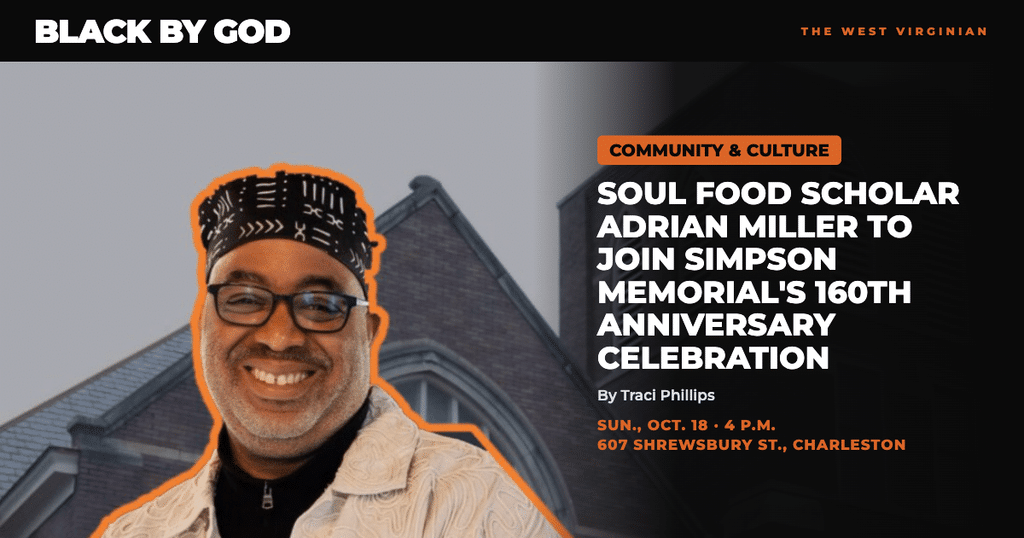
Adrian Miller is coming to Charleston hungry—for history, community and, if he gets his way, a slaw dog and pepperoni roll. Better known as the “Soul Food Scholar,” the two-time James Beard Award-winning author and culinary historian will speak as Simpson Memorial United Methodist Church celebrates its 160th anniversary. The celebration will be held Sunday, Oct. 18, at 4 p.m. at 607 Shrewsbury St.
For Miller, the invitation is more than a speaking engagement. It is an opportunity to honor a Black congregation whose faith and traditions have endured for generations. Simpson’s roots reach back to the closing days of the Civil War, when Black worshippers began gathering in the basement of Asbury Methodist Church. The congregation received its first Black minister in 1866, and its current building was constructed in 1914.
“Their ancestors started something, and it’s still around to this day,” Miller told Black By God during a recent BBG TV interview. “That is a huge achievement.”
Miller understands that kind of legacy personally. His own Denver congregation recently celebrated its 140th anniversary, and it was through church and family—not school—that he first encountered much of the Black history that would shape his work. Although Miller grew up in Colorado, his mother came from Chattanooga, Tennessee, and his father from Helena, Arkansas. Their Southern roots connected him to the food traditions he now studies and shares nationwide.
We’ll bring the best from BBG right to your inbox. You can easily unsubscribe at any time.
Sign Up for our Newsletters!
A former White House special assistant, Miller has built a nationally recognized career using food to uncover stories that traditional history books often overlook.
“Food permeates everything,” Miller said. By following what Black people grew, cooked and carried with them, he found another way into the African American story—from West African traditions that survived enslavement to the Black cooks who helped shape American cuisine.
Much of that history has traveled by word of mouth: recipes without written measurements, techniques learned by watching an elder’s hands and stories exchanged around kitchen tables and during church dinners. Miller warns that when younger generations lose their connection to those traditions, communities can lose more than a familiar dish. They can lose the memory and meaning held inside it.
Miller’s visit also creates an opportunity to place Black Appalachia within the country’s larger food story. He considers Appalachian cooking part of the family of Southern foodways and is eager to learn more about the region during his first trip to Charleston.
“I hope there will be greater awareness of Appalachia in the Black food story,” Miller said. “We are everywhere, and we make contributions.”
At Simpson, Miller plans to explore the origins of the term “soul food,” how the cuisine became mainstream and how it remains connected to West Africa, the rural South and the Black church. His message fits naturally into Simpson’s anniversary celebration: Black stories live not only in books and archives, but also in churches, kitchens and the dishes passed from one generation to the next.
Simpson Memorial United Methodist Church’s 160th anniversary celebration begins at 4 p.m. Sunday, Oct. 18, at 607 Shrewsbury St. in Charleston. The community is invited to celebrate 160 years of faith, history and service.
If you appreciate BBG's work, please support us with a contribution of whatever you can afford.
Support our stories
Related Articles
Steven Dunn: “the way I want to be in the world”
Steven Dunn is a novelist and professor currently residing in Denver, CO. But, his roots are in Kimball, McDowell County. He wants to show people of all colors that their stories can be told in their own voices.
Ten Questions with Jeremile Alexander: Building East Wheeling From the Inside Out
This article is the first installment of the EBSHF Meet Our Strategic Partners series. It was originally published on the EBSHF website.
Gail Taylor appointed to Morgantown City Council vacancy
‘My goal is bringing consensus. I think it helps to have seven people who can get on the same page’