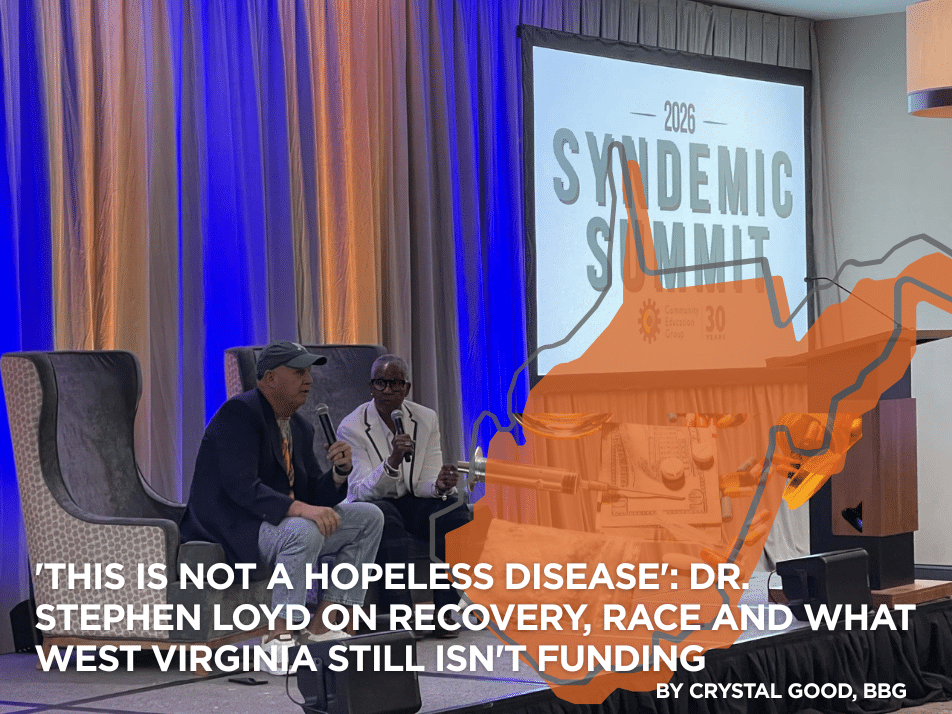
‘This Is Not a Hopeless Disease’: Dr. Stephen Loyd on recovery, race and what West Virginia still isn’t funding
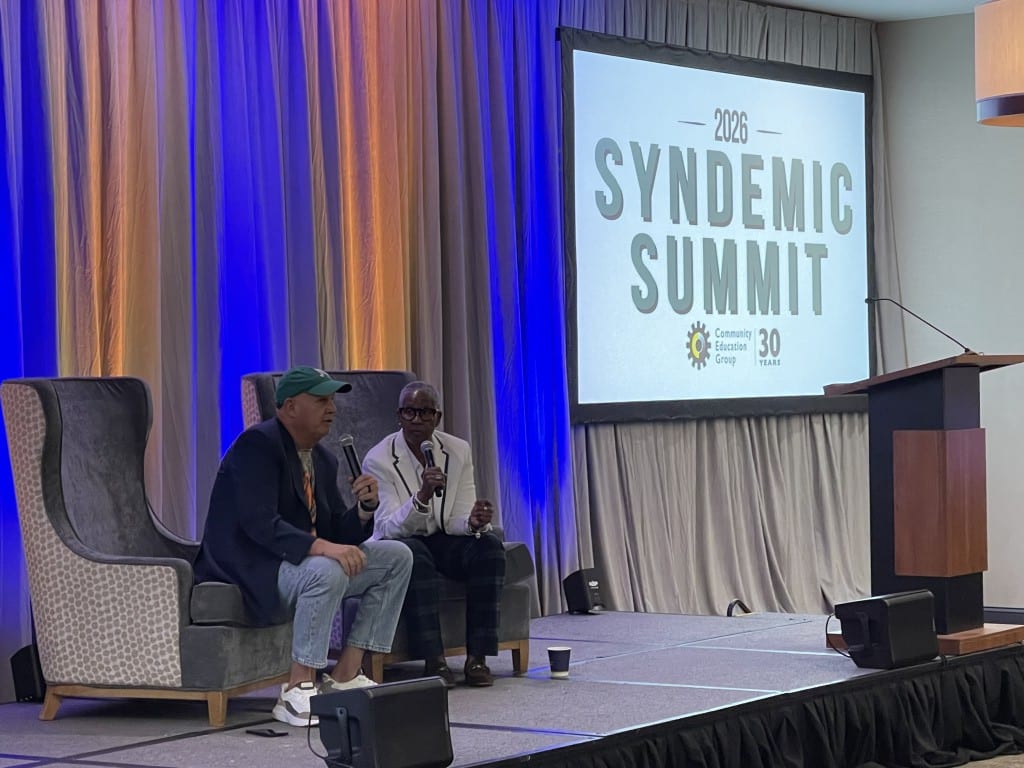
During the third annual Community Education Group (CEG) Syndemic Summit this week, the doctor whose life inspired Michael Keaton’s character in “Dopesick” sat down with CEG Founder, Dr. A. Toni Young, for a conversation that spanned from Hollywood, to Mingo County, to the White House — and back to the question nobody in the room could answer…
By Crystal Good, BBG
HUNTINGTON, W.Va. – During the third annual Community Education Group (CEG) Syndemic Summit this week, the doctor whose life inspired Michael Keaton’s character in “Dopesick” sat down with CEG Founder, Dr. A. Toni Young, for a conversation that spanned from Hollywood, to Mingo County, to the White House — and back to the question nobody in the room could answer…
Where is the opioid settlement money actually going?
Dr. Stephen Loyd didn’t plan to end up on screen. When Hulu’s “Dopesick” was in development, producers brought him in as a consultant. Loyd’s role would be as someone who could tell them how addiction actually moves through a hospital, a prescription pad, a small-town doctor’s life. He was there to fact-check a fictional West Virginia physician’s slide into OxyContin addiction. Every version the writers came up with, he said, rang false. Eventually the producers asked him a different question: what if they just used his story?
“The first thing went through my mind; well, I’m gonna take those to my grave,” Loyd told the room. He changed his mind, he said, because of what the story could do for people who’ve never seen anyone get better. “What if you had a disease that you never saw anybody get better from? What’s the hopelessness in that?” Loyd, in long-term recovery himself, said the room he was standing in proved the opposite: “This is not a hopeless disease. It’s not brain cancer. It’s not pancreatic cancer.”
He didn’t get paid for the role, he said, and he’s glad — the book sold roughly 500,000 copies and the series reached an estimated 26 million viewers, and he’s had patients come to him because their families finally understood, watching it, that treatment was something they were allowed to seek. Watching the broadcast with his wife, who works outside the recovery world as an accountant, was harder than making it. “She lived through that,” he said. “I looked over and all I saw was the top of her head, several times.”
From Charleston to the White House
Loyd led West Virginia’s Office of Drug Control Policy before moving to Washington, where he now works on what he called the Great American Recovery Initiative, created by a White House executive order at the end of January that established an Office of Addiction and Recovery. “Regardless of politics,” he said, the goal was to give the people doing the work — the people in that room — a voice at the highest level of government. His daily mission, he said, hasn’t changed in over twenty years: help as many people find a path to recovery as possible, whether that path runs through jail, an intervention at work, or a DUI.
Young pressed him on a narrative gaining traction nationally — that the opioid crisis is being “solved,” pointed to by falling overdose death numbers, even as funding for naloxone distribution gets cut. Loyd didn’t dispute that overdose numbers have fallen sharply, but he credited the people in the room, not politicians looking for a quick line on a graph. Reversing an overdose, he said, is only the beginning: “We have saved a life. What have we done past that?”
He turned to who isn’t getting saved. Roughly one in ten people who need addiction treatment get it, he said — and he estimated the rate is closer to one in twenty or one in thirty in Black and brown communities that don’t trust the medical system to begin with. “We’ve gotta build trust in our Black and brown communities,” he said, “and I don’t think anybody knows the number, but I’ll bet it’s one in twenty to one in thirty.”
It’s a pattern Loyd has flagged before. BBG reported last year that even as West Virginia’s overall overdose death rate declined, deaths among Black residents were rising — 134 per 100,000, against 77 per 100,000 for white residents, according to state DHHR data. Loyd warned at the time against reading falling statewide numbers as a sign the crisis was resolving: “The tendency is, ‘Oh, they’re going down. Our work is getting done.’ But that’s not exactly true.”
Read BBG’s full report: A Crisis Ignored: The Rising Toll of Overdose Deaths in Black West Virginia Communities.
The Mingo County Sheriff’s Facebook Post
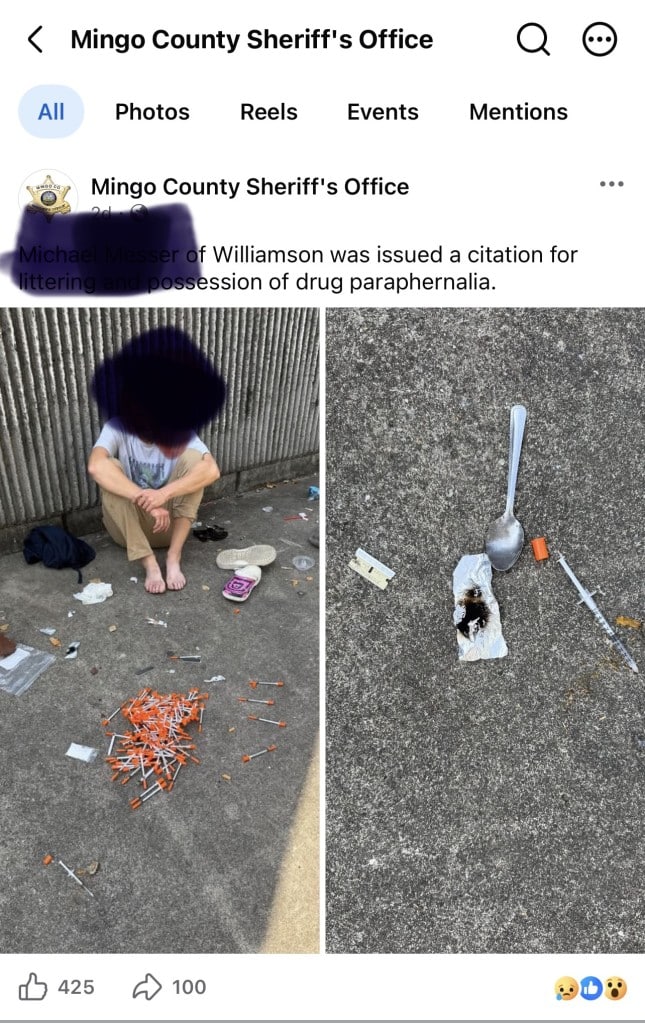
The panel’s sharpest moment came when Loyd brought up a Facebook post from a the Mingo County Sheriff’s Department, which he said had posted a photo of a young man who appeared to be actively using, framed as the department “protecting” the county from people like him. Loyd was blunt: “This is the kind of stuff that kills our folks. It kills our efforts.” He compared it to publicizing an image of a man in crisis rather than helping him, and said attendees had already worked overnight to identify who was behind it. Young and others in the room committed, on the spot, to calling it out publicly.
Where the Settlement Money Is Going
Much of the conversation turned to opioid settlement dollars — West Virginia’s roughly $1 billion, and Tennessee’s $1.1 billion for a state with nearly five times West Virginia’s population. Per capita, Loyd said, West Virginia has more settlement money than any state in the country, which is exactly why he wants transparency pushed harder: how the process works, who’s deciding where the money goes, what outcomes are being measured. “If you don’t know that,” he told the room, “you don’t know anything.”
His advice to harm reduction and recovery programs navigating a difficult funding environment: emphasize the full range of services they provide — syringe access alongside disease screening, housing referrals, connections to detox and sober living — rather than any single piece in isolation. “All of medicine is harm reduction,” he said. “We don’t cure disease. We treat it to keep the bad stuff from happening.”
He pointed to West Virginia’s syringe service program in Morgantown as a model, describing a former state legislator, once one of the program’s harshest critics, who toured the site with him and left convinced. The program screens for HIV and hepatitis C, connects people to treatment, and — Loyd noted — had brought in a primary care provider for women who’d never had a mammogram or Pap smear. He also described what unraveled a similar effort: a legislator’s “secret shopper” visit caught an inexperienced staffer handing out pipes without screening for need, which state lawmakers used to paint the whole program as promoting drug use. West Virginia now has only a handful of functioning syringe access programs left, down from a broader network a few years ago.
Methadone, Access, and ‘Four-Door Clinics’
Young asked Loyd to explain West Virginia’s methadone moratorium — a rule blocking new treatment facilities even as state law now permits mobile methadone distribution. West Virginia has the nation’s highest overdose death rate, with Tennessee second; Loyd noted the gap between first and second is larger than the gap between second and fiftieth. Existing methadone providers, he said, largely operate disconnected from recovery courts, judges, and law enforcement — exactly the systems that need to be looped in when someone is in crisis, rather than photographed and posted online.
He described the model he wants to bring to the state: “four-door clinics” that combine addiction treatment, primary care, mental health care, and help with housing and employment in one location, integrated into hospitals and medical districts rather than pushed to the margins of a community.
What He’s Asking Washington For
Young closed by asking Loyd two direct questions on behalf of the room: what is the actual federal plan for rural addiction and HIV prevention funding, given that the CDC is set to eliminate funding for roughly 96 HIV prevention organizations by the end of September, rural health clinics are closing at a rate of about ten percent a year, and telehealth is being pitched as a solution in communities without reliable broadband? And second — would White House Office of National Drug Control Policy leadership come to West Virginia, not for a “gotcha” visit, but to see the work firsthand?
Loyd said a five-point plan already exists, built around keeping people alive, preventing disease, and moving people through the full continuum of care into recovery housing — submitted within two weeks of his taking the federal role. Translating that plan into funded action, he said, is the daily fight. He pointed to his own travel — a visit to a reentry program in a Marietta, Ohio church the night before the summit — as evidence he’s trying to see the work in person, and he didn’t close the door on bringing federal leadership to West Virginia to do the same.
This article is drawn from a live conversation between Dr. Stephen Loyd and A. Toni Young at the Community Education Group Summit. Quotes have been lightly edited for clarity and readability.
If you appreciate BBG's work, please support us with a contribution of whatever you can afford.
Support our stories
Related Articles
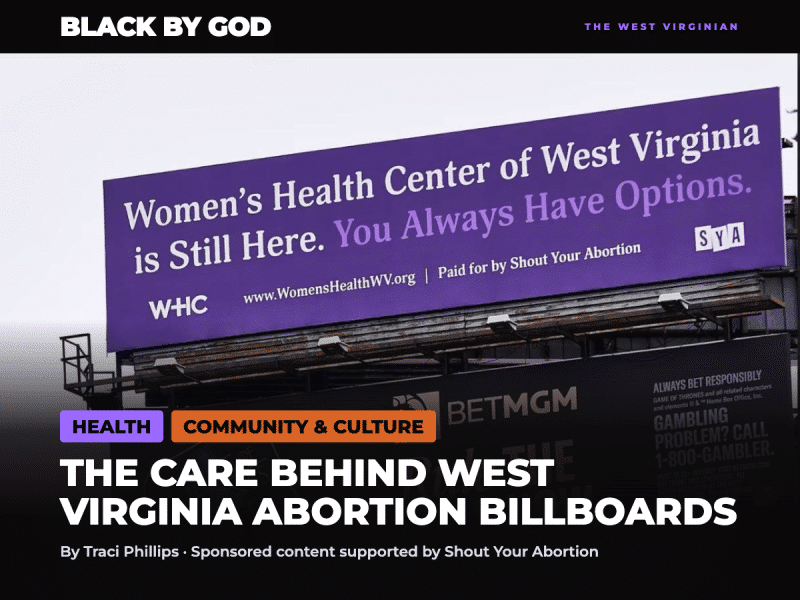
The Care Behind West Virginia Abortion Billboards
A campaign by Shout Your Abortion & Women’s Health Center of West Virginia highlights available healthcare services for Black women and underserved groups.
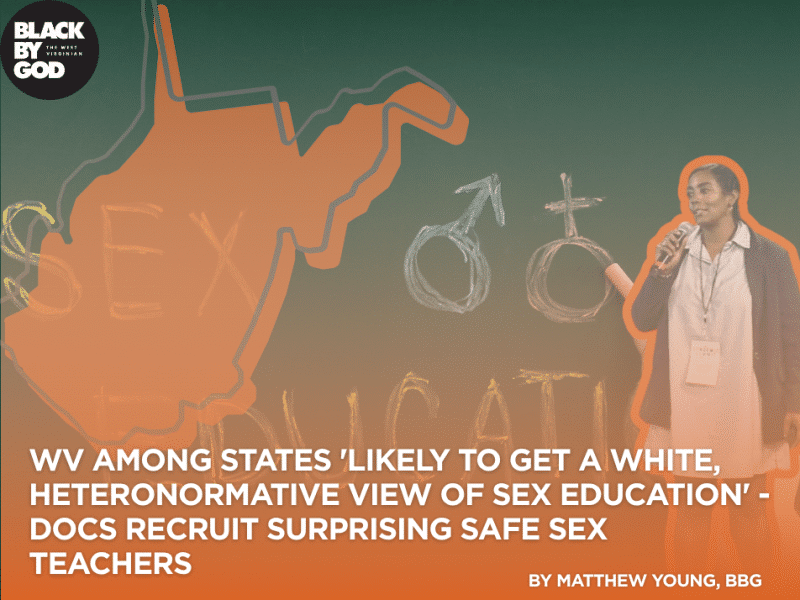
WV among states ‘likely to get a white, heteronormative view of sex education’ – docs recruit surprising safe sex teachers
UKy researchers Dr. Rebecca Bosetti & Dr. Laneshia Conner unpack sex education policy gaps and lifespan health at CEG’s Syndemic Summit.

‘I wasn’t homeless because I was using, I was using because I was homeless’ – former unhoused talk long path to rejoining society
Truth Pharm presents participant-informed research on homelessness, digital barriers, and care systems at CEG’s 3rd Annual Syndemic Summit in Huntington, WV.