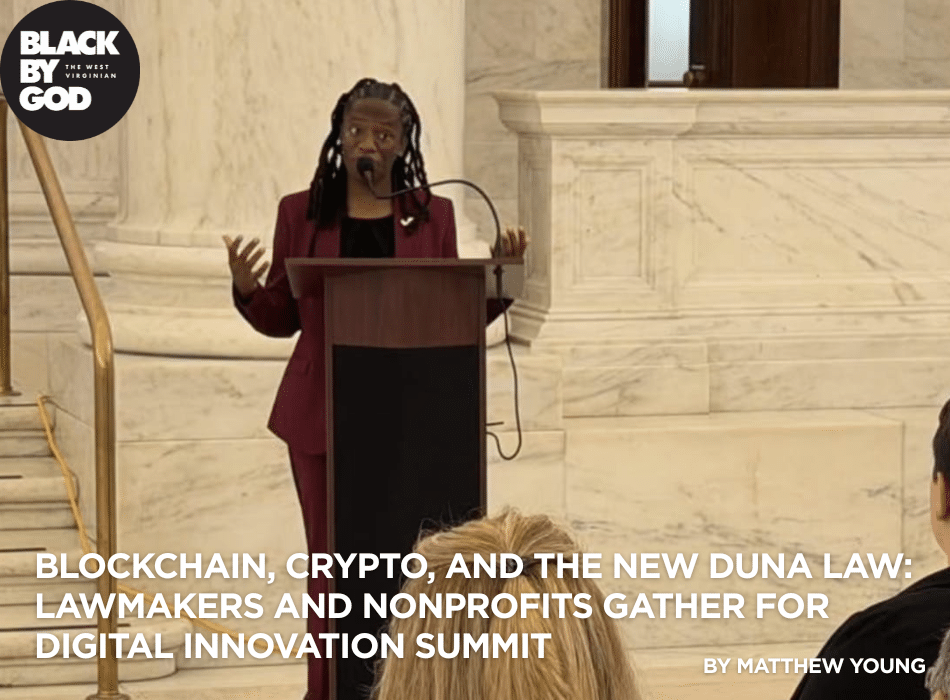
Blockchain, crypto, and the new DUNA law: lawmakers and nonprofits gather for digital innovation summit
Despite low broadband ranks, West Virginia lawmakers passed the DUNA Act and debated stablecoin bills. Learn how blockchain legislation aims to spur economic growth.
By Matthew Young
Earlier this year, the World Population Review reported that West Virginia is the 46th poorest state in the nation, while broadbandnow.com ranked it 39 out of 51 for broadband throughput. So why then are lobbyists and elected officials pushing Cryptocurrency and Artificial Intelligence – two rapidly developing technologies which require massive financial investment and stable broadband infrastructure – as the future for economic growth in the Mountain State?
As explained on the West Virginia Blockchain Foundation’s website, the answer -at least in part – lies in legislative-timing.
“The 2026 legislative session marked an important moment for blockchain policy in West Virginia,” the website states. “For the first time, multiple bills addressing digital assets and blockchain technology were introduced across both chambers of the Legislature.”
While only two such bills were passed by lawmakers in 2026 – that being the regulation of crypto automated-teller machines, and the state’s new “DUNA” law – a total of four proposals were introduced. According to Sen. Brian Helton, R-Fayette – the sponsor of one of the three bills which did not reach the finish line – it all starts with recognizing the digital asset as having real-world value.
“[Helton’s proposed SB 560] was, number one, recognizing stablecoins as a currency that the state government would have a platform for working in,” Helton told BBG on Thursday. “It was a way to allow the state to accept and make payments to vendors and contractors.”
Stablecoin, as defined by Fidelity Investments, is “a cryptocurrency whose value is ‘pegged’ (meaning tied) to another asset – often a traditional fiat currency like the US dollar. For example, one unit of a stablecoin that’s pegged to the US dollar should always be worth $1.”
SB 560, Helton noted, was intended to be a “looking forward” bill.
“If [vendors or contractors] wanted to be paid digitally, this would have really helped regulate that in the state,” Helton said. “The good thing about it is the bill really was designed to put us on a good platform by allowing faster payments and lower transaction costs. It also would have positioned us as a state that was really a frontrunner of digital-payment technology.”
Helton further noted that under his plan, only U.S. based stablecoin would be recognized.
“Really it was a total wrap-around bill to solidify West Virginia, and help us be the first in the country to accomplish all of those things, and to help make stablecoin famous,” Helton added.
As for the financial investment and broadband impact, Helton said they are non-factors for stablecoin usage.
“The transfer of stablecoin is very similar to any other Google search you would do,” Helton explained. “As far as the bandwidth required to perform those transactions, it’s the same as almost any single transaction.”
However, with Bitcoin or other types of cryptocurrency mining, Helton noted, significant broadband throughput and electricity is required.
“But in this case, these are the stablecoins,” Helton said. “It’s similar to if you went into your bank account and moved money from your checking to your savings. And these stablecoins have little-to-no transaction fees. So you’re talking about really being able to cut back on transaction fees, and you’re really not using any more internet service than you would to make a bank transaction.”
On Tuesday, the West Virginia Blockchain Foundation – in partnership with The Digital Chamber, and Stand With Crypto – hosted a Digital Innovation & Economic Development briefing at the State Capitol in Charleston. Among those in attendance were WVBF Executive Director Shekinah Apedo, Del. Tristan Leavitt, R-Kanawha, sponsor of the recently enacted “Decentralized Unincorporated Nonprofit Association Act” – otherwise known as the DUNA Act – and West Virginia Secretary of State Kris Warner, whose office handles all DUNA filings. And while DUNA differs from Helton’s proposal in its targeting of entrepreneurs and small business owners as opposed to state government, Helton is a believer in its value.
“We have to have guardrails around [recognizing decentralized unincorporated nonprofits], and I think that bill did,” Helton said. “We want to make sure that any sort of digital asset that we allow the state to invest in would be one that is not subject to a lot of volatility. By nature, a lot of times cryptocurrencies are, but at the same time, they also are a great source of value.”
As explained financial think-tank a16zcrypto on their website, a16zcrypto.com, “Decentralized governance is essential to crypto’s future, and the DUNA provides a legal structure that fits decentralized organizations.”
For entrepreneurs in the Mountain State, the new DUNA law recognizes decentralized unincorporated nonprofits as legal entities, but also provides, according to a16zcrypto.com, “limited liability and other key protections to participants in a blockchain network, while allowing them to remain decentralized. Fundamentally, the DUNA enables blockchain networks to remain decentralized while complying with the law.”
West Virginia’s DUNA law not only grants decentralized organizations legal existence, but allows them to:
- contract with regular businesses and appear in court
- Allows them to pay taxes
- Provides them essential protections
“In short, the DUNA puts decentralized organizations on equal footing with other entity forms like corporations and the LLC,” a16zcrypto.com adds.
For more information about the DUNA law, and how these emerging technologies can support entrepreneurship, investment, and economic growth in West Virginia, visit wvblockchain.org.
If you appreciate BBG's work, please support us with a contribution of whatever you can afford.
Support our stories